


Posted by Bob Lefebvre
Posted by Bob Lefebvre
Have you seen an unusual bird in Calgary? If it is a species on this Reportable_Birds list (PDF), please report it to the Rare Bird Alert line at 403 221-4519 and leave a message after the beep at the end of the recording. If you would like some help with species identification, email us at us at zoxox@shaw.ca . To report injured wildlife call the Calgary Wildlife Rehabilitation Society at 403 239-2488, or the Alberta Institute for Wildlife Conservation at 403 946-2361.
This Bird Alert was recorded on Monday, April 18, at 10:20 am.
SIGHTINGS FOR
Sunday, April 17
–SNOW GOOSE (50 – 60) – seen flying low along Hwy 1A W of Cochrane near the Grand Valley Rd junction by Joan & Malcolm McDonald.
–COMMON LOON (3) – at Seebe pond W of Cochrane where Hwy 1X crosses the Bow River by J&MM.
–RED-NECKED GREBES (6) – on the Bow River upstream from the bridge at Morley just S of Hwy 1A by J&MM.
–MOURNING DOVE – reported at a feeder NE of High River by Greg Wagner.
–RUBY-CROWNED KINGLET – several seen at the Beaver ponds at the 2nd Vermilion Lake in Banff NP by J&MM.
–VARIED THRUSH – several as above by J&MM.
Saturday, April 16
–COOPER’S HAWK (1) – reported E of Red Deer Lake Meat Packers just S of Hwy 22X S of Calgary by Terry Korolyk.
–RED-TAILED HAWK (HARLAN’S) – W of Hwy 773 SW of Calgary by TK.
–AMERICAN KESTREL – reported by several observers in the Calgary area the past few days.
–THAYER’S GULL (4th cycle) – at Sheperd Landfill in SE Calgary by TK.
–TREE SWALLOW – reported by several observers in and around Calgary the past few days.
–RUBY-CROWNED KINGLET – reported in Weaselhead Park in SW Calgary by Gus Yaki and FFCPP group.
–AMERICAN TREE SPARROW – reported by numerous observers passing through Calgary and area in large numbers the past week.
–DARK-EYED JUNCO – as above.
–WESTERN MEADOWLARK – reported by several observers in the Calgary area the past week.
–YELLOW-HEADED BLACKBIRD – a pair reported by Shirley Hartig in her yard NE of High River.
–COMMON GRACKLE – reported in the Willow Park and Mapleridge subdivisions of SE Calgary and also NE of High River.
Friday, April 15
–YELLOW-RUMPED WARBLER (1 male) – seen at Inglewood Bird Sanctuary in SE Calgary by Mike Potter. This is the first report of this species in our area this Spring.
For the past two weeks I’ve had two Eurasian Collared-Doves, likely a breeding pair, coming to my yard every day. They feed on the lawn (lately, on the snow), eating sunflower seeds that have spilled from the bird feeders.

Eurasian Collared-Doves
Eurasian Collared-Doves are not yet a common backyard bird in Calgary, but that may change. They were introduced to North America in the Bahamas in the 1970’s and have rapidly spread across the continent. I think they were first reported in Alberta in 2003, and in Calgary in 2004. I know of two pairs that have nested in the SE quadrant of the city in each of the past two years: one pair in Shepard, and another in Dover.

 This bird has an odd broken feather sticking out on its left side, so I know it’s the same bird returning each day.
Eurasian Collared-Doves are pale buff-grey to pinkish-grey in colour. They are about the same length as a Rock Pigeon, but slimmer and with a longer tail. On the back of their neck they have a narrow black half-ring, edged with white, from which they get their name.

This preening bird shows off its black collar…


Eurasian Collared-Doves are becoming more common in the rural areas south and east of Calgary, and are being seen regularly in the city as well. They seem to occupy an ecological niche between that of the Rock Pigeon and Mourning Dove. It remains to be seen if they will become a common backyard bird like the Rock Pigeon, or primarily a rural one like the Mourning Dove. If you see any in your yard, please let Birds Calgary know!
Posted by Bob Lefebvre
The male Ring-necked Pheasant is a very colourful bird with a loud, harsh and raucous “koork-KOK”, call; one that often emerges from grasslands, deep brush and agricultural land. The pheasant is native to Caucasus and Russia and has been introduced all over the world as a popular game bird.

Ring-necked Pheasant
There is usually one male who guards his harem of plain, mottled females from other males, chasing them away during the breeding season. Pheasants are known to hunker down in a roost in very bad weather, going for days without eating. They nest and forage on the ground, eating seeds, wild fruits, nuts and insects.
I had my own special encounter with a pheasant the other day. I rode my bike to Fish Creek and as I turned a corner, I came to within a couple meters of a pheasant. He was startled (so was I!) and in his haste to get away, slipped on ice! Definitely funny for me to see!

Elegance… This male Pheasant is trying to be as regal as possible.

He hits the ice as he runs away and is unprepared…

Whoa!!! He definitely wasn’t ready for this!

Dignity regained… Or so he thinks.
Posted by Matthew Sim
Welcome to the City of Calgary and Nature Calgary’s (CFNS) Bird Alert. This Bird Alert was recorded on Thursday, April 14, at 10:25 am. To report a bird sighting, phone 403 221-4519 and leave a message after the beep at the end of the recording. To report injured wildlife please call Calgary Wildlife Rehabilitation Society at 403 239-2488, or the Alberta Institute for Wildlife Conservation at 403 946-2361.
SIGHTINGS FOR:
Wednesday, April 13
–BLACK-NECKED STILT (3) – at a slough E of Irricana (the road to Tschetter Hutterite Colony) on RR 260, N of Twp Rd 270 seen by Joan & Malcolm McDonald.
–GREATER YELLOWLEGS (1) – as above at a slough on the W side of RR 254 about 1 Km N of the farm by J&MM.
–TREE SWALLOW (1) – observed by Cedric Hitchon on the Bow River at the Hwy 22X Bridge in SE Calgary.
–TOWNSEND’S SOLITAIRE (1) – reported by Matthew Sim in his yard in the Willowpark community in SE Calgary.
Monday, Apr 11
–SNOW GOOSE (1) – observed flying in with Canada Geese on Twp Rd 314 E of RR 253 N of Linden by Corrine Griffin.
–GADWALL (2 pair) – near the observation blind at Frank Lake on Hwy 23 about 8 km E of High River by Greg Wagner.
–PEREGRINE FALCON (3) – 1 seen feeding on a duck along the SW shoreline of Basin 1 at Frank Lake by GW and Thomas Glen reports a pair in downtown Calgary.
–LAPLAND LONGSPUR (300) – seen on Twp Rd 314 E of RR 253 N of Linden by CG.
–RED-WINGED BLACKBIRD (1 male) – seen by Carol Coulter in her yard in the Southwood subdivision in SW Calgary.
Sunday, April 10
–RUDDY DUCK – seen at Frank Lake by GW.
–SHARP-SHINNED HAWK – reported by Dwight Knapik at the Calgary Zoo private breeding facility off Dunbow Rd just SE of Calgary.
–WHOOPING CRANE (2) – seen flying northward over the Hwy 2 & Hwy 547 overpass S of Calgary by Roger Hoffort
Saturday, April 9
–AMERICAN KESTREL – watched by Bob Lefebvre by the irrigation canal at 32 Ave & 26 St SE in Calgary.
–PRAIRIE FALCON (1) – seen on the S side of the river upstream from the Bearspaw Dam W of Calgary by Kelly Day & Christine McDonald.
–RED-WINGED BLACKBIRD (3) – seen just SE of Frank Lake by GW.
The next scheduled update of the Bird Alert is Monday, April 18.
Posted by Pat Bumstead
Welcome to the City of Calgary and CFNS Bird Alert. This report was prepared on Monday, April 11 at 9:00 pm. To report a bird sighting,call 403-221-4519 and leave a message after the recording. The next scheduled update of the Bird Alert is on Thursday, April 14th.
SIGHTINGS FOR:
Sunday, April 10
–AMERICAN AVOCET(1), no location given
–GREATER YELLOWLEGS(1), Frank Lake
–BONAPARTE’S GULL(1), Clear Lake, east of Stavely
–NORTHERN CARDINAL(1)(F), 4th.Str. and Cliffe Ave, E.of StanleyPark
–AMERICAN GOLDFINCH(1), Votier’s Flats, Fish Creek Park
Saturday, April 9
–RED-BREASTED MERGANSER(1)(m), Bow River, Mallard Pt, East Fish Creek Park
–DOUBLE-CRESTED CORMORANT(7), snow covered gull colony, Langdon Reservoir
–BLACK-CROWNED NIGHT-HERON(2), Frank Lake
–GREATER YELLOWLEGS(1), Frank Lake
–PEREGRINE FALCON(1), Frank Lake
Friday, April 8–BLACK-CROWNED NIGHT-HERON(1) Frank Lake
Thursday, April 7–THAYER’S GULL (adult), GLAUCOUS GULL (adult) Shepard Landfill
Thank you to David Lilly for sending us these amazing pictures taken at Frank Lake on April 9/11.

Black-crowned Night-Heron


Tundra Swan displaying


Rough-legged Hawk
Posted and species identified by Pat Bumstead
We’ve seen it often enough; you’re out bird watching, looking at the deserted trees and bushes and wondering where all the birds are. Suddenly, they are upon you, lots of them, making it next to impossible to follow them all. It’s a foraging flock. But what is a foraging flock?
These congregations of several different species, often insectivorous, occur where there is an abundance of food. There has to be a ‘nuclear’ species as a basis for the flock’s hierarchy; with this species being central to the flock’s formation and movement.
Attendants come next. Attendant species often don’t join in on the activities until the flock’s activities enter their territory. Titmice and chickadees often fill the roles of a ‘nuclear’ (‘core’) species in North America and are soon followed by nuthatches, creepers, woodpeckers, kinglets and New World warblers all of which are insect-eating birds. These flocks are seen mostly in the non-breeding season when birds come out of the secrecy of breeding and raising a family.
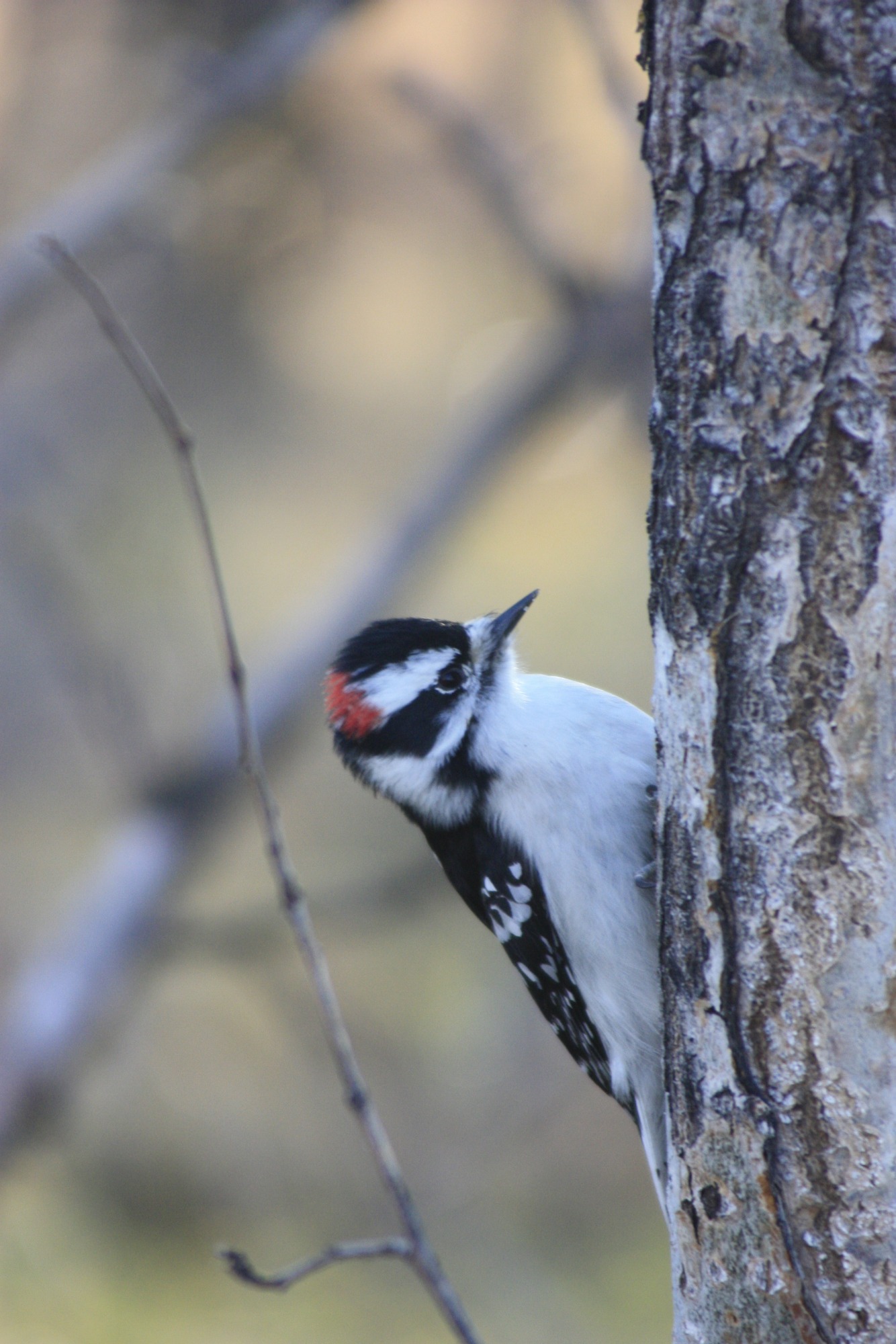
Downy Woodpeckers use chickadees as sentinels in the foraging flocks
The benefits are great for birds in these flocks, namely; the increased vigilance by more eyes, lowering the risk of predation. There could also be a rise in feeding efficiency; as bugs flee from one bird, they head right into the beak of another. Feeding together heightens the chance that someone will locate a rich feeding patch and birds benefit from the different abilities, such as a woodpecker’s strong beak.

Chickadees often act the part of the ‘nuclear’ species
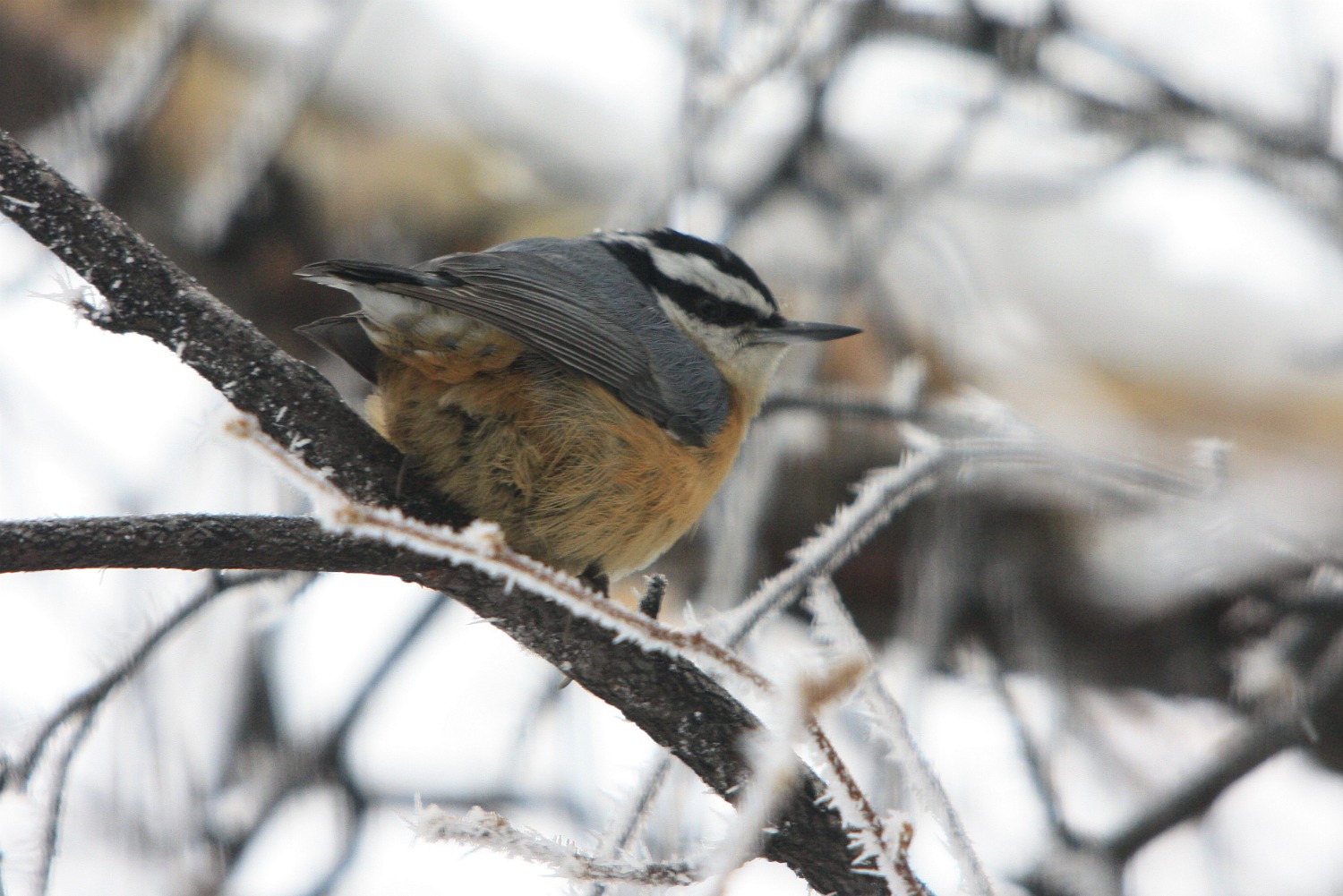
Nuthatches will often join in on the action of feeding flocks.
But there are costs as well, for example, kleptoparasitism, or parasitism by theft. This is when one more aggressive bird, steals the food caught by another bird. The costs, however, are often outweighed by the more advantageous benefits.
Well, birds of a feather don’t always flock together, but they sure know who to flock with!
Posted by Matthew Sim
Welcome to the City of Calgary and CFNS Bird Alert. This Bird Alert was recorded on Monday Apr 04.
Bird Sightings:
Mar 28:
RED-TAILED HAWK , dark morph, south of Longview
Mar 31:
A SNOW GOOSE in a flock of CANADA GEESE just east of Calgary
Apr 1:
PEREGRINE FALCON, Bow Building, (downtown),
GREATER WHITE-FRONTED GOOSE (2), east side Frank Lake
RED- BREASTED MERGANSER female, EURASIAN WIGEON male, flocks of LAPLAND
LONGSPURS at Clear Lake
Apr 2:
Possible LONG-EARED OWL east of Parkland Blvd/146 Ave SE
GREATER SCAUP, male, on the Bow River at Glenmore Tr. bridge
Apr 3:
NORTHERN HAWK OWL , TURKEY VUKTURE, Votiers Flats to Bebo Grove, FCPP
PEREGRINE FALCONS (2) Bow Bldg .
FERRUGINOUS HAWK over Turner Valley
CEDAR WAXWINGS (15) in Willow Park district
CEDAR WAXWING (1), in Douglas Glen dist
VARIED THRUSH (2) males at Harvie Heights
Welcome to the City of Calgary and CFNS Bird Alert. This report was
prepared on Thursday,March 31, at 10pm. To report a bird sighting,call
403-221-4519 and leave a message after the recording.
SIGHTINGS FOR:
Monday, March 28
–FRANKLIN’S GULL(2),Frank Lake
–AMERICAN COOT(1), same as above
–LESSER SCAUP(1m), same as above
–RING-NECKED DUCK(1m), same as above
–VARIED THRUSH(1m), North Haven backyard
–SHORT-EARED OWL((12), Frank Lake
–PRAIRIE FALCON(1) Frank Lake
Tuesday, March 29
–GLAUCOUS GULL(1st.yr.), Inglewood Bird Sanctuary
–NORTHERN HAWK OWL(1)Votier’s Flats, Fish Creek PP
Wednesday, March 30
–WOOD DUCK(1), Elbow River, Votier’s Flats,Fish Creek PP
–PRAIRIE FALCON(1) south cliffs of Bearspaw dam, Calgary
–EUROPEAN STARLING(10,000-20,000) 4 km. north of High River
Posted by Pat Bumstead