This past summer I was driving in Manitoba, near Whiteshell Provincial Park, when we passed a sign. The sign read “Alf Hole Goose Sanctuary”.
“Surely they can’t mean the Canada Goose,” I said.
We stopped to check it out for the sole purpose of finding out what goose they were giving sanctuary to.
It is, indeed, the Canada Goose that has been given sanctuary in that park. Nary a goose was in sight. Do the geese know it exists? Do they know they have a large tract of land that they are welcome to? I’m thinking if they do know, they don’t care. They will go where they want to.
Canada Goose with gosling. They aren’t always this calm! Photo June 12, 2026, Elbow River Bird Survey, by Bob Lefebvre.
The Alf Hole Goose Sanctuary was conceived in 1939 when Alf inherited some goslings and built a pond for them. This park has been giving sanctuary for 87 years! In 1939, and this is really hard to believe, the Canada Goose was endangered. Decimated, according to Audubon.
Nowadays there are many articles about how places are overrun with them. They are ruining athletic fields, eating just-planted fields of food and degrading water quality. Plus they attack people.
Efforts to save the Canada Geese populations actually introduced geese in areas where they weren’t before. They especially took to urban locations and often stayed all year, since they were never shown how to migrate. In an urban environment they have no natural predators and endless grass parks to hang out in.
Canada Geese with goslings, owning the path at the Inglewood Bird Sanctuary, May 30, 2008. Photo by Bob Lefebvre.
I have yet to see the large ‘V’ of geese flying south this year, I’m sure I will though. When I do I will breathe a sigh of relief. The Canada Geese have left, we can all go about our business more freely.
The internet has nicknamed them the “cobra chicken” for their snake-like neck and hissing. If you have ever been on the receiving end of its hissing beak, outstretched wings and beady little eyes you know what they can be like. At the zoo my friend witnessed a child chasing one and it turned around and chased him! As he ran screaming it got in a peck on his posterior. They are not to be trifled with!
Its dapper appearance, with its chin-strapped, sleek black head and two-toned outfit makes its bad manners all the more disappointing. How did such a rude animal get the name Canada when Canadians are known for being polite? There is a rumour that the goose is actually named after an ornithologist named John Canada. However after a bit of research apparently that is unfounded, probably made up by some embarrassed Canadians trying to lay blame elsewhere.
It’s possible that the Canada goose was often seen flying north, toward its namesake country.
Oh and don’t call them a ‘Canadian Goose’, there are lots of “canadian geese”, as in a goose from Canada. I bet they don’t want to be lumped in with the Canada Goose.
This spring I can recall a huge population in Prince’s Island park. There seemed to be acres of juvenile geese with a few adult geese. This is called a ‘gang brood’, when there is a large group of goslings, overseen by a couple adult geese who got the short straw. Weaving through them on the bike path is a bit frightening. I know from experience that the inside of their mouth is red.
A pair of Canada Geese with young. From Wikimedia Commons.
They do have some positive traits, for example the Canada Goose chooses a partner at about two years old and then stays with that partner for life, isn’t that sweet. Their little goslings are very cute when they paddle behind the parents, all yellow and fluffy. The adult Canada Goose is one of our largest waterfowl, and should we ever have to revert to subsistence living, they are very plentiful.
Canada Goose goslings. IBS, Calgary, May 30,2008. Photo by Bob Lefebvre.
Goodbye our friend the Canada Goose, try to behave yourselves in the States and Mexico. We know you probably won’t.
Ross Anderson of Fish Creek Park will present on The Importance of Beavers, and Co-existing With Them.
Beavers in Fish Creek Park. Photo by Tony LePrieur, April 2018.
Next Thursday, October 8th, Birds & Beers resumes in Calgary. As usual, we meet in the big ballroom at the Horton Road Legion from 5pm to 9pm. Arrive anytime before 7 pm, when the presentation will begin.
Ross Anderson of the Friends of Fish Creek Provincial Park Society will talk to us about Beavers in the park and their many contributions to the local ecology. The Friends are working hard to educate the public and change negative views about Beavers. The Friends have had a long-running program to manage the park’s resources to co-exist with the Beavers.
Ross Anderson Restoration Team Lead
Ross recently graduated from St. Mary’s University with a Bachelor of Science in Biology, and has worked at the Deer Run Community Centre in the maintenance and event planning departments. He is experienced in data collection and analysis, and outdoor fieldwork – including invasive species surveys, mapping, wildlife identification, and water quality testing. As the Field Assistant Ross enjoys working outside while using his skills, and learning about the park and the Friends conservation programs.
Everyone is welcome at Birds & Beers! We ask for an optional contibution of $2 to help cover the room charge. Come early if you can, and be sure to enter the door prize draws!
The next Birds & Beers meeting will be on Thursday November 12th, same time, same place. Karen Keller will be presenting The Antarctic, Chapter 2.
The Friends of Fish Creek will also be participating in Beaver Fest in North Glenmore Park on Sunday October 17th. See here for information and tickets.
[Subscribers who recieve these posts by email can click on the post title at the top, or here, to go the Birds Calgary website for more content.]
Featuring a presentation on “A Birding and Wildlife Safari to Tanzania” by Dianne and Bob Leonhardt.
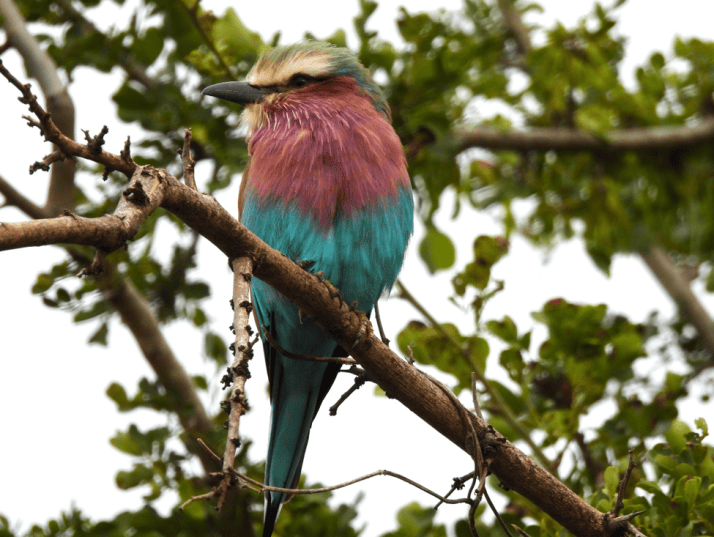
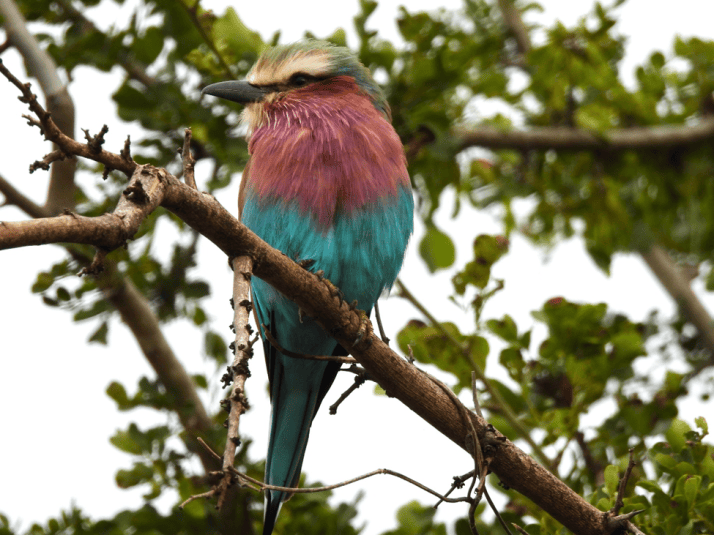
Lilac-breasted Roller. Photo by Bob Leonhardt.
The fall season of Birds & Beers gets underway on Thursday September 10th. We will meet, as usual, at the Legion at 9202 Horton Road SW, from 5-8:30 pm. Everyone is welcome to attend. The presentation will be at 7 pm but you can arrive early if you want to have a drink or meal beforehand. There is a small charge for the room, so if possible, we ask that you contribute a Toonie to that cause. Any extra cash above the fee amount is donated to the Legion.
The talk this month is by veteran Birds & Beers presenters Bob and Dianne Leonhardt. This time they will recap a trip they took to Tanzania from April 13-30, 2025. Here is a short description:
In mid-April of 2025 we flew from Calgary to Amsterdam and onward to Kilimanjaro International Airport near Arusha, Tanzania on KLM Airlines. It is a long flight of about 18 hours of actual flying time, but connections from Calgary are very good. Our small group of six participants met our Eagle-eye Guide and driver at KIA Lodge (near the airport) on April 15th and started off the following morning for fourteen exciting days of birding and wildlife viewing.
African Elephant. Photo by Bob Leonhardt.
Our tour was confined to northern Tanzania, near the border with Kenya. We visited Arusha National Park, Tarangire National Park, Lake Manyara National Park and the very famous Serengeti National Park. In addition, we visited Ngorongoro Conservation Area, including the Ngorongoro Crater, which is the world’s largest inactive, intact and unfilled volcanic caldera formed approximately 2-3 million years ago. This 260 square kilometre crater contains over 25,000 large animals and our bird list for our one day visit had well over 100 species. The area around Ndutu Safari Lodge in the Ngorongoro Conservation Area was also incredible for vast numbers of animals and birds. Following our visit to Serengeti National Park, we traveled westward to Speke’s Bay Lodge on the shores of Lake Victoria, the largest lake in Africa. From there, we drove to the airport at Mwanza, Tanzania’s second largest city, for a flight back to Kilimanjaro International Airport. We spent one last night at the KIA Lodge before flying back to Amsterdam and onward to Calgary.
In many ways this was the best tour we have ever been on. We saw about 370 species of birds and about 50 species of mammals (including huge numbers of Wildebeests and Zebras). We stayed in some very nice lodges and tented camps, had very good meals, and experienced some very beautiful African scenery.
Please join us for another memorable evening, and be sure to enter the draw for a door prize!
The next Birds & Beers meeting will be on Thursday October 8th, same time, same place.
[Subscribers who recieve these posts by email can click on the post title at the top, or here, to go the Birds Calgary website for more content.]
[Alberta birder Asher Warkentin recently wrote this article and posted it to the Alberta Birds Facebook group. Chris Fisher suggested to him that it would be useful to also post it here since Calgary birders might also find it informative and interesting. I apologize for not getting it posted sooner, but there are still two or three weeks of very active hummingbird migration this year, and it is great information to keep in mind for future years. – Bob Lefebvre]
Alberta is right in the sweet spot for hummingbird diversity in Canada. It is home to three species of regularly breeding hummingbirds (Ruby-throated, Rufous, and Calliope), and numerous other species also have the potential to turn up in the province! Black-chinned and Anna’s Hummingbirds are found annually, especially in the southwest corner of the province, and vagrants including Costa’s Hummingbird, Mexican Violetear, and Broad-billed Hummingbird have also shown up in the past.
In Alberta, the peak hummingbird numbers and diversity occur during fall migration, which occurs primarily between the last week of July and the first week of September. During this time, the vast majority of hummingbirds are either female or immature, as the males migrate south earlier. Because this paper focuses on the identification of hummingbirds in fall, it does not touch on the identification characteristics of adult males – which are typically quite unmistakable – and rather focuses on the females and immature birds.
The guide follows the process I go through in my mind when encountering a hummingbird in fall, first figuring out whether it is an Archilochus or Selasphorus species, and then focussing on the specific field marks to come to an identification. I am sure that there are field marks that I do not mention or am not aware of that can be useful for these identifications, so I would love to hear if you know of something that I missed!
A huge thanks to Jeanne Burnham, Chris Fisher, and David Scott for the use of their wonderful hummingbird photos as well as their assistance in reviewing this paper!
Archilochus vs Selasphorus Hummingbirds
The first step I take when I see a hummingbird in Alberta in the fall is to try and figure out if it is an Archilochus species (Ruby-throated or Black-chinned Hummingbird) or a Selasphorus species (Rufous or Calliope Hummingbird). This distinction determines which key features I need to focus on to identify the bird to species. After mid-September however, this distinction becomes less important as many (or most?) hummingbirds in Alberta after mid-September are Anna’s Hummingbirds which have their own set of field marks (Figure 8)!
Archilochus hummingbirds (Ruby-throated and Black-chinned Hummingbirds) often stand out from the other fall hummingbirds in Alberta by having throats that are brighter white and relatively unmarked, although some birds will have slight speckling in the central throat region. Regardless, the white throat typically contrasts with the sides of the face, which are a duskier grey (Figure 1A). Conversely, Selasphorus species in fall tend to have heavier marked throats (Figure 1B).
The flanks of Archilochus hummingbirds are predominantly grey/green (Figure 1A) which separates them from the Selasphorus species (Rufous and Calliope Hummingbirds) which have rufous/buffy flanks (Figure 1B). Note that young Archilochus hummingbirds can have limited buff/peachy colouration in their flanks (Figure 2A and 2B) although still never approaching the amount or intensity of buff that will be shown by a Selasphorus.
Archilochus hummingbirds lack rufous coloration in their tails, with the base of the tail feathers being greyish rather than rufous. This is in contrast to our Selasphorus species, which tend to show at least some rufous coloring in the base of the tail (Figure 1C). Additionally, the tails of Archilochus hummingbirds when spread have two distinct lobes, giving them a rather forked appearance. Selasphorus species have less distinctly lobed tails, which are more rounded in appearance when spread. However, obtaining good photos – or even views – of a hummingbird’s spread tail is a rather tough challenge!
Figure 1. Key differences between Archilochus and Selasphorus hummingbirds in fall. Archilochus hummingbirds tend to have little to no rufous on the flanks and clean white throats that contrasts with the dusky grey sides of the face (A – Ruby-throated Hummingbird). This differs from Selasphorus hummingbirds, which have extensive rufous in the flanks and more heavily speckled throats (B – Rufous Hummingbird). Selasphorus hummingbirds also tend to show rufous in their tails, while Archilochus hummingbirds do not (C – Ruby-throated and Rufous Hummingbird).
Ruby-throated vs Black-chinned Hummingbird
Archilochus colubris vs Archilochus alexandri
As the default hummingbird across much of eastern North America, Ruby-throated Hummingbirds are the expected hummingbird species to be found at feeders in Alberta away from the mountains.
In the extreme southwestern portion of the province, however, Ruby-throated Hummingbird becomes less common – though still semi-regular – and Black-chinned Hummingbird has recently been recognized as a regular rarity, found in small numbers annually. Separating these two species is a challenge but there are a number of characteristics that aid in the identification of Archilochus hummingbirds. A great article that dives deeper into the separation of these species can be found here:
The most reliable difference is the shape of the primaries (the longest feathers in the wings). Ruby-throated Hummingbirds have narrow inner primaries that are curved, or “sickle-shaped” (Figure 2A). Likewise, the outer primaries on a Ruby-throated Hummingbird taper to a relatively narrow tip. Black-chinned Hummingbirds have straight inner primaries that are not “sickle-shaped,” and their outer primaries are broad, blunt, and rounded (Figure 2B). The primaries of a perched Black-chinned Hummingbird also tend to extend nearly to the tip of the tail, while the primaries of a perched Ruby-throated Hummingbird are considerably shorter (Figure 2).
There are a number of secondary characteristics that can also be used to identify Archilochus hummingbirds, although these are less consistent and tougher to judge, and so should be used cautiously and in combination with other characteristics rather than as the sole ID feature (Figure 4). This includes the bill length, which is typically longer on a Black-chinned Hummingbird than a Ruby-throated Hummingbird, and the crown colour, which is generally greener on a Ruby-throated Hummingbird and greyer on a Black-chinned Hummingbird. Feeding behaviour may also be helpful, as Black-chinned Hummingbirds tend to actively pump their tails while feeding, while Ruby-throated Hummingbirds do not.
Lastly, slight differences in tail shape appear to be diagnostic, although very difficult to observe or photograph. R4 is the longest rectrix (i.e., tail feather) in Ruby-throated Hummingbirds, while R3 is the longest in Black-chinned Hummingbirds (Figure 3).
Figure 2. Wing differences between Ruby-throated and Black-chinned Hummingbirds. The most reliable trait for differentiating Ruby-throated and Black-chinned Hummingbirds in fall is the shape of the primary feathers. On Ruby-throated Hummingbirds, their inner primaries are narrow and curved, appearing almost “sickle-shaped” (A). The outer primaries are less curved, yet still narrow and tapering to a point (A). On Black-chinned Hummingbirds, all the primaries are broader and rounded (B). Additionally, the wing projection on a Ruby-throated Hummingbird tends to fall short of the tip of the tail, while on Black-chinned Hummingbirds, the wings extend nearly to the tip of the tail.
Figure 3. View of Archilochus hummingbirds with spread tails. Very difficult to see in the field, but subtle differences in tail shape exist between Ruby-throated and Black-chinned Hummingbirds. In Ruby-throated Hummingbirds (A), R4 is the longest, while in Black-chinned Hummingbirds, R3 is the longest (B). This trait, sometimes even visible in perched birds, can give Ruby-throated Hummingbirds a more “fork-tailed” appearance than Black-chinned.
Figure 4. Secondary characteristics can help support the identification of Archilochus hummingbirds, but should not be viewed as diagnostic. These include crown colour, bill length, and the overall contrast in the colour of the bird. Ruby-throated Hummingbirds (A and C) tend to have shorter bills, greener crowns, and more starkly contrasting colours overall than Black-chinned Hummingbirds (B and D), which have longer bills, greyer crowns, and are less contrasty. The tail pumping behaviour of Black-chinned Hummingbirds while feeding is also a secondary identification characteristic that can be helpful, but should not be used by itself in the identification of an Archilochus hummingbird. Note: Young Ruby-throated and Black-chinned Hummingbirds can have slight beachy colouring in their flanks (A and B) – adult females do not have this.
Rufous vs Calliope Hummingbird
Selasphorus rufus vs Selasphorus calliope
Rufous Hummingbird is the other (along with Ruby-throated) hummingbird species that can reasonably be expected in the fall throughout a large area of Alberta, but especially so in the western and southern portions of the province. The slightly smaller Calliope is less common, occurring primarily in and near the mountains.
As the name suggests, Rufous Hummingbirds tend to have more rufous colouration than other hummingbirds. In the fall, their flanks are quite obviously rufous, and rufous also shows through the green of their upperparts (back and crown) (Figure 5A and 5C). Calliope Hummingbirds have buffy/peachy flanks, though not as bright or extensive as Rufous Hummingbirds (Figure 5B and 5D).
Tail length is a very useful and reliable way to distinguish between Rufous and Calliope Hummingbirds. Calliope Hummingbirds have a very short tail, such that that when perched, their wingtips extend beyond the tip of the tail (Figure 5B). Rufous Hummingbirds have a longer tail, and their wings always fall short of the tail tip when perched (Figure 5A).
A good view of the spread tail (tough to achieve) will reveal extensive rufous bases to all the tail feathers in Rufous Hummingbirds (Figure 6A), while Calliope Hummingbirds have minimal rufous colouration in their tails (Figure 6B), limited to the bases of the outer tail feathers, if present at all. (Archilochus hummingbirds have no rufous in their tails.)
While both Rufous and Calliope Hummingbirds have markedly more heavily speckled throats than Archilochus species, the throat pattern differs among these species as well. Calliope Hummingbirds tend to have very fine markings on their throats that are evenly distributed (Figure 7D). The throat speckling on Rufous Hummingbirds varies with age and sex, such that the throats of birds in fall vary from being largely white and unmarked to being very densely marked (Figure 7A-7C). Despite this variability, the sides of the throat tend be more heavily marked than the rest of the throat, while Calliope Hummingbirds have an even distribution to their throat speckling.
Lastly, Calliope Hummingbirds have an obvious white spot behind their eye and an even smaller white spot in front of their eye (Figure 5B and 5D). While present in other species, these spots are more obvious in Calliope. Additionally, Calliope often has a small white “comma” wrapping around the base of the bill.
Figure 5. Identification of Selasphorus hummingbirds. Rufous Hummingbirds tend to have much more extensive and vibrant rufous coloration to their flanks (A and C), while Calliope Hummingbirds have flanks that are more peachy or buffy coloured (B and D). The throat patterns also differ, with Rufous Hummingbirds tending to have more heavily marked throats, especially on the edges, while Calliope Hummingbirds have fine speckling that is evenly distributed across the throat (see Figure 7 for variability in throat pattern). Calliope Hummingbirds have shorter tails than Rufous Hummingbirds, resulting in their wings extending past the tip of the tail (B), whereas the wing tips of a Rufous Hummingbird fall short of the tail (A). Lastly, Calliope Hummingbirds have a noticeable white spot behind the eye, as well as a smaller white spot in front of the eye, and a white “comma” wrapping around the base of the bill (5B).
Figure 6. View of Selasphorus hummingbirds with spread tails. Rufous Hummingbirds (A) have extensive rufous in all of their tail feathers, while in Calliope Hummingbirds (B), any buffy colouring will be limited to the bases of the outer tail feathers.
Figure 7. Variability in throat pattern of Selasphorus hummingbirds. The degree of specking on the throats of Rufous Hummingbirds varies dramatically with age and sex. A-C show this variation, from a largely white throat with minimal speckling, to a central throat patch, to the entire throat being heavily marked. Note that in each of these birds, the edge of the throat below the eye is much more heavily marked than the rest of the throat (apart from the central throat patch in B). Calliope Hummingbirds have very fine speckling that is evenly distributed across the throat (D).
Anna’s Hummingbird
Calypte anna
Anna’s Hummingbird has greatly increased on the radar of Alberta birders in the past decade, and a handful of them now show up annually at feeders in the province each fall, especially in the southwest. They are a hardier hummingbird than our more expected species, often remaining at feeders into mid-October. Any late-season (after mid-September) hummingbird in Alberta, is more than likely to be an Anna’s Hummingbird. They have even been known to attempt to overwinter.
See Figure 8 for identification tips for Anna’s Hummingbirds.
Figure 8. Anna’s Hummingbirds are slightly larger and chunkier than our other hummingbird species and can appear to be dull and greyish in colour (A). They can readily be separated from Selasphorus hummingbirds by their lack of any rufous or buffy colouration in their flanks and tail (B). Likewise, the face on an Anna’s Hummingbird is greyish and lacks the contrasting white throat and dusky side of face of Archilochus hummingbirds (D). Anna’s Hummingbirds have greenish-grey flanks (C), a relatively short bill (B), and often a central throat patch that appears greyish (A) or bright pink (C) depending on the light.
Review of hummingbird ID
While identifying hummingbirds in fall can seem challenging and confusing at first, keeping in mind the key characteristics to look for greatly simplifies the process. With any fall hummingbird in Alberta, noting the colour of the flanks, degree of speckling on the throat, and the relative length of the wings and tail is a great starting point to come to an ID!
The following is step-by-step process for identifying the five hummingbird species described in this paper in fall. While greatly simplified and omitting many of the more subtle details described earlier in the paper, hopefully this process is useful as a starting point from which you can continue to further develop your hummingbird ID skills!
–
Step 1:
White throat, bright green back/wings, grayish or green flanks (go to Step 2)
OR
Speckled throat, rufous or buffy flanks (go to Step 4)
–
Step 2:
Slender, high contrast face and body, throat white with dusky sides (go to Step 3)
OR
Chunky, dull colour, central throat patch, typically September or later*
(Anna’s Hummingbird)
–
Step 3:
Primaries narrow and pointed, widespread in Alberta
(Ruby-throated Hummingbird)
OR
Primaries broad and rounded, limited to SW Alberta, pumps tail frequently
(Black-chinned Hummingbird)
–
Step 4:
Rufous flanks, throat speckling concentrated under eye, wings shorter than tail
(Rufous Hummingbird)
OR
Peachy/buff flanks, even throat speckling, wings longer than tail
(Calliope Hummingbird)
* While Anna’s Hummingbirds can begin showing up in August, they become the most expected hummingbird in Alberta from September onwards.
With a presentation by Stephen Boucher called “Spain 2, A Cautionary Tale.”
Squacco Heron in breeding plumage, with a frog. Photo by Stephen Boucher.
Birds & Beers resumes next Thursday with our final event of the season. As usual we meet at the Legion at 9202 Horton Road SW, from 5 to 9 pm. Everyone is welcome. You can arrive at any time up to 7 pm, when the presentation will begin.
Spain 2, A Cautionary Tale by Spephen Boucher:
I grew up in England and have vivid memories of long summer bike rides along quiet country lanes lined by tall never-ending hedgerows. In every season the countryside was alive with bird song, from the spring dawn chorus, Skylarks in summer and the plaintive calls of large groups of Rooks in winter. Now many years later in my retirement one of my goals has been to see and photograph European birds. This quest began with my “Clueless in Catalonia” birding trip to Spain in the late fall of 2023.That trip was amazing but there were many more European birds still to see. I knew that I would return to Spain.
My return to Spain took place in April 2025. But much had changed in Europe and the World in the intervening 18 months. The war in Europe continued, Trump took office in January 2025, weather instability had increased due to climate change and there was a movement in Spain protesting against mass tourism.
Eurasian Spoonbill. Photo by Stephen Boucher.
Tonight I am going to talk about my return to Spain and my experience of birding in the era of package tours and mass tourism.
“It was the best of times, it was the worst of times….. “It was the season of Light, it was the season of Darkness, it was the spring of hope, it was the winter of despair” – Charles Dickens
Please come and join me for an evening of reflection.
Black Kite. Photo by Stephen Boucher.
A reminder that we do have to pay a small fee for the room, so we ask attendees to voluntarily give a donation of $1 or $2 if they are able. Any cash above the fee amount is donated to the Legion.
Birds & Beers takes a summer break in July and August, and resumes in September.
[Subscribers who recieve these posts by email can click on the post title at the top, or here, to go the Birds Calgary website for more content.]
This summer keep your ears open for a very unique bird song. It is sung by the Veery, which is a small brown bird from the Thrush family. This family is full of great singers, the American Robin, the Townsend’s Solitaire, and the Hermit Thrush to name a few. To me the headlining act would be the Veery, with its ethereal spiraling song. It has a haunting, otherworldly quality that stopped me in my tracks the first time I heard it in the Weaslehead area.
The Veery has a different vocal system then you or I. It can produce two notes simultaneously from its syrinx, which is what it has instead of a larynx. The sound sounds like “veer”, which is where its name comes from. Perhaps it seems to spiral due to the fact that its volume lowers and rises, it sounds close and then far, close and far. It seems to echo through the forest. Somehow it sounds better in the wild than the song recorded on the Merlin App. That bird was probably nervous when it got into the recording studio, concerts are always better live after all.
The bird itself is always hard to see and usually hidden in the brush. The one I heard was very elusive and I never actually got to see it. If I had, I would have seen a bird that was brown on top and white on bottom with speckles on its throat. It’s basically an unassuming little brown bird until it opens its beak and then it is an angel.
Veery – June 11, 2021, photo: Pam Hardy
The Veery’s song is a downward spiraling melody. But wait! There is another bird that also has a song that spirals, but upward. This would be the Swainson’s Thrush. So if you hear a spiralling song you need to think – is this going up or down? And if you ever find yourself in a forest trying to figure that out, you know you have advanced to “Bird Nerd” status.
Swainson’s Thrush – May 3rd, 2024 at Inglewood Bird Sanctuary. Photo: Pam Hardy
As you can see from the photos the Swainson’s Thrush is very similar to the Veery. It too is brown on top, white on bottom and with speckles on its throat. In fact there are many thrushes that look very similar. You better hope that little brown bird starts singing if you want to identify it! If you are in Calgary it’s good to know that the Swainson’s Thrush is more common, according to eBird, compared to the Veery. I’ve certainly noticed more of these around than the Veery.
eBird frequency chart, downloaded as of 2026:
Both of these birds are insect eaters during the breeding season and then they switch to fruit. The Swainson’s also enjoys ants, which is rare among temperate songbirds according to All About Birds. I think it’s smart to go for ants, they are plentiful and easy to find. I’ve got thousands in my garden that it is welcome to feast on.
Next month I’ll write about the octagon singers. Just kidding, as far as I know the spiral is the most complicated shape of a bird song. Or I should say, the most complicated shape that humans have extrapolated onto a bird song. If you were looking forward to an article on these so-called ‘octagon’ singers, then I’m afraid it’s too late for you, you are a Bird Nerd.
Great routes available for the count on May 30 or 31, 2026.
Swainson’s Hawk on the 2023 Count, Longview area. Photo by Bob Lefebvre.
The Calgary May Species Count will be held on the weekend of Saturday May 30th and Sunday May 31st. This is a survey of bird life in the entire Calgary region, a circle of 80-km radius centred on central Calgary. This is a vast area which is divided up into many routes with birders or teams of birders assigned to each route.
The May Species Count circle is divided into about 50 territories.
As of today there are still several routes that do not have coverage, both inside and outside the city. In addition, there are routes with experienced leaders who would like some help in their areas, which is ideal for those who don’t want to take on the responsibility of leading a route. This is a great time of year to be out counting the birds so please take advantage of this opportunity!
Eastern Kingbirds are back in the Calgary region. Photographed in the Longview area on the 2024 Count by Bob Lefebvre.
Routes available inside the city include: – Votiers Flats in Fish Creek Park – a mix of wooded and open areas along the creek. – Confederation Park – small park in NW Calgary that is a great stopover for migrating birds. – Pearce Estate Park – Wooded Park and a nice stretch of the Bow River. – Elliston Park and 68th Street Wetlands – a great migratory hotspot for waterfowl, ducks, geese, and shorebirds in east Calgary.
Outside the city: – Frank Lake and High River East – probably the best migratory spot for waterfowl, ducks, geese, and shorebirds in the Calgary region.
As I mentioned, there are several routes for which the leaders could use more sets of eyes to find birds. One route, a foothills area on Gorge Creek Road in the Sheep River area, has a single observer who would like some company not just to watch out for birds, but bears as well! A nice adventurous day of birding out there!
Mountain Bluebirds can be found in many rural count territories. Longview area, 2025 Count. Photo by Bob Lefebvre.
All that is required if you are leading a territory is that you try to cover your area as fully as possible, record all the birds you see on eBird, and share the results with Andrew Hart, who organizes the Calgary May Species Count.
If you are interested in taking part, please contact Andrew Hart at andrewhartch[at]icloud[dot]com or call 403.608.8918. Andrew will provide detailed but simple instructuons, and can assist you with eBird if you are new to it.
Please volunteer so that we have complete coverage of the count circle!
Tomorrow, Saturday May 9th, Is World Migratory Bird Day and the Cornell Global Big Day
American White Pelican. Photo by Bob Lefebvre.
It’s time again for the annual spring Big Day to celebrate migratory birds. There will be events in Calgary on both Saturday May 9th and Sunday May 10th at the Inglewood Bird Sanctuary. On Saturday there is a guided birding tour led by John McFaul of Nature Calgary. See this page to register. On Sunday there is a free family-friendly all-ages event from 1 to 4 pm. There will be guided walks, informative displays, games, and shows for elementary-aged children. See here for more information.
By now there should be Canada Geese with their young goslings at the bird sanctuary. Photo by Bob Lefebvre.
Goslings at the Inglewood Bird Sanctuary. Photo by Bob Lefebvre.
Saturday is also the annual spring Global Big Day celebrated by the Cornell Lab of Ornithology (click the link for more information). Anyone can particpate anywhere in the world by submitting birding checklists to eBird. Last year, over 7,900 bird species were reported by over 1.7 million observers. So get out if you can, and submit as many checklists as you like, to help record the state of the birds in the Calgary area. And you can watch the results come in on this Global Big Day page. As of noon Friday in Calgary, results are already begining to come in from the far east where it is early Saturday morning.
With a Presentation on a cruise to the Galapagos Islands by John and Maria Kimber
Blue-footed Booby. Photo by John Kimber.
Next Thursday’s Birds & Beers will feature a fascinating presentation on a trip to the Galapagos Islands, by John and Maria Kimber. The talk will begin at 7 pm, but as usual the doors open at 5 pm, so you can visit and have a drink and something to eat beforehand if you wish. The location is the Royal Canadian Legion at 9202 Horton Road SW. Everyone is welcome!
Magnificent Frigatebird. Photo by John Kimber.
Talk details: John Kimber and his wife Maria have been birding for almost 20 years. In April 2019, they headed to the Galapagos Islands for an 8-day cruise on a small Yacht with 12 other tourists who also wanted to see the fabled flora and fauna of this volcanic archipelago located on the equator off the coast of Ecuador. Diane and Bob Leonhart were also on the cruise.
The excursion included daily hikes, snorkeling and cruising to several islands of this unique landscape, each one with interesting and often unique species and landscapes. This talk is not only about the birds, but also all of the other creatures encountered. We hope you enjoy this presentation.
Red Rock Crab, or Sally Lightfoot Crab, Grapsus Grapsus. Photo by John Kimber.
And don’t forget about a special event on Saturday May 16 – The Book Launch of A Field Guide to the Birds of Alberta by Gavin McKinnon and David Scott,with a talk by the authors. Get your copy and have it signed!Everyone is welcome to join us at Birds & Beers, including children if accompanied by an adult. There is a small fee to pay for the room, so we ask for an optional donation of $1 or $2 per person. Any extra money beyond the room cost is donated to the Legion. See you there!
[Subscribers who recieve these posts by email can click on the post title at the top, or here, to go the Birds Calgary website for more content.]
Field Guide To The Birds of Alberta book launch and signing, Saturday May 16th.
As I wrote in December, there is a new field guide to Alberta birds being published on May 12th. On Saturday May 16th there will be a special Book Launch and signing event held at the Royal Canadian Legion at 9202 Horton Road SW (the Birds & Beers venue). The doors will open at 5 pm, and both co-authors, David R. Scott and Gavin McKinnon, will be on hand to sign your copy! (You can pre-order a copy here, but they willl have some available for sale at the venue.) The authors will speak on how this project came about, and what the process of writing it was like. The book is beautifully illustrated with photos by many local birders.
Everyone is welcome to attend! Minors are welcome if accompanied by an adult. There will be time if you arrive early for you to visit and have something to eat and drink before the book is launched at about 6:30 pm.
We have to pay a small fee for the room so we ask attendees for an optional donation of a dollar. Any money collected over and above the fee is donated to the Legion.
If it is more convenient for you, there will be another book launch event on Tuesday evening, May 19th, at the Alberta Wildnerness Association office.
The book is also available on Amazon. In the near future there will be another book signing at theWild Bird Store in Calgary, and they will have the book in stock there as well. Watch their Calendar for details of this upcoming signing.
Here is the book description:
Situated at the convergence of the Great Plains, Rocky Mountains, and North America’s vast boreal forest, Alberta boasts a great diversity of landscapes and habitats. From turquoise glacier lakes nestled between towering peaks, to spruce- and sphagnum-dominated muskeg, to labyrinthine badland canyons, to expansive grassland dotted with sagebrush, to islands of green space amidst sprawling cities, this province has much to offer outdoor enthusiasts, including birders! More than 300 species of birds occur every year in the province, and well over 400 have been observed at least once within its borders. This guide aims to assist those who wish to find, observe, identify, and better understand the birds around us—whether it be an American Robin nesting in a city park, a White-tailed Ptarmigan foraging in the alpine tundra, or a Turkey Vulture soaring over the badland hoodoos. With clear descriptions designed to be accessible for beginner and intermediate birders, this extensive guide is also useful for experts in the field. It comprises 305 full-page species accounts for regularly occurring species and 29 abbreviated accounts for more rarely occurring birds. With so many birds to see and hear in every region of the province, A Field Guide to the Birds of Alberta is the definitive guide for locals and visitors alike.
The authors are donating all royalties from sales of this book to Birds Canada to support their conservation efforts.
[A reminder that before this event, we have our monthly Birds & Beers event at the same venue on Thursday May 14th. More on that in the next post.]