A Morning with the Calgary Urban Species Response Team.
By Cathy Warwick
The last time I was hiking in the hills of Kananaskis south of Calgary I could see the downtown core, an island in the middle of an ocean of prairie. Hearing that birds tend to die in Calgary downtown I look at all the space to the left, and all the space to the right. Why don’t they just go around?
I had the pleasure of tagging along with Calgary Urban Species Response Team (CUSRT) volunteer Jenny for the post-dawn shift. I have since learned that, in fact, the birds are migrating 1-3 km up so they go over.
CUSRT is a team of volunteers who survey the downtown for any birds or bats affected by architectural hazards. They go out in shifts throughout the day. The team is most active during spring and fall migration. Roughly 80% of birds migrate at night so the morning shifts are most popular.
The birds will descend from their flight 1-3 kilometers up to roost and then become active during the day to forage. When they descend you can imagine that the downtown core becomes an island of light in the darkness. So birds may collide with glass as they enter the city at night. They also get into trouble during the day as well, when they find themselves in a confusing glass maze.

Prevention is Key
A major takeaway from my tag-along is that birds and glass don’t mix well. This completely obvious statement needs to be said because many of the high kill spot buildings in downtown Calgary are covered in reflective glass. Perhaps designers should make a left turn and go back to brutalist architecture? I used to like glass, somehow it looked more natural. I don’t like glass anymore! Bring on the concrete I say.

Many of the collisions in downtown Calgary happen in the northern part of it. The theory is that birds drop down to the vegetated area around the river for a rest. Once rested they attempt to continue their migration. Many follow the vegetation that continues south. The reflective buildings could be disorienting, causing them to collide with the glass as they try to continue.
The +15’s (pedestrian overpasses) found downtown garner their fair share of the kills. The bridges that cross the road are usually all glass, so people can see out. Just as reflections are hazardous to birds, so too are “fly throughs”. A fly through is a situation where clear glass may have an attraction on the other side, such as a tree, a clear route or an inside plant. Birds don’t see the glass – so they try to “fly through” and collide.
Sure, the glass is a nice design choice, it makes you feel like you’re outside. However, I don’t think that the people walking the +15 level would even notice some ‘Feather Friendly Film’ on the windows. These are little dots at regular intervals which are shown to improve bird safety. This film would improve the safety of all windows, residential and secondary homes included. There are also many other options for making glass safe, such as using art or well-spaced strips of readily-available bus wrap.
Most birds die if they collide with a window. If you see one and it seems to revive and fly away, unfortunately studies show that they actually don’t recover. It’s critical that injured birds are secured right away, and taken to a wildlife rehabilitation clinic for appropriate examination, diagnosis and treatment. Prevention of those strikes really is key.

During our survey I noticed Magpies starting to follow us, watching what we were doing. We had flashlights and were looking in the corners of the building and in planters. Once you notice Magpies around these buildings they are hard to un-notice. They are the clean up crew for deceased migratory birds. Often the CUSRT volunteers will document a pile of feathers, instead of an actual bird.
The other clean up crew are the human cleaners that work in the buildings. These hard working folks are up early looking and tidying around the buildings. The CUSRT volunteers have developed relationships with the workers. The survey team asks if staff can please put the dead birds in planters for the team to document and collect.

Bright Lights, Bird Unfriendly
At night some buildings are all lit up with spotlights. This attracts the bats as well as birds. They use lights as a cue to their navigation during migration. If there are lights bright enough to rival the sun it’s no wonder issues occur.
The Bird Friendly Calgary group has a ‘Lights Out for Birds’ initiative that is aimed at spring and fall. From March 15 to May 30 and August 15 to October 31 they ask that we turn out lights at night. Particularly from 11 pm to 6 am. Light pollution affects many species including plants, trees, fish and people so reducing lights is wise year-round.
Lights out campaigns are critical for many reasons, certainly including birds during migration. The team points out that this isn’t enough action, though. After all, it’s the glass that actually kills the birds.
Roosting Crows
On the morning of my migration season tag-along we didn’t find any small songbirds deceased, however we did find two dead crows. Interesting fact, crows have chosen to roost around the southern edge of downtown – on 8th Ave and 9th Ave. One look at the white-splattered sidewalk and you can guess there are a lot of them. Jenny has counted 120 live roosting crows here before.
Jenny wrapped up the Crows and recorded them.

Jenny is a knowledgeable and hard working volunteer. Her reasons for joining CUSRT include seeing birds up close and getting closer to wildlife.
This Fall season the CUSRT team has documented over 460 birds and bats as of October 25th. Forty-six different bird species are included in this statistic, many birds that you would never associate with downtown, including Sora, Varied Thrush, Townsend Solitaire, and Mourning Warbler.


Bats in Downtown
The downtown core provides habitat for several species of bats, including migratory and non-migratory bats, some of whom are thought to roost there permanently. There is still a lot to learn about bats in cities, such as what attracts bats into the downtown, how light affects bats, how often do they actually collide with glass and what causes them to become grounded. For whatever reason they are there. Becoming grounded in an unnatural setting leaves bats vulnerable.

I enjoyed looking in the corners of downtown buildings, wielding my flashlight like a misguided cat burglar. After a couple of large coffees I went to my job with a feeling of accomplishment. It felt good to help out documenting a problem humans have created.
More information from Kathleen Johnson, Co-Founder – CUSRT
- Highrises , like Calgary’s downtown core, are indeed problematic for birds. Research shows that 99% of collisions occur outside of the core. This means it’s important for every one of us to make our homes, schools and offices bird-safe.
- Collision birds do not “shake it off”. When YOU find a surviving collision bird, please get them to a wildlife rehab asap. Please see the poster below for detailed instructions.
- Window treatments – they need to be effective. Treatments need to be on the exterior of the glass, be spaced appropriately (no more than 2” apart if direct on glass or 4” apart for parachords), be visible (be wary of the over-the-counter UV products) and cover the whole surface.
The family-friendly videos below share accurate information about window collisions and are great for all ages, including adults!
- About window collision: https://www.youtube.com/watch?v=m9eMFS7UMP0
- Small spaces made bird safe: https://youtu.be/j08DLF7uqXk?si=mHR3uMO8CmigTxdX
- How to install Feather Friendly: https://youtu.be/SfvEXm_SEEw?si=iyFndS-K9EYiNWjQ
- How to install Acopian BirdSavers: https://youtu.be/FVsHa4VPnlE?si=UoX9lv-DP_1oCByb
- The whole series: https://www.youtube.com/playlist?list=PL4_HDAcESJsCnSsf_g17vZ-7JU63Oq1WY
“Fun Birds Calgary fact… when I first went out in Spring 2019 to explore this situation for Calgary, Bob Lefebvre and Chris Fisher did our very first bird ID’s via Twitter! Two Chipping Sparrows and one Orange-Crowned Warbler. Bob of Birds Calgary has always been a wonderful support and is so very much appreciated. I’m so glad you got to go out with Jenny. She’s tremendously knowledgeable and will have been a fantastic host on your survey walk. Big shout out to Sara, Jenny and each of the team for all you do ” – Kathleen Johnson
Information about what you should do if you find a Bird or Bat
If you have found a live bird:
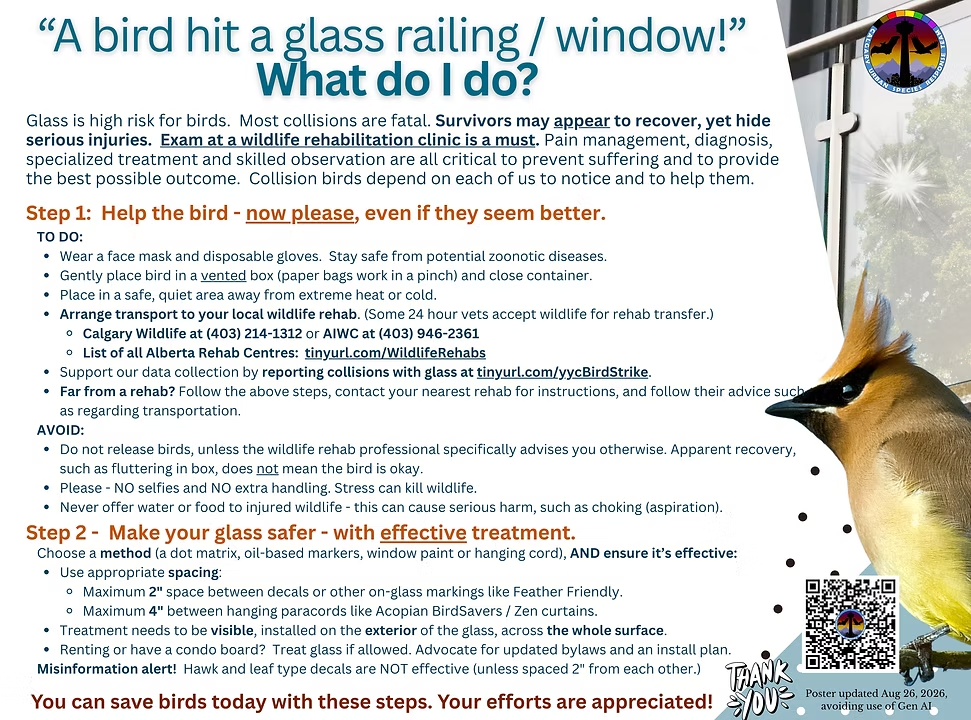
If you have found a deceased bird you can add to the data by logging it at the Global Bird Collision Mapper Or iNaturalist.
More Links:
Calgary Urban Species Response Team: https://www.calgaryurbanspecies.ca/
iNaturalist Bird Strike Reporting: https://www.inaturalist.org/projects/calgary-bird-and-bat-window-strikes
Bird Friendly Calgary: https://www.birdfriendlycalgary.ca/
Digital Bird Migration Explorer: http://www.birdmigrationexplorer.org/
Wildlife emergency? CUSRT are not a rescue service or rehab. Please contact:
- Calgary Wildlife Rehabilitation Society (CWRS) at 403-214-1312; OR
- Alberta Institute for Wildlife Conservation (AIWC) at 403-946-2361; OR
- A 24 hour vet, such as VCA CARE at 403-520-8387
To prevent death and suffering, birds affected by collisions require rehab care, even if they appear to be okay!