Rob English has been strolling through Carburn Park again. Look what he found this time! Click to enlarge.


Rob English has been strolling through Carburn Park again. Look what he found this time! Click to enlarge.
Posted by Matthew Sim
There are several factors that make Big Bend such a holy grail for birders. Factor number 1? The fact that the park offers the easternmost limit for many western species and the westernmost limit for many eastern species of birds. Factor number 2? The park is located on a major migratory flyway and is an important stop-off for many bird species. And factor number 3? Located close to Mexico, the park has many southern specialty birds that can’t otherwise be seen in the U.S. (such as Lucifer Hummingbird and Colima Warbler). The facts didn’t change anything for us though; we were having a blast and seeing many great birds in the process!
Dawn of our second day saw me up bright and early, as the saying goes, the early bird gets the worm (actually, it should be more like: ‘the early birdwatcher gets to watch the bird getting the worm’). Anyway, no matter how the saying goes, I was awake before the sun peered over the hills. I headed down to the feeders, spotting a Bewick’s Wren on my way down. Down at the feeders, I saw no new species but all the same, it was very exciting.

A Curve-billed Thrasher trying to figure out just how to get down on the bird feeder.
I did also manage to spot a Ladder-backed Woodpecker slightly closer than before and managed to get a half-decent shot in the dim light.

We didn’t spend too long at the feeders though as we had decided that today was the day to challenge ourselves. I mean really challenge ourselves. We had decided to hike the Emory peak, the tallest mountain in the park at 7,825 feet high. It is a strenuous hike and the roundtrip is… 10.5 tough miles. We started our climb at about 11am, with the temperature slowly starting to rise. Starting our climb, we were treated to the sounds of several Bewick’s Wrens singing as well as a Crissal Thrasher. While we climbed higher and higher, we started to hear the noise of several Mexican Jays and soon came across a flock of 8.

We were sweating now, hardly even half way up, yet we carried on. As we neared the top of the peak, our effort was payed off. The view was breathtaking.

As we reached the summit we watched nearly 100 White-throated Swifts swirling and diving through the air. Occasionally, as they passed closely by us, we could hear the wind rushing through their wings.

After enjoying the breath-taking scenery for a little longer, we began the long hike back down. Through our exhaustion, we even managed to find two Black-crested Titmice calling from the steep slopes.y the time we reached the bottom of the mountain, thoroughly worn out and incredibly sore, we decided unanimously to call it a day. When we reached our campground, we saw a Common Poorwill (a relative of the nighthawk), perched on the road and darting up into the air every couple of seconds to catch insects. The best part of the day though? Seeing countless stars in the night sky back at the camp. My photo does not even come close to doing the stars justice.

The next morning, due to our serious state of exhaustion, we woke up very late. Upon coming to the decision that it had been fun, but that it was now time to slowly head for home (we were very tired!) we did just that. Heading home slowly meant frequent stops to admire scenery, nature and whatever else we might see. By the time the sun was setting, we had reached Kerrville (about halfway home) and decided to stop for the night. As we reviewed all the excitement of the last several days, we realised the star of the show was still missing. The one bird you always expect to see out west. The bird that is famous worldwide. We hadn’t yet seen a Roadrunner!!!
Upon doing some quick research, we found a state park in Kerrville that might just yield us a Greater Roadrunner. To make a long story short, we spent the following morning looking for a Roadrunner without success. Just as we were beginning to despair, my dad suggested taking one last 5 minute spin around the road. No sooner had we started that 5 minute spin when… There it was! Greater Roadrunner!

Not quite where you would expect to see a roadrunner- in the woods!
We were happy- we had seen our Roadrunner. It was no time to head home.
Big Bend is a great park to visit, especially if you like birds! I would highly recommend visiting it- just be warned, summer temperatures can get up to 49 degrees celsius. Though we barely scratched the surface of this great area, I’m already looking forward to going back-whenever that might be!
Have you seen an unusual bird in Calgary? If it is on this Reportable_Birds (PDF), please report it to the Nature Calgary Rare Bird Alert line at 403 221-4519 and leave a message after the beep at the end of the recording. If you would like some help with species identification, us email us at birdscalgary@gmail.com. To report injured wildlife call the Calgary Wildlife Rehabilitation Society at 403 239-2488, or the Alberta Institute for Wildlife Conservation at 403 946-2361.
MAR 12
EURASIAN WIGEON – male at Third Lake 2 kms south of Hwy 552 on 224 St SE (Terry Korolyk)
HARLEQUIN DUCK – still at IBS (Gus Yaki and FFCPP)
GOLDEN EAGLE – 1st year southeast of Calgary at Hwy 562 and 160 St SE (TK)
SNOWY OWL – one 5 kms north of Vulcan, one northeast of Frank Lake (Tim Allison)
MAR 13
VARIED THRUSH – still in Dover near the west end of 41A Ave
MAR 14
GREATER WHITE-FRONTED GOOSE – a pair at Weed Lake (TK)
PILEATED WOODPECKER – a pair in Hull’s Wood of Fish Creek PP (Keith Craig)
The next scheduled update of the bird alert is on Mon Mar 19.
Posted by Matthew Sim
Great scenery, pristine skies, rugged wilderness, abundant wildlife, all of this found in Texas- add these all up and what do you get??? The answer- Big Bend National Park in west Texas.
Spanning a huge 801,163 acres, Big Bend is the 14th largest national park in the U.S. and covers 3 different environments; mountain, desert and river. This huge area attracts about 350,000 visitors each year and is immensely popular, with spring break being the most popular time to visit the park. This year, my family and I went to find out why the park is as popular as it is.
We left Houston early in the morning in preparation for the 11 hour drive that lay ahead of us. For a good 5 hours of the trip, we drove through heavy rain and saw no break in the clouds. Once we arrived at our campground however, about 20 miles out of the park, we stepped out of the car beneath cloudless skies and almost immediately saw several bird feeders. Right after we found the bird feeders, we found the birds. Suddenly, we were surrounded by at least a dozen birds; Cactus Wren! Curve-billed Thrasher! Black-throated Sparrow! Pyrrhuloxia! Ladder-backed Woodpecker! House Finch! White-winged Dove! The birds were everywhere!

Black-throated Sparrow; a common yet beautiful sparrow of the southwestern U.S.

A conspicuous looking (and sounding) wren of southwestern deserts, the Cactus Wren is also the largest species of wren

Pyrrhuloxia; a distinctive songbird related to the cardinal
We soon had to leave the feeders though to pitch our tent as darkness was settling fast over the desert. As we set up our tent underneath the setting sun, I couldn’t help but feel excited for what I might see in the morning.

The sun rises over the hills around our campground.
After spending a somewhat chilly night in our tent, beneath countless stars, we awoke to the beautiful sound of a singing Pyrrhuloxia, which bears a striking resemblance (both in looks and sound) to a Cardinal. We headed to the nearby bird feeders to see what was about, and nearly immediately ran into a huge surprise- a covey of 35 Scaled Quail, dashing here and there.

We continued birding around the feeders and a small water dish, finding a Sage Thrasher, a single Lark Bunting, a Rock Wren and a pair of Canyon Towhees.

Canyon Towhee; a small drab sparrow-like bird with a very bright cinnamon rump (just visible in this shot)
By late morning, we decided to head to the Chisos Basin, a small valley surrounded by mountains, to do a little hiking. While hiking down into a valley on the Window trail, we were happy to see White-throated Swift, Pygmy Nuthatch, Spotted Towhee and Mexican Jay. This national park was really starting to amaze us by the sheer beauty of it all, nature and scenery standing out above the rest. Upon finishing the hot hike, we made a quick decision to check out the Rio Grande Village after getting a tip that a Common Black-Hawk, a rare bird in the U.S. but one that has nested here for several years, might be hanging around.
Unfortunately, no hawk for us. We were treated to fantastic views of several species though; Vermilion Flycatcher, Western Bluebird, Brewer’s Sparrow and Marsh Wren, all while being merely 50 feet away from the border with Mexico (which, by the way, several Common Ravens flew across without any security checks!).

The absolutely gorgeous Vermilion Flycatcher.
After birding the Rio Grande Village, we brought an end to our fun-filled (and bird-filled) day and headed back to the campground beneath a beautiful setting sun. We were already looking forward to Day 2!

Part 2 of our Adventures in Big Bend coming up tomorrow!
Have you seen an unusual bird in Calgary? If it is on this Reportable_Birds (PDF), please report it to the Nature Calgary Rare Bird Alert line at 403 221-4519 and leave a message after the beep at the end of the recording. If you would like some help with species identification, us email us at birdscalgary@gmail.com. To report injured wildlife call the Calgary Wildlife Rehabilitation Society at 403 239-2488, or the Alberta Institute for Wildlife Conservation at 403 946-2361.
MAR 9
CALIFORNIA GULL – 8 reported by Dan Arndt at Inglewood Bird Sanctuary
MAR 10
CANADA GOOSE – thousands at Frank Lake (Richard Clarke)
TUNDRA SWAN – 7 at Clear Lake (Joan and Malcolm Macdonald), 3 on Silver Lake (Terry Korolyk)
EURASIAN WIGEON – 1 male at Frank Lake (Joan & Malcolm Macdonald)
CANVASBACK – 4 as above
REDHEAD – 11 as above
NORTHERN PINTAIL, AMERICAN WIGEON AND MALLARD – numerous, as above
NORTHERN HAWK OWL – just east of Range Road 20 and south of Twp Rd 302 southwest of Carstairs (Phil Evans)
GYRFALCON pale grey one on Hwy 8 near Hwy 22 (RC); a gray morph adult in Williams Coulee west of Nanton (TK)
GOLDEN EAGLE – an immature at Frank Lake (RC)
MAR 11
TUNDRA SWAN – 3 at Third Lake, 2 kms south of Hwy 552 on 224 St SE (TK)
EURASIAN WIGEON – 2 males, as above
AMERICAN WIGEON – 25 at Frank Lake (Andrew Hart and Nature Calgary)
GREEN-WINGED TEAL – 3, reported by TK; also 2 seen by Andrew Hart and a Nature Calgary field group at Frank Lake
NORTHERN PINTAIL – thousands, as above
CANVASBACK – 8 at Frank Lake (Andrew Hart and Nature Calgary)
REDHEAD – 20, as above
RING-NECKED DUCK – 1, as above
AMERICAN COOT – 1, as above
RING-BILLED GULL – 1 south of the Cushing Bridge (Terry Poulton and Sam Williams)
CALIFORNIA GULL – 17, as above
AMERICAN CROW – 2 north of Black Diamond (TK)
The next scheduled update of the bird alert is on Thu Mar 15.
Posted by Dan Arndt
It was quite evident by the bird activity last week at Carburn Park that spring would be arriving soon, and it became even more clear by the presence of two pairs of nesting Great Horned Owls at the East end of Fish Creek Provincial Park. One of our longest walks to date, at over 7km, we covered a huge amount of ground and saw some amazing sights.

Bow Valley Ranch to Lafarge Meadows and back
Meeting at Bow Valley Ranch, we headed along the hillside on the north edge of the lot to attempt to find a Ring-necked Pheasant which had been seen and heard just before my arrival, but to no avail. Heading southward towards the creek, we found the first male Great Horned Owl guarding a nest, and female, that remained undiscovered by our group. A success in the eyes of any parenting owl, but it would be a great find in a month or two once the eggs hatch and babies begin to fledge, and even moreso if someone were there to get some photos! On the other hand, a well hidden nest keeps away those who wouldn’t treat it with the proper respect.

Great Horned Owl - Male 1

Great Horned Owl - slightly irritated
As we headed across the road through the park, and further south, we were constantly serenaded by the drumming and calling of the incredibly numerous Northern Flickers and Downy Woodpeckers in the area, both of which numbered at least twenty individuals through the course of our walk.

Downy Woodpecker - male

Downy Woodpecker - female

Male Downy Woodpecker digging for a morsel

One of the many male Northern Flickers seen yesterday.
One of the most common questions of the day was, quite honestly, not surprising. With the incredible numbers of European Starlings coming in, many of those on our walk simply had no idea just how wide the range of Starling vocalizations truly was, and almost every variation of their call drew at least one question of “What bird made that call?” To which my answer usually was: “This one.”

The scourge of those who bird by ear.
We headed toward the south end of the park, and stopped briefly by the river to see if there were any unusual birds on the ice, on the shores, or in the water, but surprisingly, there were very few waterfowl at all on the Bow River. Directly on the river were a few Mallards, and on one pond just to the west, a few more Mallards and a pair of Common Goldeneye.

Mallard ducks. (Female on left, male on right)

Common Goldeneye (male left, female right)
Turning back towards Sikome Lake, we came across the second pair of Great Horned Owls. The male appeared slightly agitated, and as we approached, actually flew closer to the nest to better guard it. It also appeared that this pair was much better known, as there were quite a few others viewing the pair as well. The female, though well hidden, was barely visible sitting atop the clutch of eggs.

A slightly more agitated and alert male Great Horned Owl, guarding his mate.

Male Great Horned Owl

Female Great Horned Owl on nest. Nope, I can't see it either.
Not too far away from this pair was another alert parent guarding his potential offspring. I wonder how many of his offspring will help feed the developing owlets in the coming months.

Canada Goose on nest
After stopping to watch this Canada Goose for a bit, we headed back north towards the vehicles, but first stopped to see just a few more woodpeckers in action. Both the Downy and Hairy Woodpeckers in this part of the part are incredibly tolerant to people walking only a few meters away.

Male Hairy Woodpecker

Feeding female Downy Woodpecker
And with that, we headed back to the vehicles, and home. It’s quite an exciting time here during spring migration, and one of the things every birder looks forward to with great anticipation. What will the coming week bring? I suppose I’ll just have to wait until next Sunday to find out!
Posted by Pat Bumstead
Yes friends, my overwintering Mourning Doves are still hanging around the yard. Judging by this affectionate display, I can soon look forward to having even more of them to feed! Last year they nested in my neighbor’s spruce tree, so I’ll be keeping a sharp eye on that location in the coming months.
http://www.youtube.com/watch?v=E7N4A3vfnIg“&rel=0”Have you seen an unusual bird in Calgary? If it is on this Reportable_Birds (PDF), please report it to the Nature Calgary Rare Bird Alert line at 403 221-4519 and leave a message after the beep at the end of the recording. If you would like some help with species identification, us email us at birdscalgary@gmail.com. To report injured wildlife call the Calgary Wildlife Rehabilitation Society at 403 239-2488, or the Alberta Institute for Wildlife Conservation at 403 946-2361.
Mar 4:
RED-BELLIED WOODPECKER overwintered in High River, George Lane Park is still there, Eugene and Lynn West.
Mar 5:
BARROW’S GOLDENEYE, 2 pairs, at the boat launch, Hull’s Wood, FCPP, Gus Yaki,FFCPP.
CEDAR WAXWINGS (7) and AMERICAN ROBINS (25) on a hill above the Glencoe Club 29th St SW, Phil Cram.
Mar 7:
NORTHERN SHRIKE as well as the WAXWINGS and ROBINS as above, unkown observer.
HARRIS’S, WHITE-CROWNED and SONG SPARROW east of the substation at 51 Ave & 68 St SE, Phil Cram.
ROUGH-LEGGED HAWKS (12), seen between Priddis, Turner Valley, Black Diamond, DeWinton, Terry Korolyk.
The next scheduled update of the Bird Alert is on Monday Mar 12.
Posted by Dan Arndt
Once again the Friends of Fish Creek Birding course made its way to Carburn Park, without the lure of the Northern Saw-whet Owl back in January. Since then, the weather has warmed, the birds have begun preparations to nest, and while most have chosen their mates, others are still in the process of defining their territory and competing with their rivals for the few mates still unspoken for. We were gifted with a few wonderful displays of an incredible number of Northern Flickers all throughout the park, as well as the beautifully crimson male House Finch, and huge numbers of Bufflehead, Common Goldeneye, Mallards, and Canada Geese.

Carburn Park Route
This time around, we headed south from the parking lot to the bridge over the Bow River, which is one of the best places in the city to get good views, and good photos, of birds in flight. Both Canada Geese and the juvenile Bald Eagles came low over the bridge, almost posing as they flew by.

View from the bridge at Carburn Park

Canada Geese

Canada Geese

Juvenile Bald Eagle

Juvenile Bald Eagle
From there, we headed further south along the river to get views of the duck species present, and were allowed particularly good views of Buffleheads, Mallards, Common Goldeneye, and even my first female Common Merganser of the year.

Buffleheads & Mallard

Common Goldeneye

Common Merganser
We headed east about a hundred meters before heading north along the back fences of the community adjacent to the park. Here we were greeted by the melodious sounds of House Finches and Black-capped Chickadees at the feeders.

House Finch
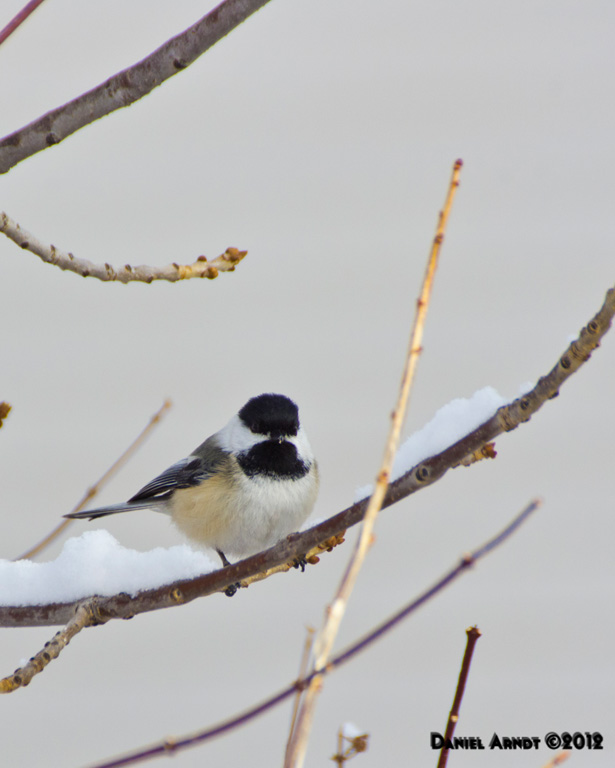
Black-capped Chickadee
Cutting back over to the river bank, the overcast skies opened up to let the blue shine through, and the light was absolutely incredible for the better part of an hour. Along this stretch of river, we were constantly hearing the drumming and calling of the Northern Flickers, and across the river, a family of Bald Eagles was down on the ice. Overhead, the Canada Geese continued their flyovers before heading eastward to the outlying fields for the day.

Canada Geese

Canada Geese

Northern Flicker

Northern Flicker

Bald Eagles
From there, we headed along the shoreline in a clockwise direction. While the light remained good, we came across a curious Black-billed Magpie, and a group of Common Mergansers also swam in close, the males showing off their beautiful green head plumage.

Black-billed Magpie

Common Merganser

Common Mergansers
While the number of ducks and geese was incredibly high, the evidence of their predation by the ever present Bald Eagles was apparent.

Juvenile Bald Eagles

Mallard Carcass
We continued to trek onwards, and in our search for the Northern Saw-whet Owl seen here in January that came up empty, we almost literally stumbled upon a herd of twenty or so White-tailed Deer, spread out along the trails in the northwest section of the park.

White-tailed Deer
While the remainder of the walk was a little rushed, it remained relatively relaxing, as the birds had quieted down quite a lot, and none really seemed to pay us any mind as we strolled the interior of the park along the pond, back to our vehicles, and then home.
See you next week!
Posted by Matthew Sim
Back in November, the Calgary Herald ran an article on the Sage Grouse, a large and impressive grouse that faces a bleak and dismal future. For me, this was a depressing article; it opened my eyes to a species I never knew even lived in Alberta, only to present very pessimistic prospects for the bird here.
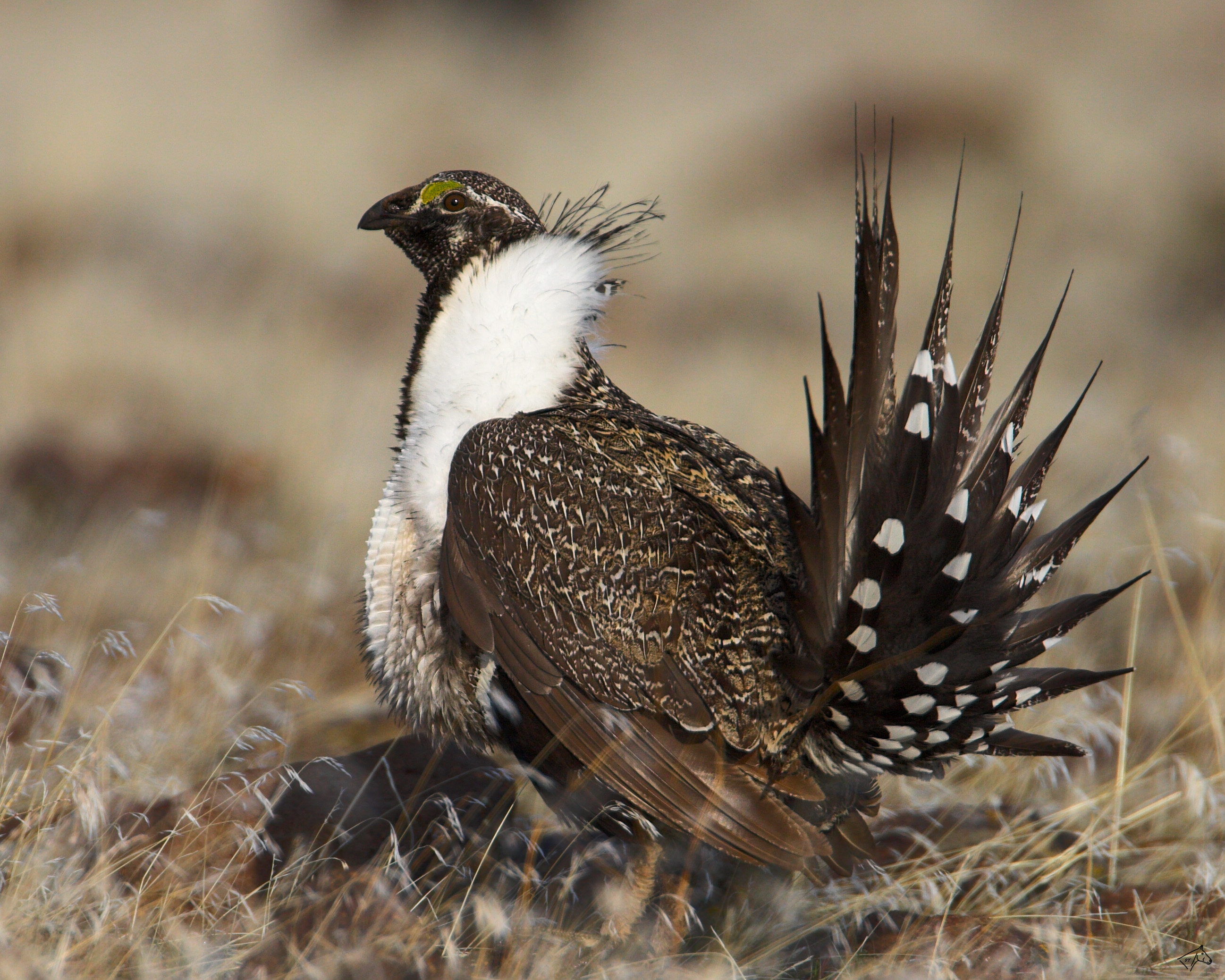
Image courtesy Wikipedia
A scarce permanent resident with a very limited distribution in our province, the sage grouse needs large stands of sagebrush as well as wet meadows, river bottoms or green areas for foraging. This habitat is crucial for the bird and without it, the grouse cannot survive. It is for exactly this reason that population levels have decreased in Alberta since the 1960’s, in fact, the sage grouse population in Alberta is down to just 13 males. Many experts have already given up any hope of saving Alberta’s prairie sage grouse, however, led by the Alberta Wilderness Association, 12 environmental groups are acting to save the species. These groups have asked that the federal government enact an emergency protection order, which would force Environment Canada to do whatever it can to save this species’ habitat. Though it may be too late, let this species plight be a lesson to all of us, and let us ensure that this never happens again.
To read the Herald’s article, follow the link below: