Rare Bird Alert Calgary: Feb 27

Have you seen an unusual bird in Calgary? If it is on this Reportable_Birds (PDF), please report it to the Nature Calgary Rare Bird Alert line at 403 221-4519 and leave a message after the beep at the end of the recording. If you would like some help with species identification, us email us at birdscalgary@gmail.com.  To report injured wildlife call the Calgary Wildlife Rehabilitation Society at 403 239-2488, or the Alberta Institute for Wildlife Conservation at 403 946-2361.

February 22
–SNOWY OWL, Storney Trail and McKnight Blvd., by Lori Anderson et.al.
–AMERICAN ROBIN(18), Queen’s Park Cemetery , by Dan Arndt.

February 23
–RED-BELLIED WOODPECKER(1) still in High River’s George Lane Park, by LA. Has been there for several months.

February 24
–NORTHERN SAW-WHET OWL, yard of Paul Kuelker in Montgomery. Not seen following day.

February 25
–GREEN-WINGED TEAL(F), Bow River, Policeman’s Flats, end of Bow River Bottom Rd, off Dunbow Rd., by Terry Korolyk
–GREATER SCAUP(2M) , Bow River, just N. of Hwy. 22x bridge, by TK.
–AMERICAN ROBIN(6+), backyard of Margaret Brunner in Oakridge subdivision.

February 26
–KILLDEER(2), Elbow River at Griffith Wood park, by Bob Lefebvre and Dan Arndt
–AMERICAN DIPPER(1), Elbow River at Griffith Wood park, by Bernie Diebolt and Janet Gill. One was also seen recently by Steve Kassai in Big Hill Springs PP.

The next scheduled update of the Bird Alert is on Thursday, March 1.

BIRD STUDY GROUP – Meets the first Wednesday of the month, September – May at 7:30 pm, Room 211, BioSciences Building, University of Calgary. The next meeting will be Wednesday March 7. The program is titled “High Science: The Natural History of Alpine Ptarmigan”, by Kathy Martin.

Sunday Showcase: Pileated Woodpecker

Rob English got these last Friday in Carburn Park in southeast Calgary, and says this was the first time he’d ever managed to see one there. The bird was so easy going he couldn’t stop taking pictures. When she did fly it was only 50 or 60 feet so he stayed with her for about an hour just shooting and watching her peel bark. Click on the photos for a larger view.

Movie Time: Bohemian Waxwings

Posted by Pat Bumstead

Rare Bird Alert Calgary: Feb 23

Have you seen an unusual bird in Calgary? If it is on this Reportable_Birds (PDF), please report it to the Nature Calgary Rare Bird Alert line at 403 221-4519 and leave a message after the beep at the end of the recording. If you would like some help with species identification, us email us at birdscalgary@gmail.com.  To report injured wildlife call the Calgary Wildlife Rehabilitation Society at 403 239-2488, or the Alberta Institute for Wildlife Conservation at 403 946-2361.

February 17
–GYRFALCON, overflight, oxbow at W end of Glenmore Reservoir, Weaselhead Natural Area, SW Calgary, Phil Quinn (403-802-0568)

February 20
–SHARP-TAILED GROUSE, photographed in her back yard in Coach Hill, SW Calgary, by Myrna Belyea, (403-246-6071)
– –SNOWY OWL (12), in Irricana Slough area between Range Roads 253 and 264, Frank Wood

February 21
–GOLDEN-CROWNED KINGLET, W quarter of Fish Creek Provincial Park, Phil Quinn

February 22
–PRAIRIE FALCON, N end of Nose Hill Park in NE Calgary, PQ
–PEREGRINE FALCON, S of Okotoks, Brian Elder, Mike Mulligan (403-232-1013), RayWoods
–SHARP-TAILED GROUSE (17) SW of Nanton, same
–SNOWY OWL (3) Frank Lake, same
–MOUNTAIN CHICKADEE, Bebo Grove, W end of Fish Creek PP, Nemali Seneviratne
–DARK-EYED JUNCO, same, same
–BREWER’S BLACKBIRD, Nose Hill Park, near intersection of Shaganappi Trail and John Laurie Blvd, PQ

The next scheduled update of the Bird Alert is on Monday, February 27.

BIRD STUDY GROUP – Meets the first Wednesday of the month, September – May at 7:30 pm, Room 211, BioSciences Building, University of Calgary. The next meeting will be Wednesday March 7. The program is titled “High Science: The Natural History of Alpine Ptarmigan”, by Kathy Martin.

Monitoring a Flicker nest

Posted by Matthew Sim

As spring approaches once again, I like to reminisce about the previous year and all of its most exciting moments.

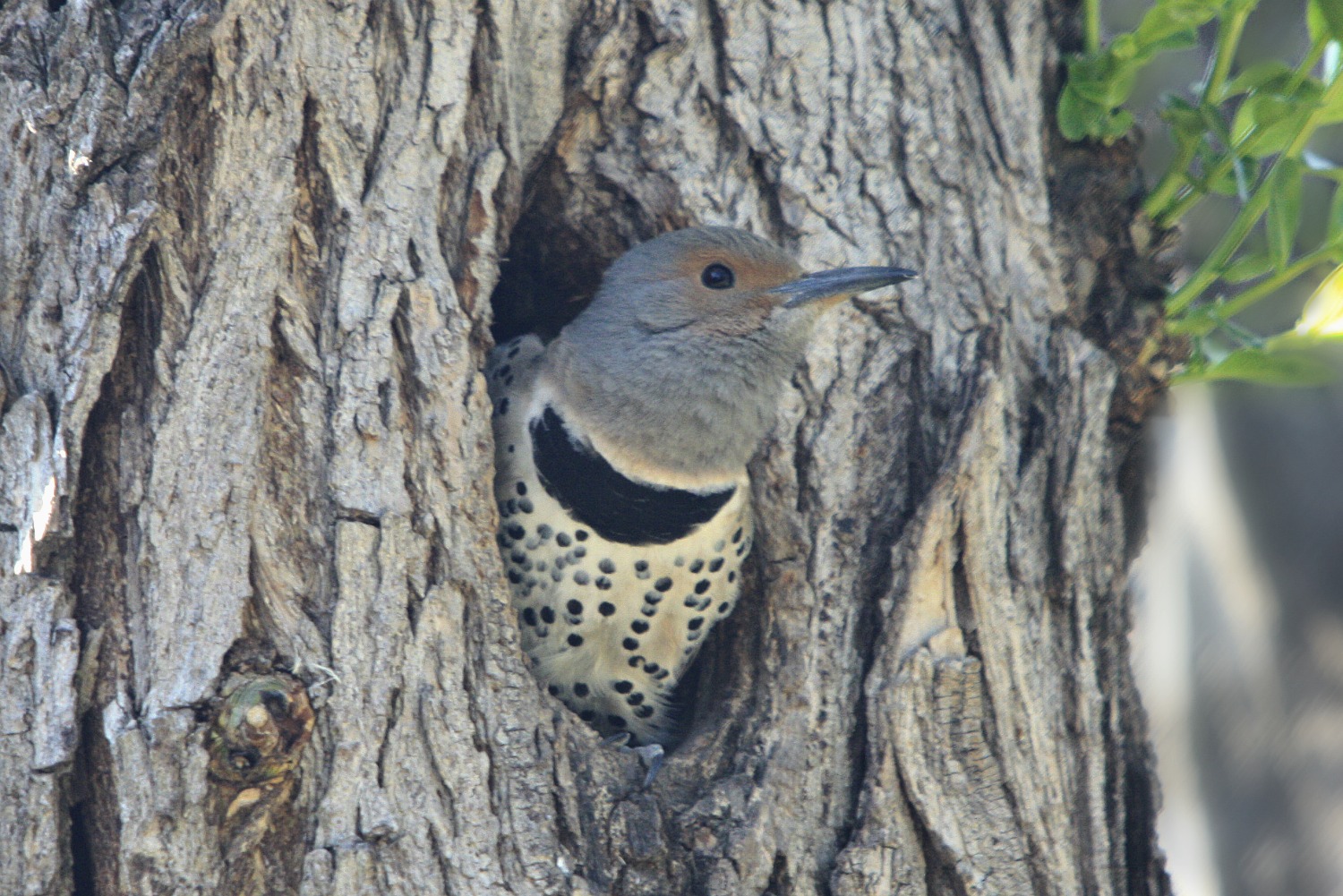
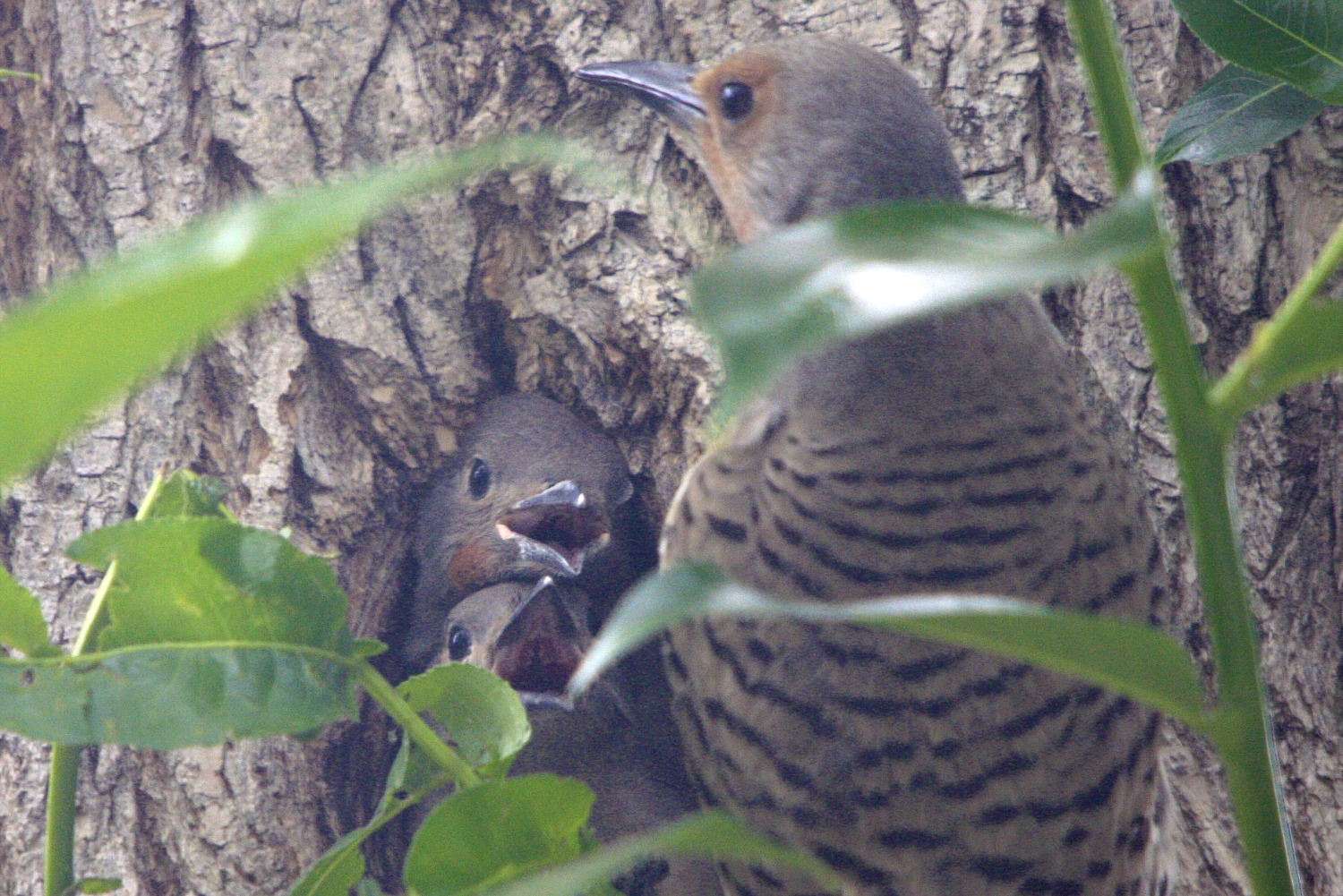
For the past several years, flickers have nested in my neighbor’s tree. I had never really observed this nest closely before; however, last year, I did just that.  Flickers usually excavate nest holes in dead or dying tree trunks or large branches. These nest holes are most often found at 6-15 feet off the ground and will often be reused.  By late May/ early June in Calgary most flickers have laid their 5-8 white eggs. I started to notice that the flickers were more active around the nest in early June and it is my belief that on around the 3rd or 4th of June, “my” pair laid their eggs.

This is the nest hole with the female looking out on June 10. The flickers had been in and out of the hole since late May

    Incubation of the eggs ranges from 14-16 days and I had been closely following all the bird’s actions in attempt to discover when the eggs would hatch. On June 24, I heard the first sounds coming from the hole. The flickers had been born! I think that we can assume that there is a possibility that the young flickers were born a day or two earlier and I had not heard them until then.

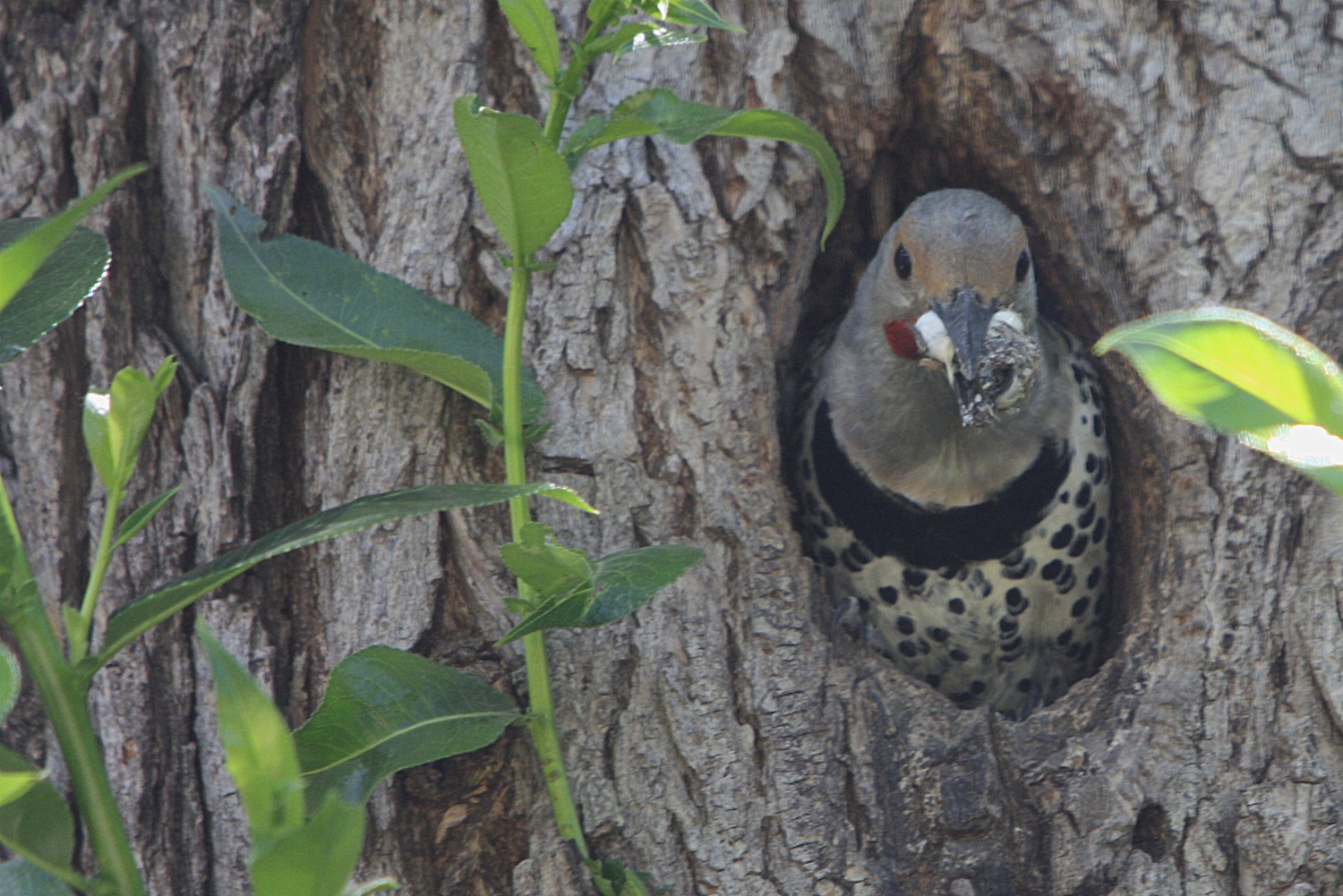
If you compare this shot with the photo above, you can see that the leaves around the hole grew a lot as the summer progessed, adding even more security and privacy to the flicker residence.

The first visible evidence of the young flickers was the clean-up crew. As all parents can attest to, there is a lot of cleaning up involved with kids.  The adult flickers, both male (pictured in photo above) and female, had to work constantly to ensure that their young were well-fed, safe from predators and, perhaps most importantly, in a clean home.

July 1st came around and I had still not seen the young flickers, though I had definitely heard them. Each and every day they were getting louder and louder and soon I could hear them from across the alley, in my yard, maybe 35 feet away. The young flickers cry is often described as a hissing noise and is uttered for two weeks, day and night, growing stronger as the birds grow older.  I was not worried about not having seen the flickers yet as their eyes do not open until they are ten days old, so  wouldn’t be seeing them until then. July 3, I was up in Banff, where I happened upon a flicker nest with two young already poking their heads out of their hole. At that point, I couldn’t help but wonder how my flickers were doing.

July 5th, marked a special day for my monitoring project. That day, I got my first glimpse of the young flickers. I took my first photos of the young flickers on July 9th, and they were looking healthy and fit; all 3 of them!

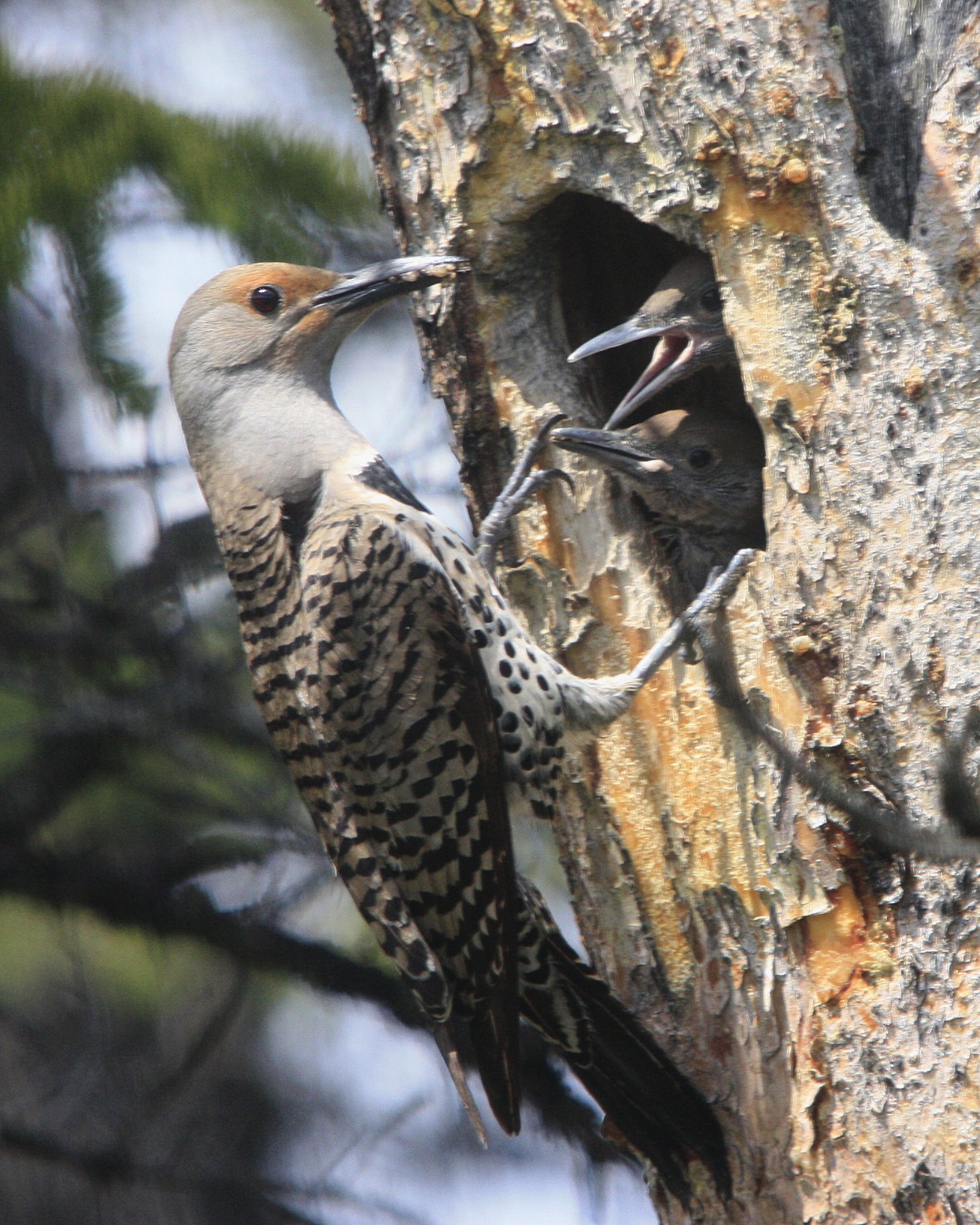
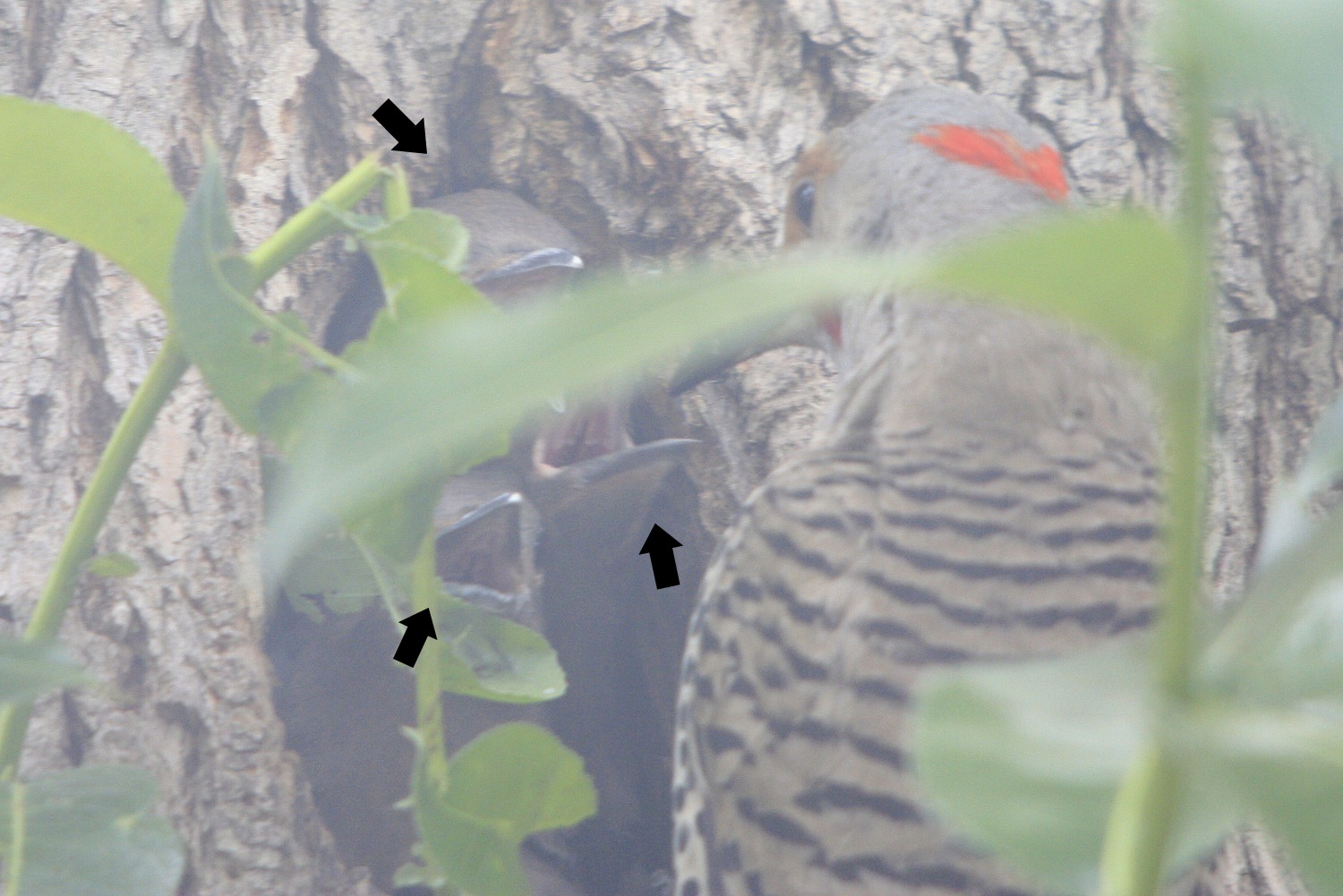
But that’s where it went all wrong. The nest holes of flickers (and often of many other species of birds) are the scenes of very fierce battles. Three young birds with very sharp bills, duking it out for supremacy and the right to remain looking out of the nest hole, therefore receiving the most food. The stronger birds almost invariably end up on top, and maintain their authority by jabbing the others with vicious pecks of their beak. The opening is only big enough for two heads and the third one gets pushed to the bottom. There, the young flicker receives very little food and consequently, it perishes. July 9th, I took the photo above, showing 3 young flickers. By the next day, July 10th, I was only seeing 2 young flickers.

Disappointed though I was, I realized that sometimes, this is the way nature must work. I continued to watch the flickers for several days, amazed at the rate at which they grew. After about 4 weeks, the flickers would fledge and would begin to leave the nest; my flickers started appearing out of the nest around July 16th. The two young birds started hopping about and practicing flying, getting ready for the day when they would leave the nest altogether.

Than one day, I did not see the flickers. Nor did I see them the next day. Or the day after that. It would seem that the two young flickers that I had watched for a nearly a month had successfully fledged. I don’t think I ever saw these two again, though I was seeing flickers in the neighborhood, which might just have been one of the young. From time to time, I did hear the distant call of several Northern Flickers and I couldn’t help but wonder if it was the fledgelings, calling away.


Rare Bird Alert Calgary: Feb 20

Have you seen an unusual bird in Calgary? If it is on this Reportable_Birds (PDF), please report it to the Nature Calgary Rare Bird Alert line at 403 221-4519 and leave a message after the beep at the end of the recording. If you would like some help with species identification, us email us at birdscalgary@gmail.com.  To report injured wildlife call the Calgary Wildlife Rehabilitation Society at 403 239-2488, or the Alberta Institute for Wildlife Conservation at 403 946-2361.

February 18
— RED-BELLIED WOODPECKER, George Lane Park, High River, AB, Yousif Attia
— HORNED LARK, Frank Lake area, Andrew Slater

February 19
— HORNED LARK, NW of Strathmore, Terry Korolyk & CFNS Group
— AMERICAN TREE SPARROW (25+), Irricana Sloughs area, Tony Timmons, Howard & Lynn Heffler
— GYRFALCON (gray morph), Frank Lake, Andrew Slater; adult female dark gray morph on 226 Ave. SW Terry Korolyk
— GRAY JAY, Bebo Grove/Shannon Terrace, FCPP, Bob Lefevre, Dan Arndt, FFCPP Group
— AMERICAN THREE-TOED WOODPECKER, as above
— NORTHERN HAWK OWL (2), Grand Valley Road, Jeff Bingham
— COOPER’S HAWK, possible sighting west Fish Creek PP, Gus Yaki
— NORTHERN GOSHAWK (2), Big Hill Springs PP, Steve Kassai
— SNOWY OWL, Hwy 1 & 84St NE (in the city), Brian Elder, Ray Woods
— DARK-EYED JUNCO, SW Calgary, Phil Quinn

The next scheduled update of the Bird Alert is on Thursday, February 23.

BIRD STUDY GROUP – Meets the first Wednesday of the month, September – May at 7:30 pm, Room 211, BioSciences Building, University of Calgary. The next meeting will be Wednesday March 7. The program is titled “High Science: The The Natural History of Alpine Ptarmigan”, by Kathy Martin.

Bebo Grove and Shannon Terrace – Fish Creek Park’s quieter, calmer west side

Posted by Dan Arndt

This week the Friends of Fish Creek course was touring through Bebo Grove, over to Shannon Terrace, then back again. It’s approximately a 5 km route, return, and throughout the week, some great new birds were seen, such as the American Three-toed Woodpecker, Boreal Chickadees, and a fairly good number of White-winged Crossbills.

Bebo Grove to Shannon Terrace Route

I was most excited for the American Three-toed Woodpecker, since that would be a new bird for me for the year, and probably a more satisfying sighting than my original sighting of it, which ended up being back at my computer scanning through my photos and later realizing that yes, that little black and yellow lump on the trunk of the tree was, in fact, the American Three-toed Woodpecker I’d been looking for.

Here’s that photo, for reference, taken back in August 2010 at Brown-Lowery Provincial Park.

American Three-toed Woodpecker

American Three-toed Woodpecker

Unfortunately, both Saturday and Sunday groups missed out on good sightings of the woodpecker, but at least on Sunday we got to hear it calling amongst the trees, and a brief flyover allowed at least one confident ID, but certainly no photo opportunities. Flyovers of uncommon birds seemed the rule of the day, as we also had a Grey Jay towards Shannon Terrace, which, to my understanding, hadn’t been seen in the park for a number of years.

The good side is that we did get great views of Hairy and Downy Woodpeckers, Red-breasted Nuthatches, the amazingly adorable Boreal Chickadee, and a few Townsend’s Solitaires.

Boreal Chickadee

Boreal Chickadee

Townsend's Solitaire

Townsend's Solitaire

I was particularly happy with this shot of the Common Raven, which are always hard to shoot against a light sky, which tends to wash out their features. Thankfully, this bird decided to perch in the foliage, allowing much better views of its somewhat iridescent plumage.

Common Raven

Common Raven

Add to that the many great angles we were given of the White-winged Crossbills, such as this one, detailing the presence of the crossed-bill for which it gets its name.

White-winged Crossbill

White-winged Crossbill

The gender of the Red-breasted Nuthatch can be identified by the color of the crown. The male, seen below, has a jet black crown.

Red-breasted Nuthatch - male

Red-breasted Nuthatch - male

The female, on the other hand, has a grey crown. Even without the two of them together, just a quick comparison of the color of the eye line and the crown can show that telltale difference.

Red-breasted Nuthatch - female

Red-breasted Nuthatch - female

Both the male Downy and Hairy Woodpecker can also be identified by the bright red patch on the back of their heads, while the female lacks the red patch.

Hairy Woodpecker - male

Hairy Woodpecker - male

Downy Woodpecker - male

Downy Woodpecker - male

Downy Woodpecker - male

Downy Woodpecker - male

I was quite impressed at this little Townsend’s Solitaire on Saturday. While preening, it stretched out its wings again and again, showing off the thick yellow bar in the primary flight feathers of the wing. Unless it’s displaying like this, that yellow bar is almost invisible, and in some individuals, nearly absent.

Townsend's Solitaire

Townsend's Solitaire

Townsend's Solitaire

Townsend's Solitaire

Thanks for reading, and have a great week! Hope you enjoyed the photos!

Sunday Showcase: Golden Eagle

Have you ever wondered how the Golden Eagle got its name? These outstanding photos  from Paul Turbitt answer that question. Paul took these  juvenile eagle pictures at The Ann & Sandy Cross Conservation Area (ASCCA) just south of Calgary. If you haven’t visited this magical place, put in on your to-do list!

The ASCCA is open to the public, but visitors must make a booking online prior to their visit. Upon arrival, you must also register at the kiosk and pay the $2/person user fee.

Rare Bird Alert Calgary: Feb 16

Have you seen an unusual bird in Calgary? If it is on this Reportable_Birds (PDF), please report it to the Nature Calgary Rare Bird Alert line at 403 221-4519 and leave a message after the beep at the end of the recording. If you would like some help with species identification, us email us at birdscalgary@gmail.com.  To report injured wildlife call the Calgary Wildlife Rehabilitation Society at 403 239-2488, or the Alberta Institute for Wildlife Conservation at 403 946-2361.

February 12
–PILEATED WOODPECKER(1) Hull’s Wood, Fish Creek PP, by Howard Heffler.
–NORTHERN SHRIKE(1), near 22x bridge in FCPP, by HH.
–TOWNSEND’S SOLITAIRE, three on the eastern slope of Beaverdam Flats, by D. Arndt; one in backyard of Andrew Slater in Oakridge area, and one on Feb.13 W. of Bebo grove in FCPP, by Gus Yaki, et.al.
–AMERICAN ROBIN(3) , back yard of AS in Oakridge area of Calgary.

February 13
–SHARP-SHINNED HAWK, near home of Corrine Griffin in Linden.

February 14
–THREE-TOED WOODPECKER, Bebo Grove area of FCPP, by GY et.al.

The next scheduled update of the Bird Alert is on Monday Feb.20.

Wednesday Wings: Bathing Merlin

If you’ve taken any pictures of interesting birds in the Calgary region, you can share them with us by emailing birdscalgary@gmail.com and we may post them on the blog.

Dave Arnold took these great shots of a Merlin having his Sunday bath on the edge of the Bow River.  Thanks for sharing, Dave!

Ian Chatt also witnessed this and got these three photos: