Rare Bird Alert Calgary: Oct 25

Have you seen an unusual bird in Calgary? If it is on this Reportable_Birds (PDF), please report it to the Nature Calgary Rare Bird Alert line at 403 221-4519 and leave a message after the beep at the end of the recording. If you would like some help with species identification, us email us at zoxox@shaw.ca  To report injured wildlife call the Calgary Wildlife Rehabilitation Society at 403 239-2488, or the Alberta Institute for Wildlife Conservation at 403 946-2361.

This Bird Alert was recorded on Monday Oct 24 at 10:10 am.

Bird Sightings:

Oct 20:
DUNLIN (1), PECTORAL SANDPIPERS, STILT SANDPIPERS, 400 DOWITCHERS at Weed Lake, Phil Cram, Brian Elder & Ray Woods.

Oct 22:
PACIFIC LOON, SURF SCOTER female at Glenmore Res., Bill Wilson.
1000 GREATER WHITE-FRONTED GEESE, 800 SNOW GEESE at Namaka Lake SE of Strathmore, Andrew Slater.
GOLDEN-CROWNED KINGLET (2), PINE GROSBEAK (2) at Big Hill Spr. PP, Steve Kassai.
COOPER’S HAWK, TOWNSEND’S SOLITAIRE, BOHEMIAN WAXWING (60) at Votier’s Flats, FCPP, Katrina Lybbert.
FRANKLIN’S GULL (1) at Shepherd Landfill, Terry Korolyk.
TOWNSEND’S SOLITAIRE (7), AMERICAN ROBIN (25), RED CROSSBILL (6), GOLDEN-CROWNED KINGLET, Votier’s Flats, FCPP, Gus Yaki & FFCPP.

Oct 23:
DUNLIN (1) at Chestermere Lake, Terry Korolyk.
DOWITCHER (400), BLACK-BELLIED PLOVER (5 juv.), PECTORAL SANDPIPER (3), 1st yr. THAYER’S GULL at Weed Lake, TK.
MAGNOLIA WARBLER, Mount Royal district, Phil Cram.

The next scheduled update of the Bird Alert is on Thursday Oct 27.

Brand New Downies

We recently had a couple of very cute visitors to the yard – a couple of hatch year downy woodpeckers. They seemed to be eagerly checking out their surroundings, much like excited youngsters of any species in a new environment.  They were so small that when the first one landed on the tree, I thought for a minute it was a Brown-creeper.

Posted by Pat Bumstead

Nothing But Shoreline

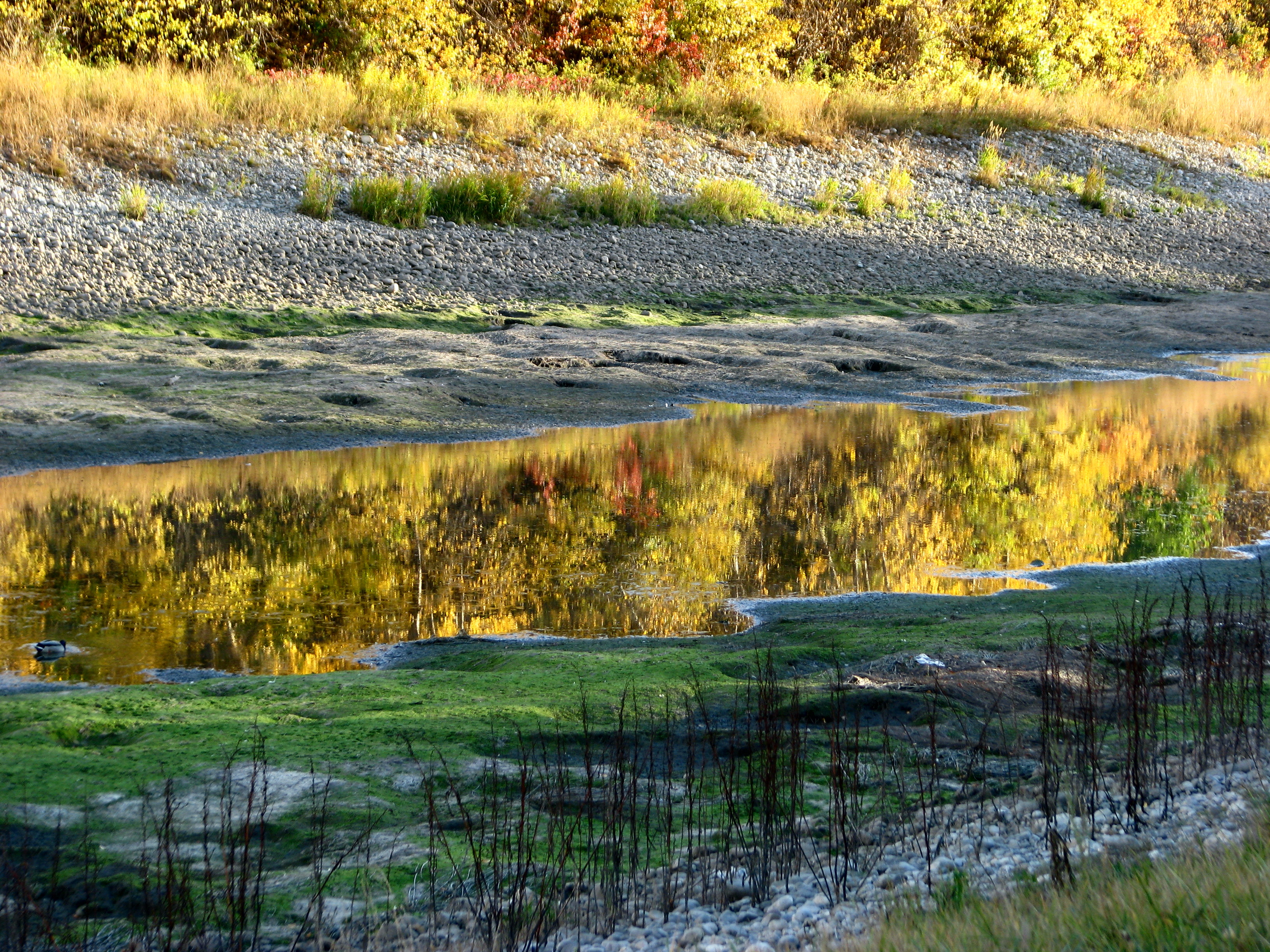
The irrigation canal in southeast Calgary is drained in late September, and as the water level drops, it exposes lush shorelines with plenty for the birds to eat.  From mid-September to freeze-up is the time to get out to look for waterfowl, gulls, and late migrating shorebirds.

Fall colours reflected in the remaining water

I usually explore the sections from the canal headworks near the Max Bell Arena to south of 50 Avenue SE.  There are four parking areas, and you can go up and down a portion of the canal from each one.  It’s a long walk to do it all at once, but a fairly short bike ride.

Click to enlarge the map.

Max Bell Arena:  Access from Barlow Trail SE, just south of Memorial Drive.  There is a large parking lot north of the arena, and you can walk down to the canal headworks from there, and walk along the east bank.  If you want to get to the west bank, you have to cross over at the 17 Avenue SE bridge.

Bow Waters Canoe Club:   Access is off 26 Street SE, just south of 17 Avenue.  Cross the bridge to get to the paths on the west side.  The path on the east side between here and Gosling Way has some steep, difficult terrain, and it is almost impassable by bike.  This lot is fairly secluded and I don’t like to leave my vehicle there.  I prefer Max Bell or Gosling Way.

Gosling Way:  Go west off 26 Street SE at 34 Avenue.  This is the road that goes to the Inglewood Golf and Curling Club.  The parking lot, used by off-leash dog walkers, is just west of the bridge over Deerfoot trail, on the south side of Gosling Way.  It only holds about ten vehicles.  From this lot, walk down to the bridge over the canal and take the paths from there.  In the winter, you can also park at the golf and curling club, but it is a bit of a walk back to the canal.

50 Avenue SE:  It is difficult to park here.  There are only two small spots, each with room for two cars,  at the east end of the bridge over the canal.  It can also be a very busy road, so I avoid parking here as well, and usually just walk from Gosling Way.

The canal has a paved path on one side (sometimes on the east, sometimes on the west) and a dirt or gravel path of sorts on the other side.  I like to go on the east side in the mornings and on the west side in the afternoons, to keep the sun behind me.  This late in the year, the water is usually frozen in the mornings, so there are few birds around.  But on warm afternoons the ice melts, and the birds arrive.

Muskrat and female Hooded Merganser

Detail of Gosling Way Parking.  Click to enlarge.

Looking south from Gosling Way.

Looking north to the bridge on Gosling Way.

Pat and I have each posted about birding the canal before.  You can see Pat’s post here, and my post here.

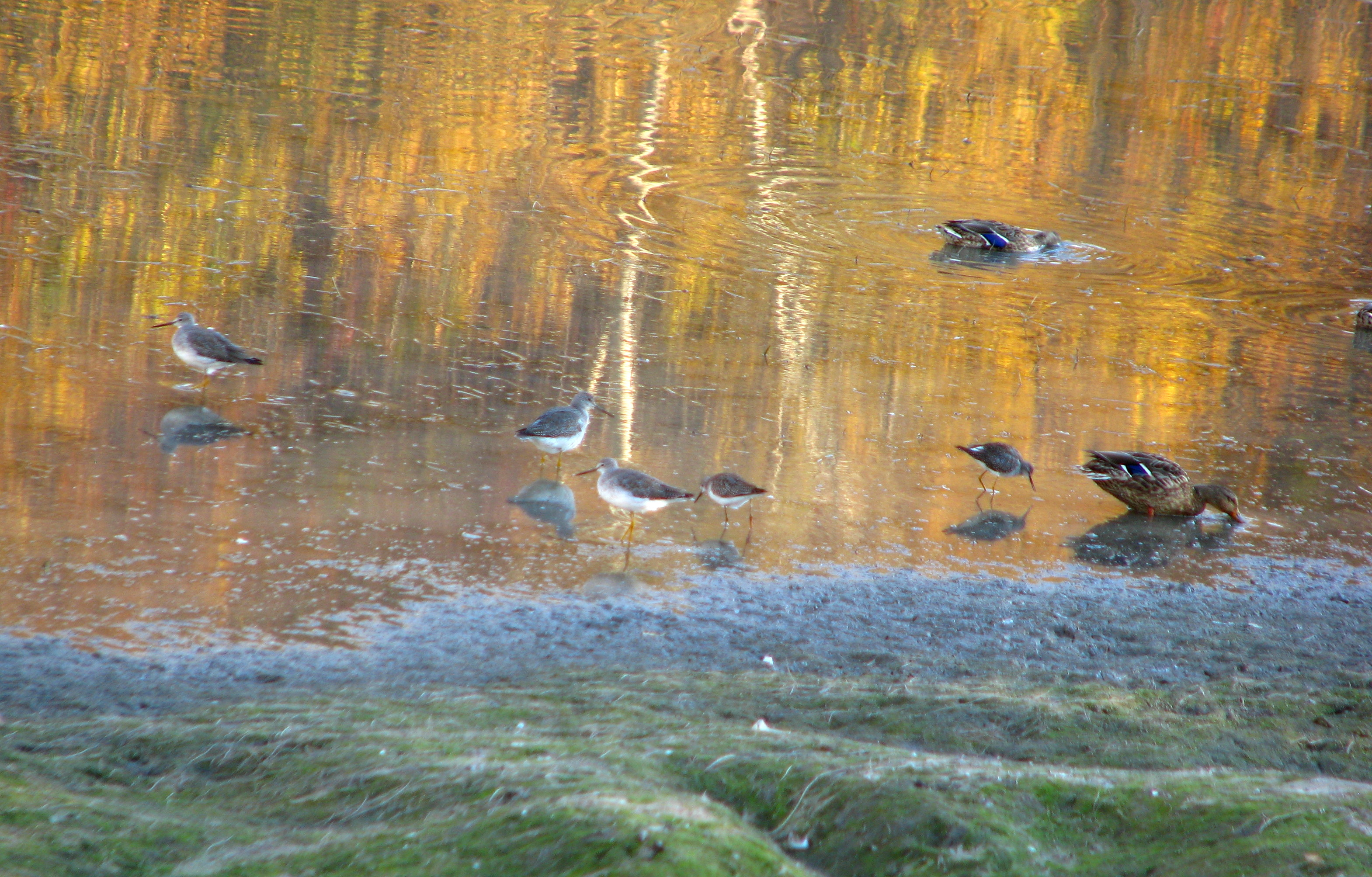
Lately I’ve seen quite a few Canada Geese, Mallards, and Ring-billed Gulls, and a few Hooded Mergansers, Common Goldeneyes, and Greater Yellowlegs.  In past years I’ve seen Redheads, Blue-winged Teal, Killdeer, Long-billed Dowitchers, and Rusty Blackbirds all feeding along the shorelines.

Mallards and an assortment of Yellowlegs.

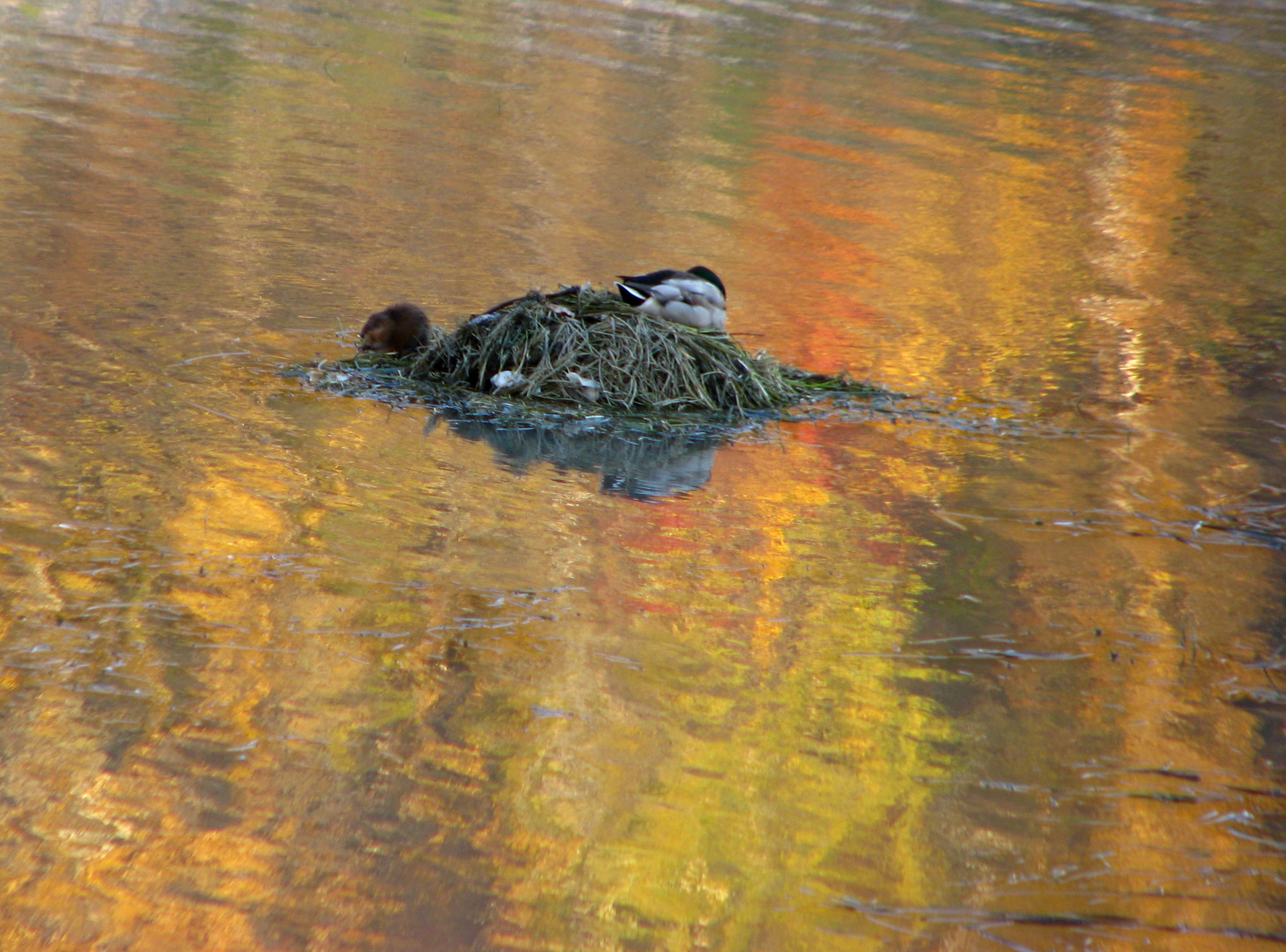
Muskrat and Mallard sharing the Muskrat’s lodge.  Background by Monet.

A Black-billed Magpie looks for food on the old canal bottom.

Posted by Bob Lefebvre

Sunday Showcase: Young Swainson’s Hawk

Rob English was fortunate enough to capture these stunning shots of a young Swainson’s hawk hunting grasshoppers. He took them in Hulls’ Wood, Fish Creek Park in early September. He says the bird hung around the area for about three days, and showed no fear. His wife named him “Mr. Personality.” Thanks so much for sharing these Rob! Click to enlarge. 

eBird

“Global tools for birders, critical data science”.

This one line sums up eBird perfectly. eBird is an online checklist program for birders that has changed the way we submit and access data for the better. This program enables you to easily view data submitted from across the globe by birdwatchers.

Well how does it work? eBird gets many thousands of birders engaged in contributing to a huge online database. You simply fill in a checklist on your birding trip; the who, what, when and where of the outing and then submit the form. eBird stores the data and allows you to view your own lists of what you have seen for the month, for the year, for a certain location and so on. Rare birds get flagged by the data quality filters and are then reviewed by local experts. Once a rare bird has been confirmed it is accessible for all to see via rare bird alerts, allowing others to share in the discovery. Your checklist goes to the database to help scientists accumulate information on birds and helps them to determine species ranges, bird distribution and other such data which can help save endangered birds. As they explain on the website: “any contribution made to eBird increases our understanding of the distribution, richness, and uniqueness of the biodiversity of our planet.” I look forward to seeing many observations submitted to eBird from you!

http://ebird.org/content/ebird/

Posted by Matthew Sim

A Bird ID Quiz

We received the following email from a birder in the United Kingdom, and asked him if we could post it on our blog. He’s looking  for ID help on three local bird species, so we thought we would ask our readers what they think the birds are. Two sparrow-ish birds and a shorebird should give you quite a challenge. Leave your best guesses in the comments below, and we’ll put up the correct answers eventually…

Dear Pat, Bob and Matthew,

Firstly I want to say how great your blog is – I have just gotten back to the UK after two weeks in your neck of the woods [late September] and the blog was very helpful in finding out about local spots and unfamiliar birds! I particularly enjoyed the sections on Fish Creek Park which we visited a couple of times and had great views of Bald Eagle, fishing Osprey and Lesser Yellowlegs.

I have a couple of ID questions that I hope you can help me solve! This was my first trip to Canada and most of the species are entirely unfamiliar (I have just one short non-birding trip to Texas last year as previous North American experience!).

Firstly, I attach a jpg file, ‘Sparrow sp’. I intially thought this was a pipit from stance but later revised my opionion to a sparrow, possibly Vesper due to the strong white eye ring. It was foraging for food in sparsely vegetated ground near the Elbow Valley constructed wetland. Any thoughts on ID would be greatly appreciated!

Another,  ‘Bunting sp’ is also attached… This one was seen out near Forgetmenot Pond by the Elbow River. I’m thinking Lapland Longspur but wouldn’t be surprised to discover it’s something else!

Finally, a picture of a Yellowlegs from Fish Creek Park near Mallard Point. I initially thought it was a Lesser, but the bill length, amount of yellow on the bill base and the head shape have made me unsure, although it lacks the bolder streaking of Greater. Your views are appreciated.

Many thanks in advance for your time and assistance, and with great appreciation for your blog,

Steve Marshall

Rare Bird Alert Calgary: Oct 20

Have you seen an unusual bird in Calgary? If it is on this Reportable_Birds (PDF), please report it to the Nature Calgary Rare Bird Alert line at 403 221-4519 and leave a message after the beep at the end of the recording. If you would like some help with species identification, us email us at zoxox@shaw.ca  To report injured wildlife call the Calgary Wildlife Rehabilitation Society at 403 239-2488, or the Alberta Institute for Wildlife Conservation at 403 946-2361.

This Bird Albert was recorded on Oct 20, 2011.

OCT 16

GREAT GRAY OWL – Grand Valley Road on the first east-west section of road past the 4-way stop, Ron Kube
WHITE-WINGED CROSSBILL – 4 juveniles, yard in Mount Royal, Phil Cram
TOWNSEND’S SOLITAIRE – on the summit of Sulphur Mtn in Banff NP, Thomas Glen
RUSTY BLACKBIRD – Found again at a slough east of Calgary on Rge Rd 28 just south of Glenmore Trail, RK

OCT 17

WHITE-WINGED CROSSBILL – over 60 seen by Gus Yaki and the FFCPPSoc at Votier’s Flats in Fish Creek PP
RED CROSSBILL – 4 juveniles/females, yard in Mount Royal, PC

OCT 18

RED-THROATED LOON – on Glenmore Reservoir between Yacht Club and Canoe Club, TG
WHITE-WINGED CROSSBILL – 12 in Votier’s Flats of Fish Creek PP, Gus Yaki and the FFCPPSoc
RED CROSSBILL – 3, as above
NORTHERN GOSHAWK – 2, as above
PINE GROSBEAK – 1, as above; also 2 immature/female birds seen by PC in Britannia

OCT 19

WHITE-WINGED CROSSBILL – more than 60 seen by GY and the FFCPPSoc at Votier’s Flats
PACIFIC LOON – 1 seen on Glenmore Reservoir from Heritage Park, Bill Wilson

The next scheduled update of the bird alert is on Mon Oct 24.

Rare Bird Alert Calgary: Oct 17

Have you seen an unusual bird in Calgary? If it is on this Reportable_Birds (PDF), please report it to the Nature Calgary Rare Bird Alert line at 403 221-4519 and leave a message after the beep at the end of the recording. If you would like some help with species identification, us email us at zoxox@shaw.ca  To report injured wildlife call the Calgary Wildlife Rehabilitation Society at 403 239-2488, or the Alberta Institute for Wildlife Conservation at 403 946-2361.

This Bird Albert was recorded on Oct 17, 2011.

OCT 10

GREAT GRAY OWL – Grand Valley Road, Ian Maton and Keith Sharkey

OCT 13

SANDHILL CRANE – 2 flocks east of Carstairs-Didsbury area, 9 birds on Rge Rd 270 south of Hwy 582, 30 birds at Twp Rd 314 and Rge Rd 271 junction – seen by Corinne Griffin
SNOW GEESE – 200 seen by CG at Twp Rd 314 and Rge Rd 271 junction
TRUMPETER SWAN – 7, CG at Twp Rd 320 just west of Hwy 791

OCT 15

TRUMPETER SWAN – 4 at the north end of Chestermere Lake – Terry Korolyk and members of Nature Calgary
TUNDRA SWAN – flocks of 20 and 30 in the middle of Weed Lake – seen by TK group as above
GREATER SCAUP – on Chestermere Lake – 3 to 5 seen by TK group
AMERICAN GOLDEN PLOVER – juvenile at Weed Lake, Nature Calgary group with TK
PECTORAL SANDPIPER – 1, as above
BLACK-BELLIED PLOVER – 3-4 as above
LONG-BILLED DOWITCHER – 45 as above
RUSTY BLACKBIRD – Found by Ron Kube at a slough east of Calgary on Rge Rd 28 just south of Glenmore Trail

OCT 16

RED-THROATED LOON – on Glenmore Reservoir between the sailing club and the canoe club, reported by Bob Storms
GREATER WHITE-FRONTED GOOSE – TK, 16 birds at the south end of Clear Lake (15 kms east of Stavely)
AMERICAN GOLDEN PLOVER – TK, north end of Clear Lake
LESSER YELLOWLEGS – 5 birds as above
GREATER SCAUP – TK, 3 as above
SHARP-SHINNED HAWK – near Bow Valley Ranch in east Fish Creek PP, seen by Steve Kassai
AMERICAN TREE SPARROW – 7 as above

The next scheduled update of the bird alert is on Thu Oct 20.

95+ Years of Pigeon Roosts

If you’ve ever driven south on Deerfoot Trail, you would have passed the Federal Grain Elevator in Bonnybrook, on the west side of the road.

This grain terminal was built around 1916, and over the years, has provided roosting and nesting sites for untold thousands of rock doves. When the grain trucks were delivering to the building on a daily basis, the spilled grain also attracted ducks and geese from the nearby Bow River. All that terrestrial bird activity naturally attracted the predators, and it was often a good place to spot a Northern Goshawk in the winter.

As of last Sunday, the rock doves have lost their perch. Apparently the high cost of operating the aging structure meant it was no longer financially advisable, so it was imploded at 8:00 am Sunday morning.

On a chilly pre-dawn morning, we were lined up on the hill to the west of the elevator with the media, police and a host of spectators. I was there because I was curious about the bird aspect of the whole thing.

The charges were set mid-way down the building, so when it went down, the rock doves on the roof went up. They circled the area, drifting in and out of the large dust cloud as it wafted towards the east.

The explosion also lifted a flock of geese off the river, and a small flock of ducks.

The whole thing was over in less than two minutes. As the sun rose through the dust, the rock doves gradually settled on a small, remaining tower, no doubt wondering what on earth had just happened to their world.

Posted by Pat Bumstead

Rescuing Wild Birds

Last time I posted about a sick Ring-billed Gull found in Fish Creek Park (see post).  I wondered if it would have been accepted at any of the local wildlife rehabilitation centres. 

Ring-billed Gulls, which were in trouble in the early twentieth century, have been increasing in numbers and expanding their breeding range ever since they were given protection under the Migratory Bird Treaty in 1916.  They lay one to four eggs (more usually two or three), and have an unusually high hatch rate of nearly 80%.  It takes three years to reach breeding age, and a typical lifespan is ten to fifteen years.  So even though they do have a high rate of loss of young birds, the population has grown to the point where they are now the most common gull in North America, and are considered by many to be a pest that needs management.

Adult Ring-billed Gull in Valleyview Park Pond, SE Calgary, 2007

Nevertheless, it turns out that two of the local wildlife rehabilitation centres that I contacted would accept an injured or sick Ring-billed Gull.  The Alberta Institute for Wildlife Conservation (AIWC), located north of the city near Madden, accepts all bird species except House Sparrows and European Starlings, non-native birds which are considered to be invasive.  The Calgary Wildlife Rehabilitation Society (CWRS), located in northwest Calgary, will accept any wildlife but discourages people from bringing in Rock Pigeons and Richardson’s Ground Squirrels.  The AIWC will send a volunteer to pick up wildlife, but you have to bring the animal in to the CWRS.

These organizations, and others like them across the province, take sick, injured, or orphaned wildlife and rehabilitate them, if possible, for return to the wild.  They typically are volunteer-based and include veterinarians and experts in wildlife rehabilitation.

If you find a bird or other animal in distress, it is important first to be able to recognize if it is really injured or orphaned, or behaving normally, and second, to be able to handle it safely.  The above organizations have excellent information about this on their websites, which is well worth reading for any birder.  If you think you might want to use these services, keep their phone numbers handy and know what to do if you find an injured bird.

I asked the AIWC if there are times in the year when they are so busy that taking common birds like Ring-billed Gulls might put too much of a strain on their resources, but they assured me that although it does get very busy sometimes, they never refuse any animal and always manage to properly look after them all.  If you find an injured bird, it is up to you if you want to pursue rescuing it.

All of the wildlife rehabilitation organizations rely heavily on volunteers, so there are plenty of opportunities to get involved if you are interested in helping.  They also have regular open houses and give presentations to inform the public about their work.  AIWC recently spoke to the Bird Studies Group of Nature Calgary.

Blackjack, a Swainson’s Hawk used by AIWC in their educational presentations, at the Bird Studies Group meeting.

Here are links to the websites of some local wildlife rehabilitation organizations.

Alberta Institute for Wildlife Conservation

Calgary Wildlife Rehabilitation Society

Cochrane Ecological Institute

Medicine River Wildlife Centre

Alberta Wildlife Rehabilitator’s Association

Posted by Bob Lefebvre