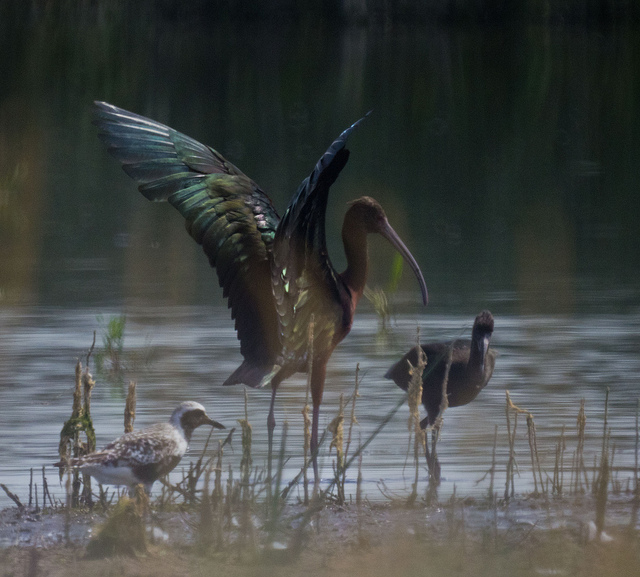
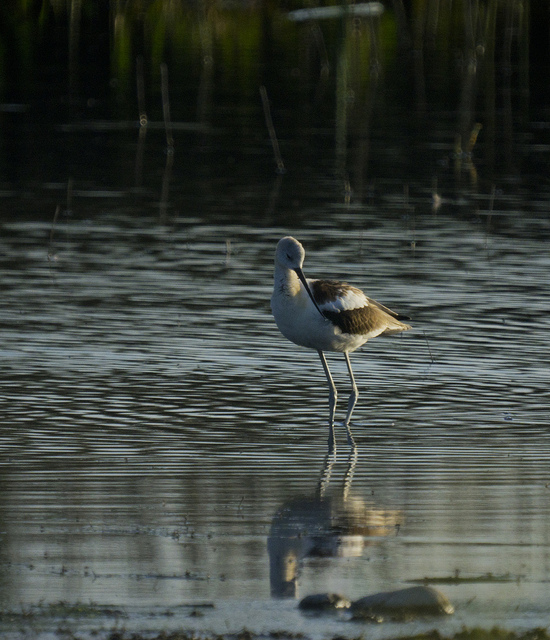
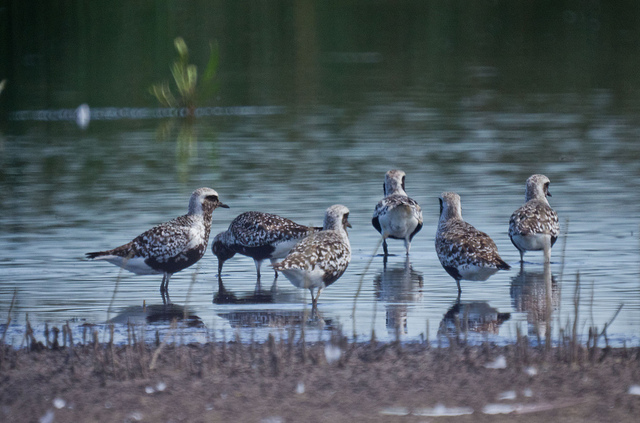
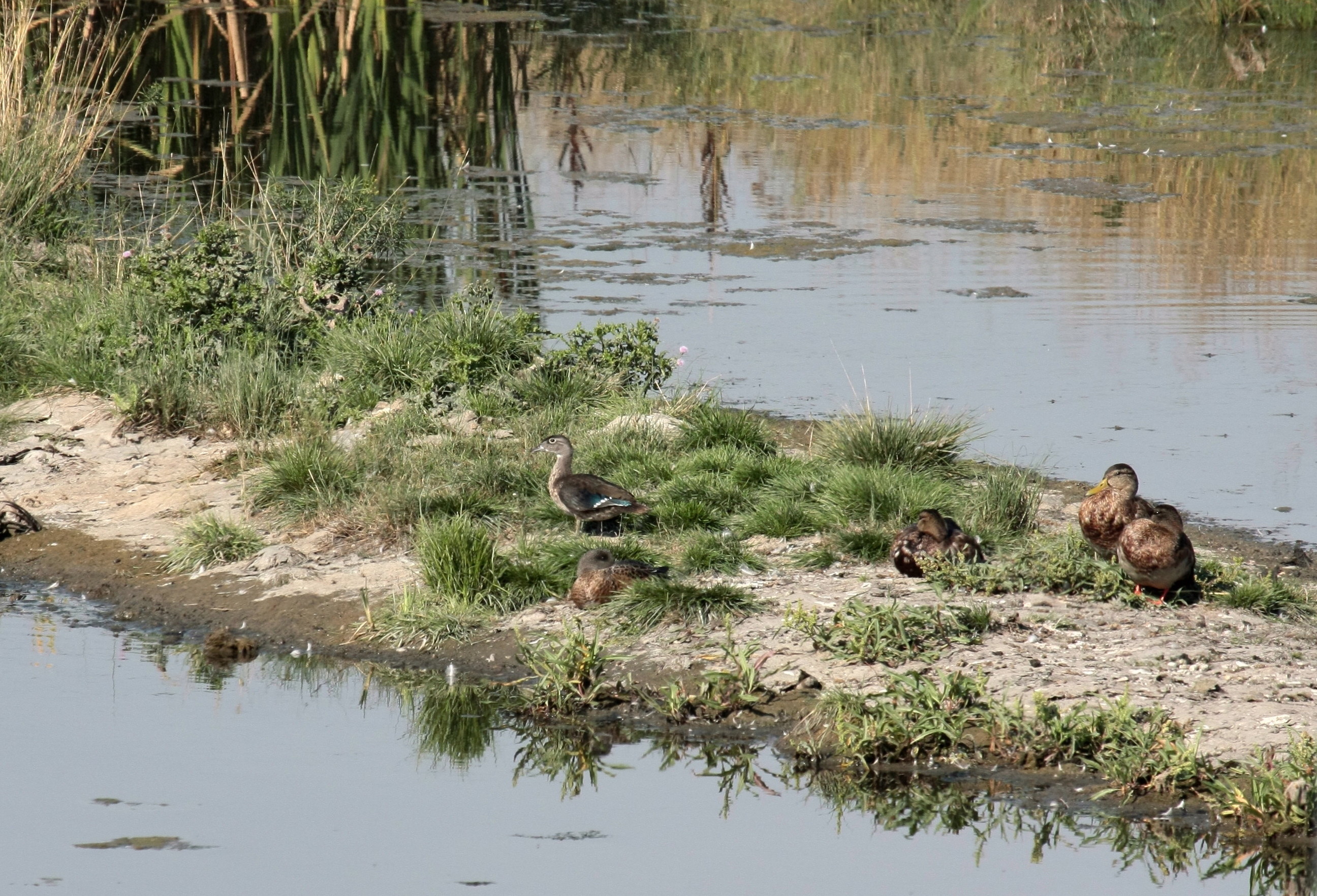
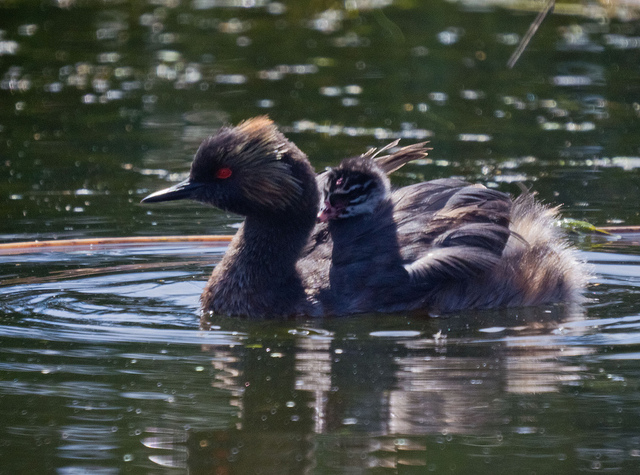
Rob English spotted this family gathering south of Airdrie, early in September. Click to enlarge.
Rare Bird Alert Calgary: Sept 30
Have you seen an unusual bird in Calgary? If it is on this Reportable_Birds (PDF), please report it to the Nature Calgary Rare Bird Alert line at 403 221-4519 and leave a message after the beep at the end of the recording. If you would like some help with species identification, us email us at zoxox@shaw.ca To report injured wildlife call the Calgary Wildlife Rehabilitation Society at 403 239-2488, or the Alberta Institute for Wildlife Conservation at 403 946-2361.
This report was prepared on Friday September 30.
September 24
— SHARP-SHINNED HAWK (4), Rocky Mountain Eagle Research Foundation site near Mount Lorette, Bill Wilson
— NORTHERN GOSHAWK, Mt. Lorette, BW
— GOLDEN EAGLE, (4) Mt. Lorette, BW
September 25
— SHARP-SHINNED HAWK (5), Plateau Mountain, CFNS Excursion led by Peter Roxburgh
— SHARP-SHINNED HAWK (2), Plateau Mountain, CFNS Excursion
The next scheduled update of the Bird Alert is on Monday October 3.
BIRD STUDY GROUP:
Bird Study Group meets 1st Wednesday of the month, Room 211, BioSciences Building, U of C.
October meeting is Wednesday, October 5. Birds of Prey – presented by Alberta Institute for Wildlife Conservation. Meeting time is 7:30pm.
Famous birders
There are many famous birders, some renowned for their birding accomplishments, others simply because of their non-birding accomplishments. Todays famous birder is Phoebe Snetsinger, a birder who had a remarkable story; and a strong will.
Phoebe Snetsinger was born June 9, 1931 in Lake Zurich, Illinois. One of three children of Naomi Geddes and the powerful advertising baron, Leo Burnett, she inherited a small fortune, thanks to her father. Upon seeing a Blackburnian Warbler in 1965 at her home in Webster Groves, Missouri, Phoebe was inspired to start birding. Birding remained a hobby for Phoebe until the moment in 1981 that would reshape her life; a doctor diagnosed her with terminal melanoma and told her she didn’t have long to live.
Photo courtesy Wikipedia
This news motivated Phoebe to observe birds; as many species as she could. It all started with one trip to Alaska. Phoebe returned home after the trip to Alaska and from then on, traveled the world seeing as many species as she could. Phoebe lived much longer than doctors thought she would and, in 1999, 18 years after she was diagnosed with terminal cancer, Phoebe was still going strong. Unfortunately, Phoebe’s travels were brought to an abrupt end. While in Madagascar looking for a Red-shouldered Vanga, a species discovered by science only two years earlier, the van Phoebe and her group were traveling in, overturned on the decrepit roads, killing Phoebe instantly.
This remarkable woman was very dedicated and persevering in her travels and still has one of the biggest life lists ever recorded. Phoebe’s last lifer on a list that totaled more than 8,400 species of birds, was the Red-shouldered Vanga.
Posted by Matthew Sim
Whooping Cranes at the Zoo Ranch
Whooping Cranes are so rare that most of us have never seen one in the wild. But there is an opportunity to see captive ones right here in Calgary. The Calgary Zoo maintains a Whooping Crane breeding program at their Zoo Ranch facility just south of the city. On Saturday October 8, there will be a field trip to see these magnificent birds, as well as other rare birds and animals. Crane Keeper Dwight Knapik will guide the group on a tour of the facility and explain their breeding programs.
Whooping Crane pair. All photos from 2008.
There will be a limit of 25 participants accepted for this free trip, so if you have never been to the Zoo Ranch, you should take this opportunity. Call Gus Yaki at 403-243-2248 to register (the best time to reach him is between 6 and 7 pm). In the past this trip has always been fully booked.
Up close and personal with a Whooping Crane!
The group will meet at the Anderson LRT Station next to McLeod Trail, 109 Ave SW, south of the pedestrian overpass, at 1:30 pm to carpool to the site. (If it is raining the date may be changed to Sunday October 9.)
Are you looking at me?
Desmoiselle Cranes
Sandhill Crane
Przewalski’s Horse
Grevy’s Zebra. Unfortunately this animal has since passed away.
Posted by Bob Lefebvre
Fish Creek Park Birding
I had a very slow birding summer, with a knee problem that kept me out of the field and off my bike for three months. But now my knee is better and I am back birding with Gus Yaki and the Friends of Fish Creek Society. I went out twice with this group to the Hull’s Wood/Sikome/Lafarge Meadows area in mid-September. Here are some pictures from those trips (click on the pictures to enlarge them).
Two Double-crested Cormorants, and on the right, an Osprey, silhouetted against the rising sun.
A cormorant dries its wings.
Double-crested Cormorant, this time with the light on the right side of the bird.
The Osprey perched in a tree.
Red-tailed Hawk in flight.
Northern Flickers.
Greater Yellowlegs, in one of the ponds by highway 22X.
We found a single Wood Duck (centre) hanging out with the Mallards.
Great Blue Heron on its usual rock.
Juvenile Bald Eagle.
This Cedar Waxwing was picking insects out of a spider web high in a tree.
American Kestrel.
Killdeer on the pond.
Killdeer on the river.
Common Raven calling near where they nested in Lafarge Meadows.
Finally, there is this bird, which we found sitting on a path that runs from the Sikome boat launch parking lot to the river. I’ll tell its story next week.
Posted by Bob Lefebvre
Rare Bird Alert Calgary: Sept 26
Have you seen an unusual bird in Calgary? If it is on this Reportable_Birds (PDF), please report it to the Nature Calgary Rare Bird Alert line at 403 221-4519 and leave a message after the beep at the end of the recording. If you would like some help with species identification, us email us at zoxox@shaw.ca To report injured wildlife call the Calgary Wildlife Rehabilitation Society at 403 239-2488, or the Alberta Institute for Wildlife Conservation at 403 946-2361.
This report was prepared on Monday September 26.
September 22:
–BLACK VULTURE, Raymond, AB. Reported by Jocelyn Hudon. First confirmed record for Alberta. Photographed perched on top of the town hall.
September 23:
–AMERICAN GOLDEN-PLOVER, S.end Weed Lk, by Andrew Slater
–SANDERLING(13), same as above.
–TOWNSEND’S WARBLER(1), Confederation Park, by Bill Wilson and Ilya Povalyaev.
September 24:
–WESTERN SANDPIPER(Juv.) S.end Weed Lk, by IP et al.
–ROUGH-LEGGED HAWK(1), along Hwy.#22,just S. of the Water Valley turnoff, by Tim Allison.
–SNOW GOOSE(1), a pond along Hwy.#22x, just S. of Calgary, by Terry Korolyk.
The next scheduled update of the Bird Alert is on Thursday September 29.
BIRD STUDY GROUP:
Bird Study Group meets 1st Wednesday of the month, Room 211, BioSciences Building, U of C . October meeting is Wednesday, October 5. Birds of Prey – presented by
Alberta Institute for Wildlife Conservation. Meeting time is 7:30pm.
Digiscoping
Digiscoping is the activity of combining a digital camera with a spotting scope to record images through the scope. Anyone who has ever looked through a good scope knows how impressive they are at turning distant specks that can’t be identified, even with binoculars, into sharply defined birds. The combination of big lenses and up to 60X magnification really brings faraway objects into close focus. Scopes are especially useful for waterfowl far out on lakes, and shorebirds on distant shorelines.
Today’s post features some wonderful photographs taken using digiscoping by local birder and photographer Daniel Arndt.
Digiscoping can be done with any point-and-shoot or SLR camera (or even a camera phone) coupled with any scope or binocular, but it can very tricky to get to good quality pictures by just holding the two together.  Here is a White-crowned Sparrow I photographed in my yard this week, using my camera phone held up to my 8X42 binoculars:
It’s very hard to tell when you have the shot in focus. It’s even hard to get on the bird! You get a better shot with just a good camera:
The same bird, from the same distance, taken with an SLR and 400 mm lens. Note the leg band.
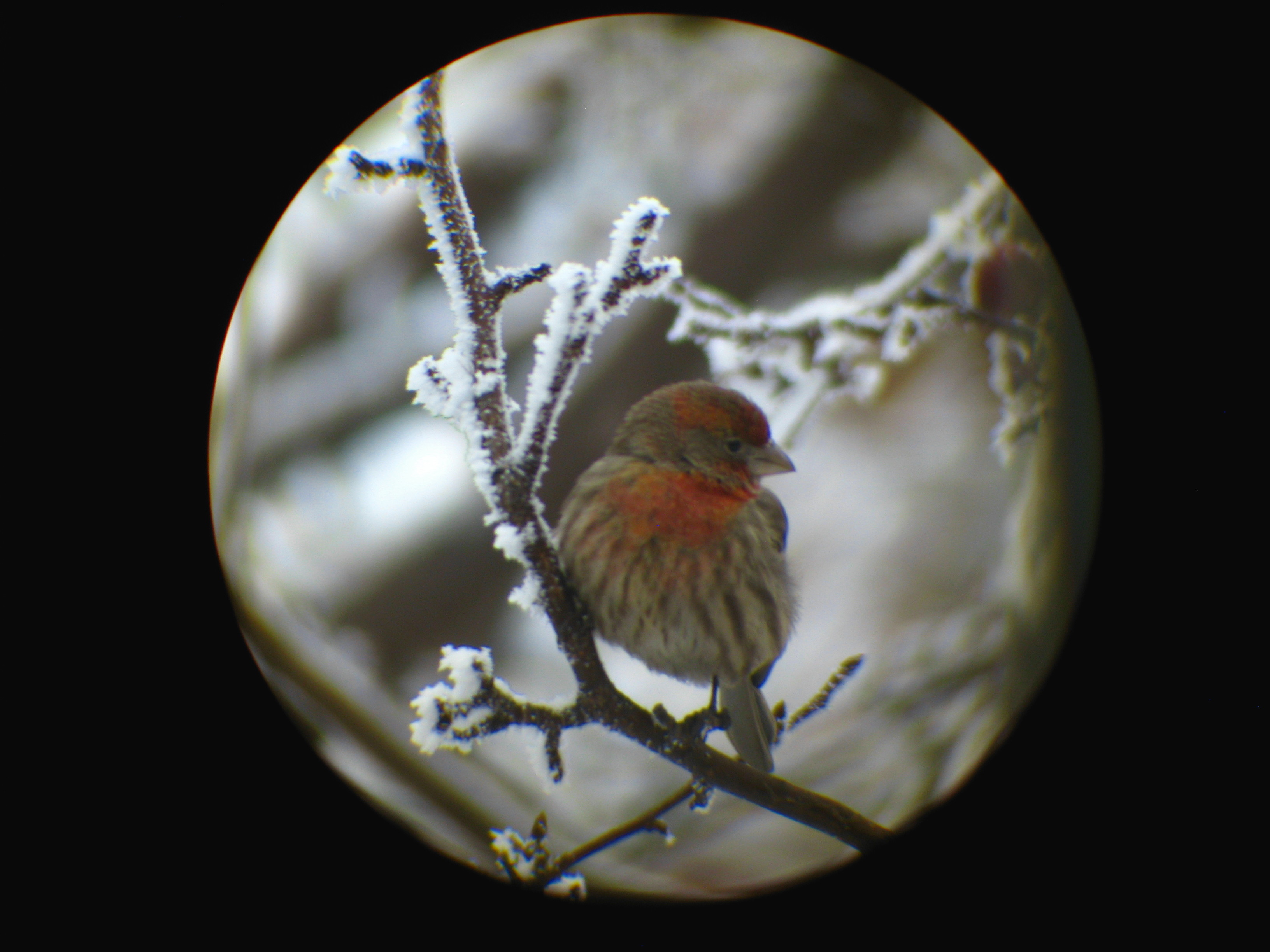
Here is another shot I took (in the winter) of a House Finch, using a point-and-shoot camera held up to my spotting scope.
However, the birds in these examples were only about twenty feet away. I could identify them with the naked eye. If you are dealing with distant waterfowl and shorebirds, the thing to do to get good photographs is to get an adapter that fixes your camera to the scope. Dan Arndt’s outfit, pictured below, consists of :
Pentax K-5 camera with T-mount adapter
Meade ETX-90EC 90mm Matsukov-Cassegrain Telescope
Meade #844 Advanced Field Tripod
Meade Electronic Focuser
Meade MT-64 Camera Adapter
Pentax 39892 Waterproof Remote Shutter Release
Here are some of the amazing photos Dan took this summer at Frank Lake using his digiscoping rig.
You can see all of Dan’s digiscoping pictures on his Flickr page here, and while you’re there, explore all of his other excellent photographs as well.
Posted by Bob Lefebvre
Sunday Showcase: Cooper’s Hawk & Fledglings
Willet (or won’t it)
As colder weather begins to descend upon Calgary, it can be nice to reflect a little bit on some birds that we were familiar with during the summer months.
Many species of birds vary greatly from region to region. The Willet is one of these birds that are highly variable with two distinct subspecies, the eastern semipalmata darker, browner and thicker-billed than the western subspecies inornata that we see both in Calgary, and down here on the Gulf Coast.
A large shorebird with a flashy black-and-white wing pattern seen in flight,  the willet was given its name thanks to its territorial call: pill-will-willet. A very vocal bird, the Willet, as biologist William Vogt wrote many years ago, has another call, a ringing kaaaty. When William Vogt studied a breeding pair of Willets back in 1938  he couldn’t help but call them Will and Kate, thanks to their calls.
Several years ago, before I was a big birder, I traveled out east for vacation. I observed my first Willet out there and now I have the chance to compare photographs of eastern and western Willets.
While the shots of the Western Willets are winter plumaged birds, you can still see the smaller size, darker color and stouter bill in the eastern Willet pictured above.
I always find regional variations in birds intriguing and the Willet is a bird with an easily visible difference, making it a good subject to view and compare from the east to the west.
Posted by Matthew Sim
Rare Bird Alert Calgary: Sept 23
Have you seen an unusual bird in Calgary? If it is on this Reportable_Birds (PDF), please report it to the Nature Calgary Rare Bird Alert line at 403 221-4519 and leave a message after the beep at the end of the recording. If you would like some help with species identification, us email us at zoxox@shaw.ca To report injured wildlife call the Calgary Wildlife Rehabilitation Society at 403 239-2488, or the Alberta Institute for Wildlife Conservation at 403 946-2361.
This report was prepared on Thursday September 22.
September 18
— BLACK-NECKED STILT (20), Weed Lake, Terry Korolyk
September 21
— COOPER’S HAWK, Hull’s Woods, Fish Creek Provincial Park, TK
–AMERICAN GOLDEN-PLOVER, Weed Lake, Ilya Povalyaev
The next scheduled update of the Bird Alert is on Monday September 27.
BIRD STUDY GROUP:
Bird Study Group meets 1st Wednesday of the month, Room 211, BioSciences Building, U of C
October meeting is Wednesday, October 5. Birds of Prey – presented by Alberta Institute for Wildlife Conservation. Meeting time is 7:30pm.