Must-see Birds: August

August means migration for many birds here in Calgary while others are having a second brood of young ones or are concentrating on raising their first brood. This month’s birds are:

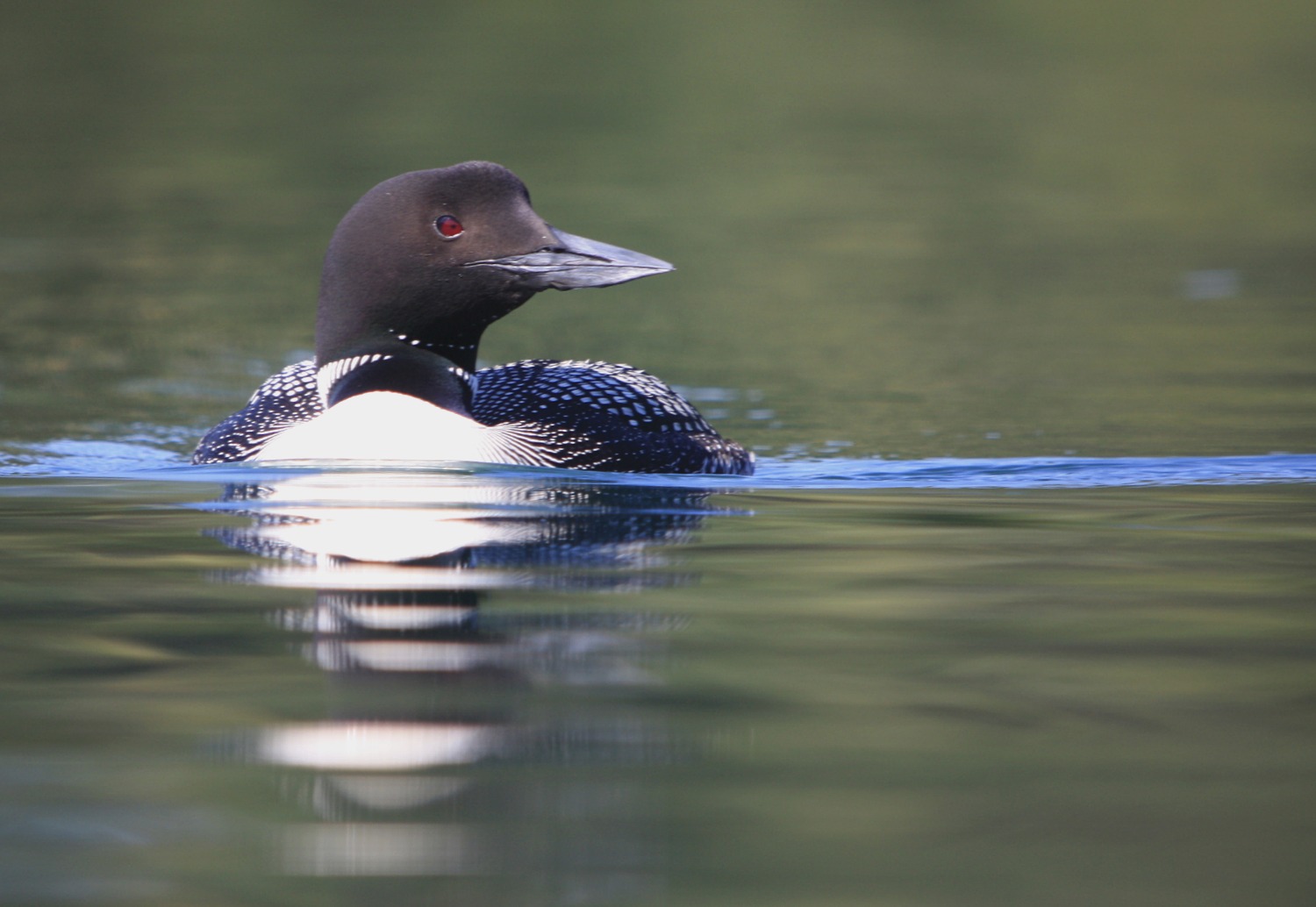
1. Common Loon

Best known for its lonely echoing calls that are considered by most people to be heard in unspoiled wilderness. The Common Loon has a seemingly star-studded back, a white necklace and a bright red eye that stands out in the right light. The Common Loon can stay underwater for long periods, up to a minute while feeding and longer if the bird is escaping from danger. Common Loons inhabit clear, open lakes where there are few people and plenty of fish. They can be seen in the mountains, foothills, parkland and boreal forest but are few in the grasslands.

2. Western Meadowlark

A stocky bird with a grayish brown back and a yellow breast with a black V on the bib, the male Western Meadowlark delivers a rich melodious song from posts in the grasslands. The Meadowlark breeds where there is a thick growth of weeds and grasses, laying 3-7 white eggs. The male bird is beautiful and defends his territory with various displays. Look for the Meadowlark in grasslands around Calgary.

File:Western Meadowlark.jpg

Image courtesy Wikipedia

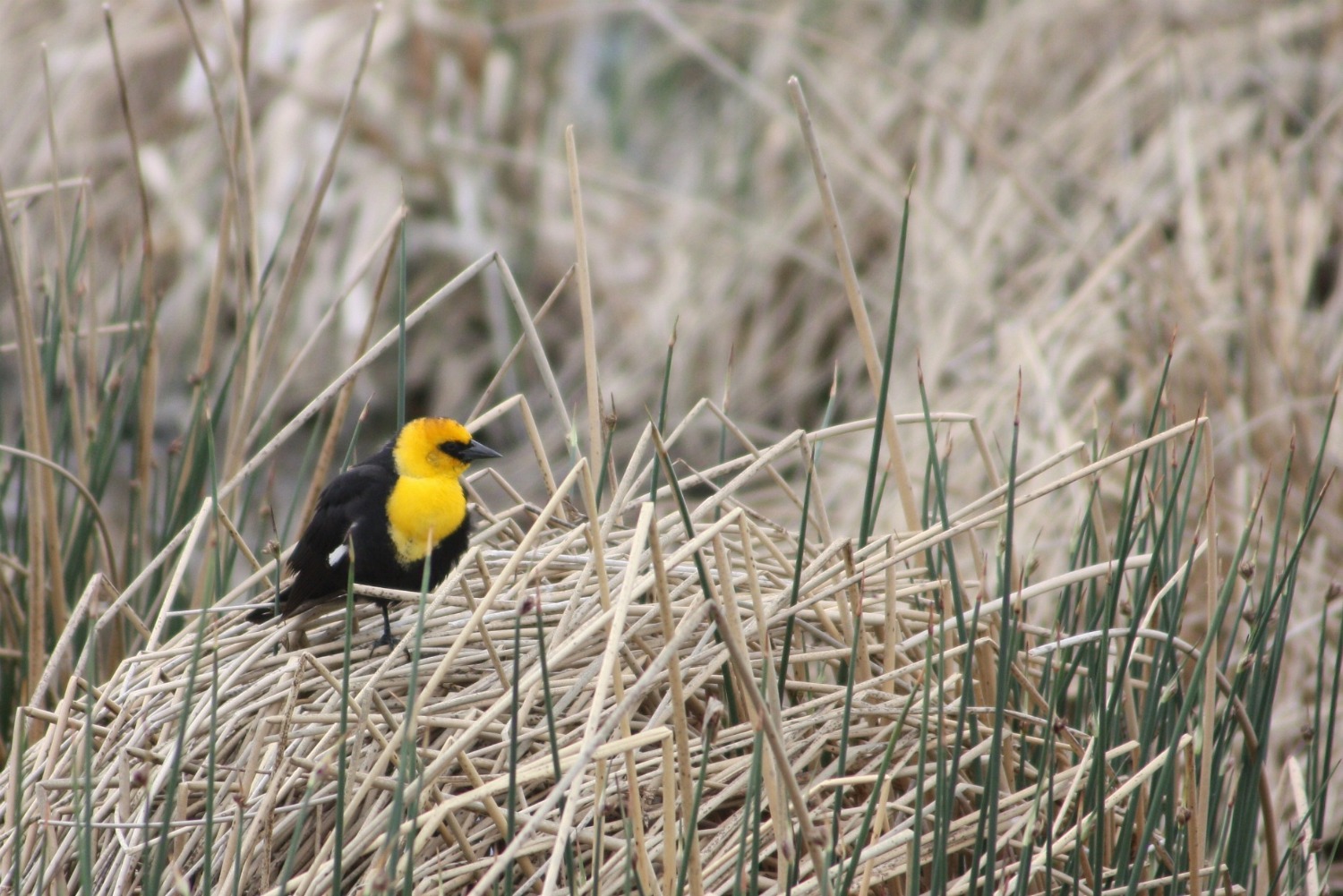
 3. Yellow-headed Blackbird

Our third bird is the loud and noisy Yellow-headed Blackbird. The male is easily recognized by his bright yellow head and neck, black eye patch and white wing patch. the female is brown and mottled with a faint yellow head. The Yellow-headed Blackbird nests in the same marshes as Red-winged Blackbird and will displace the smaller Red-winged Blackbird from the prime nesting spots. The yellow-headed Blackbird is easy to see at Frank lake.


4. Black-crowned Night-Heron

A small stocky heron that at times appears to have no neck, the Black-crowned Night-Heron has a greenish black crown and long slender white head plumes. Most active at night, the Black-crowned Night-Heron was not observed in Alberta until 1958; it is now a local breeder. these herons colonize large bodies of water with dense emergent vegetation; I have seen them at Frank lake every time I have gone there during the spring and summer.

5.  Peregrine Falcon

Our final bird this month is the speedy Peregrine falcon.One of the swiftest birds in the world when diving at prey, it can attain speeds of over 300km/h when diving. The adults are blue-grey above with barred underparts and a dark head with thick sideburns. One of the most widespread birds in the world, the name peregrine means ‘wanderer’ and the Peregrine falcon has one of the longest migrations of any North American bird. Look for this fast falcon nesting on the U of C campus and at shorebird concentration spots like Weed lake, where a Peregrine will hunt the migrating shorebirds.

File:Falco peregrinus nest USFWS.jpg

Image courtesy Wikipedia

These are our 5 birds for August, see which ones you can find! We will have our final must-see birds post on September 1.

Posted by Matthew Sim

Rare Bird Alert Calgary: July 28

Have you seen an unusual bird in Calgary? If it is on this Reportable_Birds (PDF), please report it to the Nature Calgary Rare Bird Alert line at 403 221-4519 and leave a message after the beep at the end of the recording. If you would like some help with species identification, us email us at zoxox@shaw.ca  To report injured wildlife call the Calgary Wildlife Rehabilitation Society at 403 239-2488, or the Alberta Institute for Wildlife Conservation at 403 946-2361.

This Bird Alert was recorded on Thursday July 28 at 9:50 am.

Bird Sightings:

July 24
AMERICAN DIPPER
RED-NAPED SAPSUCKER (3)
WHITE-CROWNED SPARROW
WHITE-THROATED SPARROW (3)
PINE SISKIN (5) – all seen on a Nature Calgary walk in Votier’s Flats FCPP, Janet Gill, Bernie Diebolt.

July 27
Leucosistic GREAT-HORNED OWL NW of Linden, Twp Rd 314,Rge Rd 261, Corrine Griffin (photos taken).

The next scheduled update of the Bird Alert is on Monday Aug 1.

The Woodpecker Tree

While on my latest bike ride into Fish Creek Provincial Park, I came across one very special tree. I have started calling it: The Woodpecker Tree. Standing proud and tall on the banks of the creek, this poplar tree seemed to be a gathering place for woodpecker food. I abruptly stopped on the dirt path I was riding on because I had heard a Hairy Woodpecker calling. I approached the tree for closer inspection and I was surprised to see 2 Downy Woodpeckers and a large female Hairy Woodpecker. Much to my surprise I heard another Downy Woodpecker calling high up in the tree and I looked up to see a male Downy Woodpecker and a White-breasted Nuthatch. I then heard a tapping coming from the opposite side of the tree and found it to be a male Hairy Woodpecker tapping away. Eventually, my final count of woodpeckers came up to 3 Hairy Woodpeckers, 4 Downy Woodpeckers and the lone White-breasted Nuthatch.

This tree obviously fulfilled the nourishment needs for 7 woodpeckers and a nuthatch. As I continued to watch all these birds, I saw them eating insects, tapping at fungal growths on the tree and investigating sap.

After a dozen of  minutes or so, the woodpeckers started to spread out into the surrounding area to hunt down more food. Yet some of the birds, stayed on the woodpecker tree, clearly enjoying the abundance of good food.

Now, I can’t help but wonder if this is a regular occurrence at this tree, or was it a one-time event?

Posted by Matthew Sim

Rare Bird Alert Calgary: July 25

Have you seen an unusual bird in Calgary? If it is on this Reportable_Birds (PDF), please report it to the Nature Calgary Rare Bird Alert line at 403 221-4519 and leave a message after the beep at the end of the recording. If you would like some help with species identification, us email us at zoxox@shaw.ca  To report injured wildlife call the Calgary Wildlife Rehabilitation Society at 403 239-2488, or the Alberta Institute for Wildlife Conservation at 403 946-2361.

This report was prepared on Monday July 25.

May 14
— GRAY FLYCATCHER, Jasper NP (first record), report by Jason Rogers

July 23
— GREATER YELLOWLEGS, Weed Lake (Langdon), various observers
— LESSER YELLOWLEGS, same
— SANDERLING, same
— SEMIPALMATED SANDPIPER, same
— BAIRD’S SANDPIPER, same
— PECTORAL SANDPIPER, same
— STILT SANDPIPER, same
— SHORT-BILLED DOWITCHER, same
— LONG-BILLED DOWITCHER, same
— RED-NECKED PHALAROPE,same
— SHORT-EARED OWL, Weed Lake, Chris & Ken Havard

July 24
— BONAPARTE’S GULL, Ralph Klein Park (Calgary), Terry Korolyk

The next scheduled update of the Bird Alert is on Thursday July 28.

Bird Profile: Red-tailed Hawk

Chances are you have seen this species before; this large hawk is one of the most widely distributed, numerous and commonly observed raptors in Canada. With a wingspan of up to 1.4m (58”) the Red-tailed Hawk is a highly variable buteo; soaring hawks that have wide tails and long, broad wings. Circling high up in the air, the Red-tailed Hawk can see mice scurrying about on the ground from 30 m (100ft) up .

This particular hawk in the photo appears to have done just that; he saw a mouse and then caught it, bringing the unfortunate rodent away to eat it, flying right over my head in the process of carrying off the mouse.

As mentioned before, the Red-tailed Hawk is a highly variable hawk with at least 14 recognized subspecies; ranging from the dark ‘Harlan’s Hawk’ to the ‘Krider’s Hawk’, a very pale subspecies of the Red-tailed Hawk.

Red-tailed Hawks love woodlands near open country; therefore, their habitat is diverse and they can be seen almost anywhere in Calgary. In summer, we tend to see light-colored morphs of the Western calurus the most and in migration and winter, we usually see dark morph ‘Harlan’s Hawks’. Also, in the southern part of Alberta, we have some krider’s Red-tailed Hawks. However, no matter what subspecies you see, they are still very impressive, especially when you get a good look at those talons!

Posted by Matthew Sim

Autumn Birding Course

The best way to learn about birds in Calgary is to get out in the field with an experienced teacher.  The Friends of Fish Creek Park Society offers birding courses throughout the fall, winter and spring.  The weekly two-and-a-half-hour sessions are led by lifelong naturalist Gus Yaki and consist of field trips to various local natural areas.

You can attend Monday, Tuesday or Thursday mornings (the Saturday course is now full).  The cost is $50 for fourteen weekly sessions for Friends of Fish Creek Members, and $75 for non-members.  A membership costs $25.  See the poster here.   For information or to register, email chris@friendsoffishcreek.org  or call Chris at 403-238-3841.

Rare Bird Alert Calgary July 21

Have you seen an unusual bird in Calgary? If it is on this Reportable_Birds (PDF), please report it to the Nature Calgary Rare Bird Alert line at 403 221-4519 and leave a message after the beep at the end of the recording. If you would like some help with species identification, us email us at zoxox@shaw.ca  To report injured wildlife call the Calgary Wildlife Rehabilitation Society at 403 239-2488, or the Alberta Institute for Wildlife Conservation at 403 946-2361.

This report was prepared on Thursday July 21.

July 17
— LONG-BILLED CURLEW, NW of Beiseker, Ron Kube
— PACIFIC WREN, West of Sibbald Meadows Road, Bill Wilson
— FOX SPARROW, Highwood Pass, BW

July 18
— SPOTTED TOWHEE, Votier’s Flats (Calgary), Matthew Sim
— RED CROSSBILL, Willow Park (Calgary), MS

July 20
— SANDERLING, Weed Lake (Langdon), David Pugh
— CASPIAN TERN, Glenmore Reservoir, Terry Korolyk

The next scheduled update of the Bird Alert is on Monday July 25.

Rare Bird Alert Calgary: July 18

Have you seen an unusual bird in Calgary? If it is on this Reportable_Birds (PDF), please report it to the Nature Calgary Rare Bird Alert line at 403 221-4519 and leave a message after the beep at the end of the recording. If you would like some help with species identification, us email us at zoxox@shaw.ca  To report injured wildlife call the Calgary Wildlife Rehabilitation Society at 403 239-2488, or the Alberta Institute for Wildlife Conservation at 403 946-2361.

This report was prepared on Monday July 18.

Bird Sightings

July 13
— GREAT EGRET, Silver Lake, east side of Hwy 2 about 4 km. north of Nanton (or 1 km. north of Mosquito Creek), Gus Yaki

July 16
— OVENBIRD, Fish Creek Provincial Park west of bridge 7, Bill Wilson

July 17
— WHITE-RUMPED SANDPIPER, Ralph Klein Park, north side of Glenmore Trail and just east of 84th St., Terry Poulton and Grant Danielson
— PACIFIC WREN, Sibbald Meadows Pond, Sibbald Creek Trail (Hwy 68), BW

The next scheduled update of the Bird Alert is on Thursday July 21.

Sunday Showcase: Birds In Calgary

More wonderful photos sent to us by Terry Chiddy. Click on the images for a larger view. Enjoy!

Lesser or Greater Scaup?

American Wigeon

Common Loon

Red-winged Blackbird, American Crow

Bird Profile: Red-winged Blackbird

Up here in the northern part of the continent, we know when spring is here when the robins arrive. These are not the only harbingers of warmer days however; the Red-winged Blackbird heralds the arrival of spring as well, the males arriving before the females to claim their territory.

One of the most abundant and widespread birds in North America, the male is a striking bird; all-black plumage save for his bright red and yellow wing epaulets. The female is a heavily streaked brown bird with a light streak over the crown and above the eye. Males have harems of females living in their marshes, these harems can sometimes number up to 15, but up to one half of the nestlings turn out to be sired by a male other than the territorial bird. During the breeding season, Red-winged Blackbirds are rarely seen far from water and are communal nesters, often nesting alongside other species of blackbirds. Once nesting is over, the Red-winged Blackbird forms flocks and go out to forage over the countryside, returning to marshes to roost at night.

Red-winged blackbirds are a common victim of the parasitic Brown-headed Cowbird but this does not seem to affect the former`s numbers. The young are mostly fed insects, and this is exactly what the female Red-winged Blackbird pictured above is doing; she is feeding insects to a fledgling hidden in the grass. The male does a remarkable job and helps feed  the fledglings in is territory; there can be quite a few young birds to feed!

Red-winged Blackbirds may be seen at any marsh, lake or pond in Calgary with cattails and bulrushes. Don`t forget to listen; you can always tell if there is a Red-winged Blackbird nearby if you can hear the males distinctive “Conk-la-ree“ song.

Posted by Matthew Sim