Grebes, grebes, grebes

Grebes are a worldwide family of aquatic diving birds with lobed toes, making them strong swimmers. There are 22 species of Grebe found across the world with 6 of those being found here in Alberta. Grebes are very clumsy on land and therefore spend most of their time on the water, staying there to feed, sleep and court. One of the oldest living family of birds, they can dive down 6m below the surface and can remain submerged for up to 30 seconds, where they search for small fish, aquatic insects and crustaceans to eat.

Of the 6 species of Grebes that live in Alberta, 5 of these can be seen in the Calgary region; above is the Horned Grebe, an attractive grebe that may be seen in Calgary on the Mckenzie Towne Ponds, which is where I saw this one last week.

Similar to the Horned Grebe is the Eared Grebe which can be distinguished from its close relative by its yellow feathered “ears” instead of compact “horns”. I find that one of the best places to see Eared Grebes is at Frank Lake, near High River.

The Western Grebe, together with Clark’s Grebe (which is only seen in the far south of Alberta), is a very large grebe. Below, is a procession of birds; from left to right; first is an Eared Grebe, then a Western Grebe, followed by another Eared Grebe and another Western Grebe. After that is a Franklin’s Gull and an Eared Grebe bringing up the rear.

The Pied-billed Grebe is the most common grebe in North America; it is also very intelligent. When apprehensive, the Pied-billed Grebe will sink slowly, expelling air from the body and feathers to lower their gravity, then they will swim with only their head above the water, facilitating an escape if need be. The adult Pied-billed Grebe is similar to the juvenile (juvenile below), except it will have uniformly colored cheeks and a black ring on its beak.

The last Grebe that can be seen in Alberta is the Red-necked Grebe, a large noisy bird with a broad black crown, white cheek patches and chestnut neck.

Grebes are a very varied family of birds and all are beautiful; makes sense when you find out that they are related to loons; a family of birds that amaze many people!

Posted by Matthew Sim

Must-see birds: June

June is another great month to go birdwatching, migrants can still be seen during the early parts of the month and the summer residents have started to settle down.  In June, the first fledglings appear, learning to survive and to fly. Our list for the month of June contains a varied list of species, some beautiful and others simply impressive.

1. Ruddy Duck

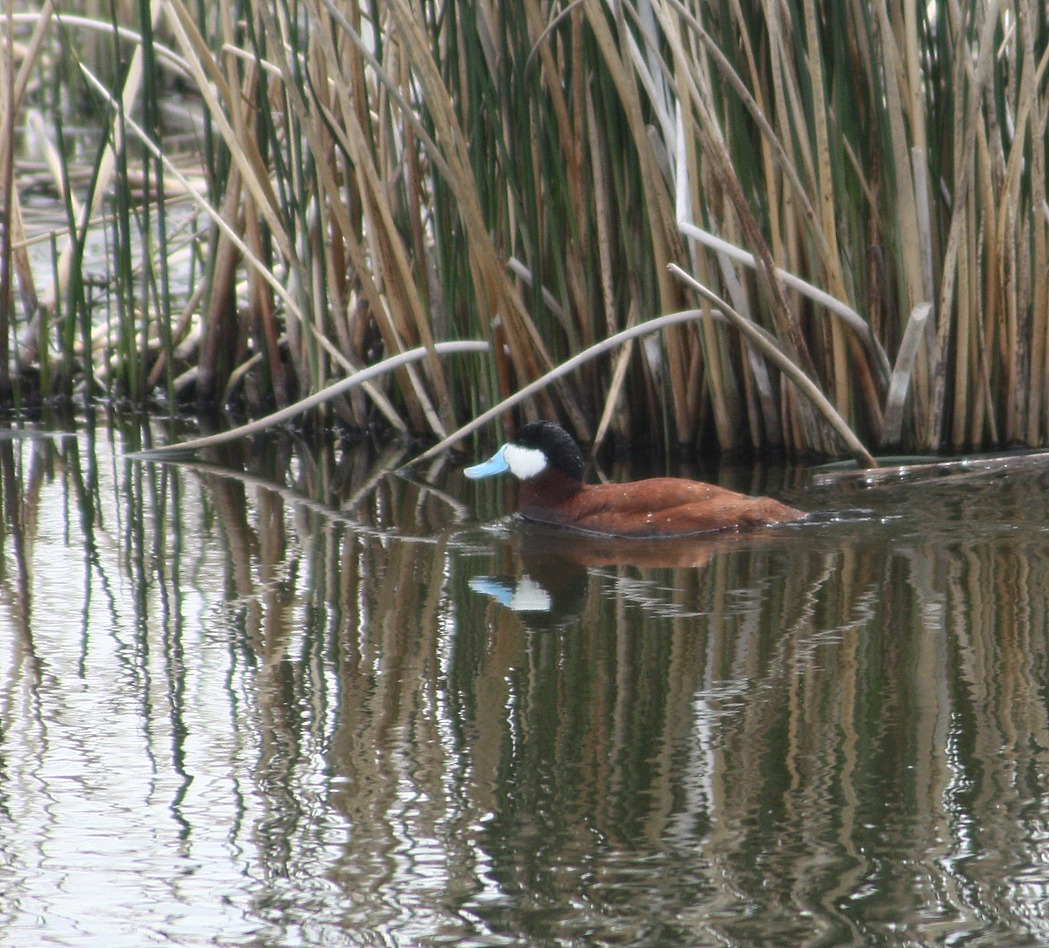
A small diving duck, the male Ruddy Duck has a black cap, white cheeks, a reddish body and a bright blue bill, rendering it a colourful duck. The female is dark brown above and lighter below with white cheeks and a gray bill. When disturbed, the Ruddy Duck will be more likely to dive then to fly. The Ruddy Duck may be seen at Frank Lake, which is where I see many Ruddy Ducks.

2. Mountain Bluebird

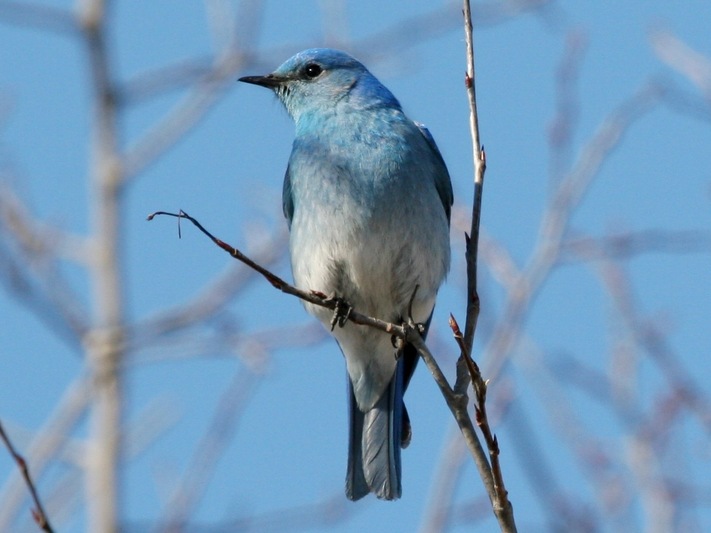
The male Mountain Bluebird is a beautiful sky-blue passerine from the thrush family. The female is brownish grey above and grey below, with some blue on the wings, rump and tail. A truly brilliant bird, the bluebird made it onto the list with ease. Look for Mountain Bluebirds in the Cochrane area or the Water Valley area in June. You can also visit the Ellis Bird Farm near Red Deer which is dedicated to the conservation of many birds, the Mountain Bluebird being one.

3. Great Horned Owl

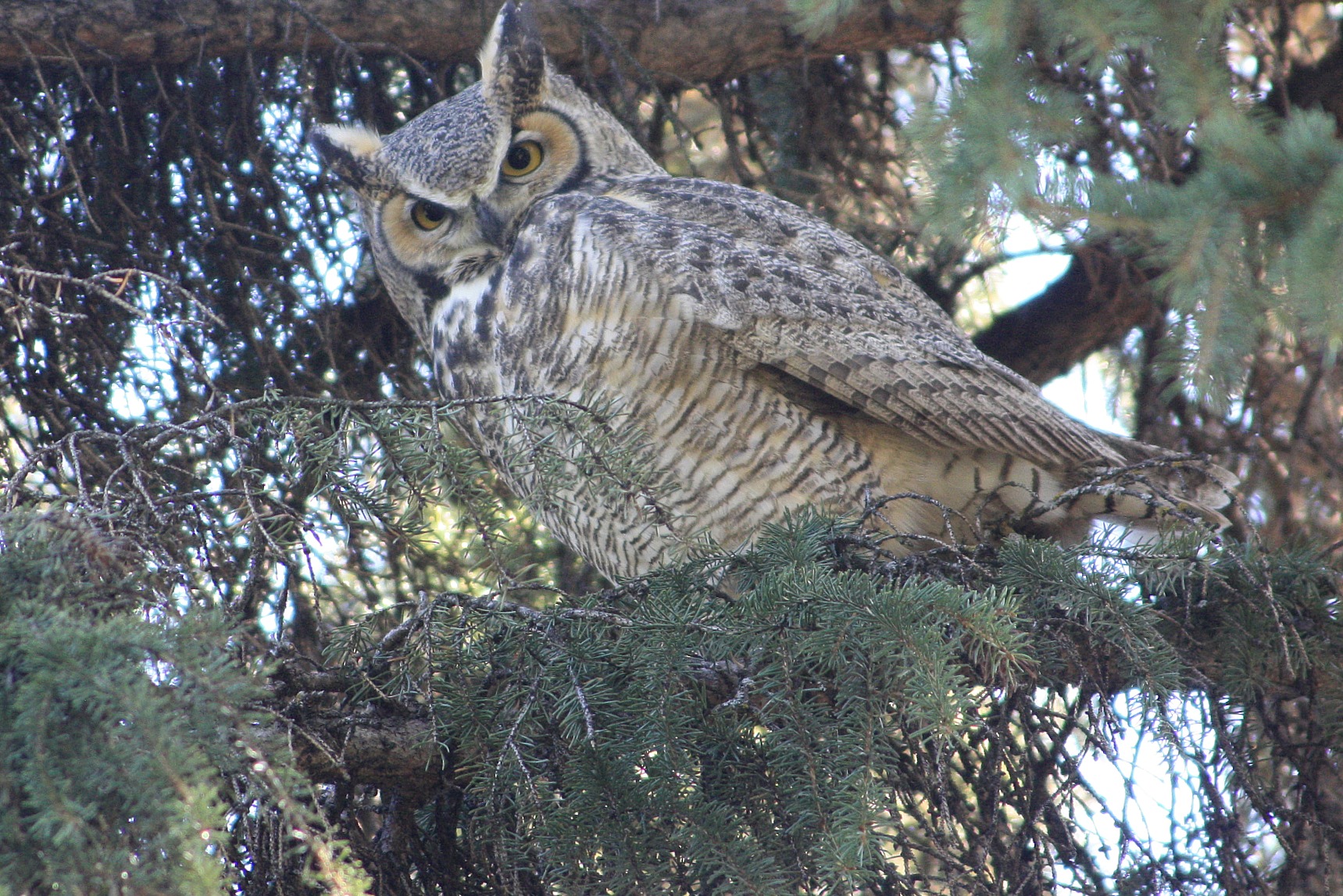
The Great Horned Owl is a widespread owl throughout much of North America but never fails to impress thanks to its large size and regal composure. It has been described as the fiercest,  most aggressive and most impressive owl of North America. The Great Horned Owl is also the official provincial bird of Alberta. There are many different places to see this large owl, there is currently a nest in the Sikome area of Fish Creek.

4.  Spotted Towhee

A member of the sparrow family, the Spotted Towhee is rather inconspicuous, except in the summer when the male can be found singing his distinctive call; one or two short introductory notes followed by a fast trill. The song may sound like the bird is singing, ‘drink your tea’. The best places to see the Spotted Towhee in Calgary are in the Weaselhead and in Votier’s Flats, in Fish Creek.

File:Pipilo maculatus.jpg

Image courtesy Wikipedia

5. Rufous Hummingbird

Our last bird for the month of June is the Rufous Hummingbird, a bird with fiery colors and a fiery temper. The male has rufous coloring on his back, sides, flanks and tail while his crown is glossy green. The male Rufous Hummingbird is very aggressive and territorial and will use many different displays to protect his territory. Look for this hummingbird in  the Weaselhead or on the Many Springs Trail in Bow Valley Provincial Park, west of the city.

File:Selasphorus rufus on Saltspring Island.jpg

Image courtesy Wikipedia

Which of these birds can you find? Feel free to send us your photos and stories, they may make it up on the blog!

Posted by Matthew Sim

How To Help Baby Birds

We’re fast approaching the season where this is a popular question. See this excellent article on the 10,000 Birds blog that answers a myriad of baby bird questions!

Oranges for Orioles

For the last couple of years I have been putting out slices of oranges in my yard in the hopes of attracting Baltimore Orioles or Gray Catbirds.  I place the oranges on my tray feeder and in suet cages.  So far this has attracted only ants.  Last Friday morning, I thought that perhaps the heavy rain might force some migrants down, so I put out two fresh orange halves on a flower planter.  Within a half hour of arriving home in the afternoon, I looked out to see this bird feeding on the orange.

This first-year Baltimore Oriole stayed around the yard for two days, feeding on all the oranges, including the ones in the suet cage that I had placed there about two weeks before.

So if you want to see a Baltimore Oriole in your yard, putting out oranges really does work.  Now I’m just waiting for that Catbird.

Posted by Bob Lefebvre

Rare Bird Alert: May 30

Have you seen an unusual bird in Calgary? If it is a species on this  Reportable Birds (PDF), please report it to the Rare Bird Alert line at 403 221-4519 and leave a message after the beep at the end of the recording. If you would like some help with species identification, us email us at zoxox@shaw.ca  To report injured wildlife call the Calgary Wildlife Rehabilitation Society at 403 239-2488, or the Alberta Institute for Wildlife Conservation at 403 946-2361.

This report was prepared on Monday May 30.

May 27
— ARCTIC TERN, Cattleland Slough, Yousif Attia, Ilya Povalyaev
— LAZULI BUNTING, southwest Calgary, Margaret Brunner, Rob Shifanski(?)

May 28
— PACIFIC LOON, Cold Lake, Tom Hince & Paul Pratt
— TURKEY VULTURE, Fish Creek PP, Gus Yaki group
— SABINE’S GULL 80+, Cold Lake, TH & PP
— ARCTIC TERN, Cold Lake, TH & PP
— COMMON NIGHTHAWK, Wyndham – Carseland PP, Andrew Hart
— YELLOW-BELLIED SAPSUCKER, Mallard Point (Calgary), Bill Wilson
— OLIVE-SIDED FLYCATCHER, Confederation Park (Calgary), BW
— WESTERN WOOD-PEWEE, Fish Creek PP, GY

May 29
— VIRGINIA RAIL, Eagle Lake, Lenora & Dick Flynn
— SABINE’S GULL 9, Frank Lake, Ian Halladay, Bruce Barnetson, Dave Gibson
— COMMON NIGHTHAWK, Carburn Park (Calgary), Louise & Michael Geldorp

The next scheduled update of the Bird Alert is on Thursday June 2.

Backyard Birds: Tufted Finches

House Finches are the ‘new kids on the block’ in Alberta, and a favorite of many back yard bird watchers.

These colourful little birds were originally found only in the southwestern United States and Mexico. In the 1940’s a small number were imported to New York, in an attempt to sell them as caged birds called “Hollywood Finches.” The business venture failed, and the birds were released on Long Island. They quickly started breeding, and now the two populations have spread across almost all of the United States and southern Canada.

The first Alberta birds were reported from the mountains in the 1960s. Sightings expanded to Calgary in the early 1970s, but significant populations did not develop until the late 1990s. Now these melodic singers are found throughout the city.

House Finches have received a much warmer welcome than the introduced House Sparrows or European Starlings. People love the cheerful red head and breast of males, and their long, twittering song brightens up any rainy day. These birds have also managed to survive Canadian winters, and are common feeder birds throughout our cold months, bringing a welcome splash of colour to the yard.

Most of the males are red, but House Finches can also come in orange…


Or yellow…


And a few times a year, they come with tufts!

House Finches have two or more broods each year, and each clutch has 4 or 5 eggs. This not only explains why they have colonized the continent so quickly, it also accounts for the appearance of the tufted juvenile finches in my yard throughout the year. Most birds feed their young insects for the protein content, but House Finches feed their chicks vegetable matter and seeds. Backyard bird feeders with their regularly available seeds have also helped them conquer the continent.

It’s no wonder bird watchers like House Finches – they’re an ongoing challenge to identify. The female looks like a member of the sparrow family, the males come in a variety of bright colours depending on their diet, and the tufted juveniles look like a separate species altogether.

The Cornell Lab of Ornithology estimates the current House Finch population to be somewhere between 267 million and 1.4 billion individuals. It seems safe to say we will have these colourful singers in Calgary for the foreseeable future!

Posted by Pat Bumstead

Yellow House Finch Picture by Bob Lefebvre

Sunday Showcase: Wood Ducks

These beautiful photos were sent to us by Rob English. Thanks for sharing! (Click images for a larger view).

Rare Bird Alert: May 26

Have you seen an unusual bird in Calgary?

If it is a species on this Reportable_Birds (PDF), please report it to the Rare Bird Alert line at 403 221-4519 and leave a message after the beep at the end of the recording. If you would like some help with species identification, us email us at zoxox@shaw.ca  To report injured wildlife call the Calgary Wildlife Rehabilitation Society at 403 239-2488, or the Alberta Institute for Wildlife Conservation at 403 946-2361.

This report was prepared on Thursday May 26.

May 19
— STILT SANDPIPER 4, pond east of Hwy 817 north of Strathmore, Isobel Anderson & Nimali Seneviratne
— LONG-BILLED DOWITCHER, Boundary Rd near Weed Lake, IA & NS

May 23
— SNOW GOOSE 2, Twp Rd 312 near Linden, Corrine Griffin
— SABINE’S GULL adult, Glenmore Reservoir, Bill Wilson (also seen by Terry Korolyk)

May 24
— EURASIAN WIGEON male, Glenmore Res, Yousif Attia & Ilya Povalyaev
— WHIMBREL, Glenmore Reservoir, YA & IP

May 25
— SUMMER TANAGER 2nd year male, photographed, Cypress Hills PP, Jeremiah Kennedy — if accepted this will be the 6th record for Alberta

The next scheduled update of the Bird Alert is on Monday May 30.

Local gems: Fish Creek

Most of us take Fish Creek Provincial Park for granted. We are, however, extremely lucky to have such a gem of a park in our city. One of the largest urban parks in the world at 13.48 square kilometers (5.2 square miles), Fish Creek has over 80 kilometers of trails, 30 of which are paved and encompasses three natural regions; grasslands, parkland and foothills forest.

The Glennfield area of Fish Creek is one of the many different sections of this amazing park.

The Bow river cuts through Fish Creek attracting fishermen, rafters and birds, lots of birds. Fish Creek is a haven for birds in a busy and bustling city, leading birds to flock here; more than 200 species of birds have been recorded here. Stretching through southern Calgary, Fish Creek also provides an easily accessible hotspot for birders.

There are many different sections of Fish Creek, some of the more well-known being Votier’s Flats, Mallard Point and Sikome Lake (a recreational lake that thousands of Calgarians visit each summer).

Canada Geese are common throughout Fish Creek.

 The Tree Swallow’s blue-green upper parts separate it from other species of Swallow.

Nature Calgary has many field trips to various parts of Fish Creek, see if you can attend one; you may find a very good bird.

Sat June 4, 8:30am: Birding Hull’s Wood FCPP, turn left off Bow Bottom Tr SE shortly after entering the park. Meet West end of parking lot. Leader, Howard Heffler, 403-284-2961.

Sun June 5, 8am: Birding Marshall Springs to Votier’s Flats area, FCPP. Meet at Marshall Springs parking lot on the south side of FCPP, just East of Sanderson Ridge condos, on North side of Fish Creek Blvd. Leader, Grant Brydle, 403-270-4957.

For more information on Fish Creek Park and to volunteer as well as participate in many activities, visit the Friends of Fish Creek at

http://friendsoffishcreek.org

Cinnamon Teal may be seen in Fish Creek.

Posted by Matthew Sim

Nature Calgary’s Big Day

Update:  Results of the Big Day

The day started off well, but the weather gradually deteriorated, and by 4:30 in the afternoon, with cold driving rain, and after eleven hours of birding, we decided to stop.  The total for the group was 93 species.  I saw or heard 88 of them, so I’ll have to try another time to reach 100 species in a day.  Due to the weather we missed almost all shorebirds and warblers.

We went to the following locations:  Votier’s Flats, Bow Valley Ranch and Sikome, all in Fish Creek Park; Inglewood Bird Sanctuary; Elliston Park; Ponds one mile west of Shepard; Shepard; Shepard Slough (east of Shepard); a series of ponds south of highway 22X in the far SE; a pond just east of Spruce Meadows; the South shore of Glenmore Reservoir.  We didn’t go into the Weaselhead as planned.

Click here for the report, with a list of the species seen or heard, from Albertabird.

————————————————————————————————

How many species of birds do you think you could find within the city of Calgary in a single day?  The answer at this time of year is over 100.  This weekend there will be a great opportunity to see if you can do it.

Birders call this a “Big Day” – an attempt to identify as many species as possible in a twenty-four hour period.  This is often done as a competitive or fundraising activity, usually with teams of birders all trying to get the highest total.

For the past few years, Nature Calgary has offered a guided Big Day field trip every Victoria Day holiday.  It can be a long, hard day, especially in bad weather, but it is a great chance to see most of the bird species present in Calgary in the spring.  This year the trip is on Monday, May 23.  We will meet at Votier’s Flats in Fish Creek Park (at the south end of Elbow Drive SW) at 5:30 am.  From there, the leader, Tony Timmons, will guide us to several different habitats within the city over the course of the day.  Bring a  lunch, and be prepared for whatever weather we might get.

Last year, the group managed to find 111 species!  The highlight of the day was a Virginia Rail calling at a slough in SE Calgary.

Virginia Rail. Photo by Mike Baird, from Wikimedia Commons.

In 2009, in very cold, wet conditions, the total was 108 species.  The birds are out there, so come out on Monday and help us find them!  If you need more information, call the leader, Tony Timmons, at 403-256-0754.  Like all Nature Calgary field trips, it is free and open to all members of the public.

Posted by Bob Lefebvre