This Sharp-shinned Hawk was keeping a close eye on the feeders in this Brentwood yard on November 10, 2012. Photos by Eric White.


This Sharp-shinned Hawk was keeping a close eye on the feeders in this Brentwood yard on November 10, 2012. Photos by Eric White.
Bob Lefebvre photographed these Pikas at Rock Glacier Trail in Peter Lougheed Provincial Park in September 2012. You can see why one of their common names is ‘rock rabbit.’


Posted by Bob Lefebvre
Since the Barred Owl was first reported in the Bebo Grove/Shannon Terrace area of Fish Creek Provincial Park, Tony LePrieur has made many trips there to search for it. After almost two months without success, he finally was able to see and photograph it on December 7. He watched it for almost an hour as it hunted. All photos by Tony LePrieur.


Barred Owl with Meadow Vole.

Barred Owls are uncommon in the area and rarely seen in the city. This one (or another Barred Owl) has been in the Bebo Grove area for the last two winters (they are non-migratory, but I don’t think it has been reported in the summer – likely it nested in another nearby area).
If you go looking for it, please stay on the trails and watch from a respectful distance. Do not try to flush it – Barred Owls are vulnerable to predation, especially from Great Horned Owls, which are also in this area.

On the same trip, Tony was entertained by this Merlin which took a bath in Fish Creek.


Posted by Bob Lefebvre
The Calgary Christmas Bird Count is coming up this Sunday, December 16, and that means that we are now in the Count Week period. Any species which are seen from December 13 to 19, but missed on the count day itself, are included in the database as Count Week birds. Sometimes there are very good birds which are known to be around but can’t be found on count day, and sometimes it’s an unexpected bird showing up before or after the count.
If you see an unusual or out-of-season bird during count week, and it is inside the Count Circle, make a note of the sighting. If the bird is not reported on count day, pass the information about your sighting to Phil Cram, the count coordinator, at crampj(at)gmail.com.

The Count Circle for the Calgary CBC. Note that the circle does not include all of the city.

This Song Sparrow has been hanging out at Votier’s Flats in Fish Creek Park for a few weeks – outside the count circle. Can we find one inside the circle? (Photo by Daniel Arndt)
There have been several sightings of Snowy Owls inside the city recently. This would be a great bird to add either on Count Day or as a Count Week bird.
Posted by Bob Lefebvre
This bird has been in my yard for the last couple of weeks. When I first saw it, on a feeder with its back facing me, I thought it was a new species for the yard, but it turned out to be a male Common Redpoll with some white feathers in its wings and tail.


From some angles it looks normal…


Feeding on the ground…


Next to a normal (if out of focus) Common Redpoll…


Here is the Cape May Warbler that Elizabeth Sargeant had in her yard in SW Calgary last Sunday, December 2. It was feeding with a group of Golden-crowned Kinglets. Needless to say, this is very late for any warbler to be around, but it is the fourth time in the last eleven years that a Cape May Warbler has been reported in Alberta in the winter months (December-February).


You have to be amazingly lucky and very quick with a camera to get a photograph of a wild weasel. Glenn Alexon has managed to snap not one but two excellent portraits of local weasel species.
Here is a Long-tailed Weasel seen by the administration building at the Inglewood Bird Sanctuary on one of our Friends of Fish Creek birding walks, September 9, 2011.
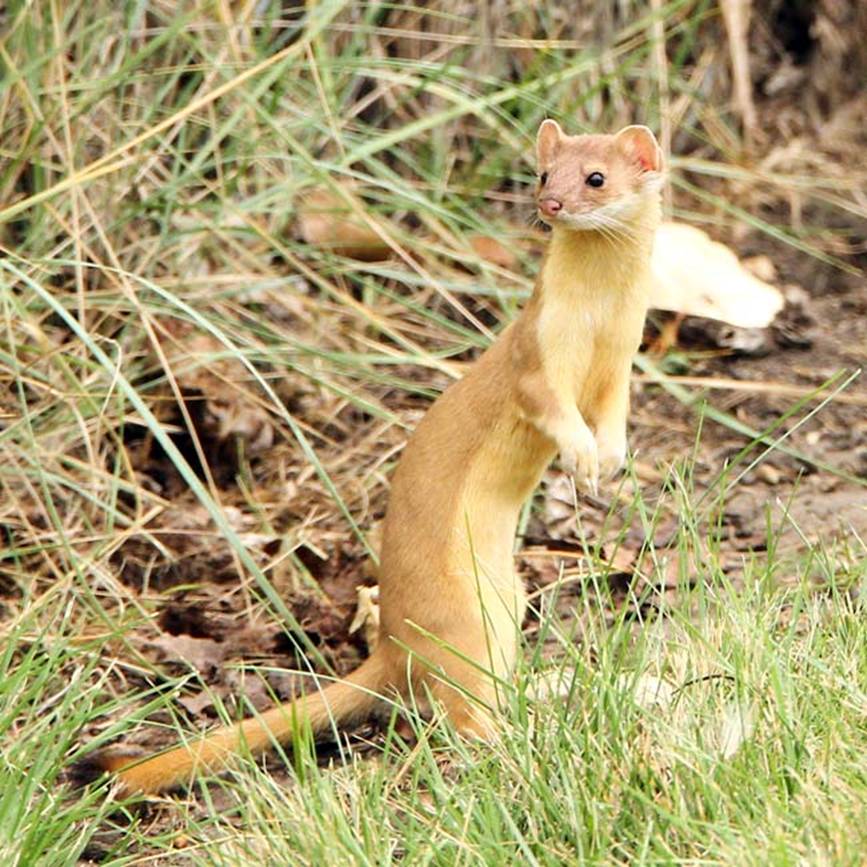
The most widespread weasel in the western hemisphere, Long-tailed Weasels are sleek, long bodied hunters 20-26 cm long, with a tail measuring half to two thirds of their body length. Summer coats vary from rich chocolate to rusty brown, with creamy white to yellowish underparts. Northern populations moult to pure white in winter, but their tail always has a black tip, regardless of coat colour. Southern populations do not change colour in winter.
Living from southern Canada to northwestern Brazil, these animals have the greatest habitat tolerance of any American weasels. They can be found in virtually all habitats, from Arctic-alpine to tropical, and are absent only from true desert and agricultural areas. They are most abundant in open woodland, brushland, and grasses and meadows near water.
Glenn has also managed to photograph a Short-tailed Weasel on the back of Sulphur Mountain in Banff.
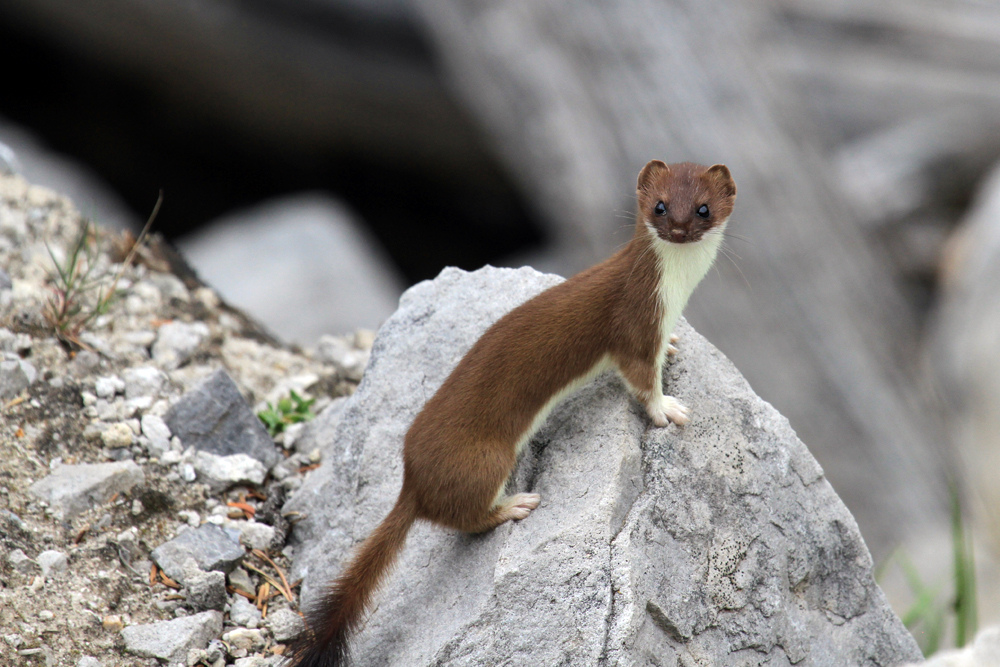
Called Ermine or Stoat in Europe, Short-tailed Weasels measure 17-34 cm. Their coats are rusty to chocolate brown with white undersides, and the tail has a black tip. Northern populations moult to white in the winter, but retain the black tail tip. In North America, they are smaller than the Long-tailed Weasel with a proportionately shorter tail, and the two species occupy the same geographic areas.
Found throughout the northern hemisphere in North America, Eurasia and Greenland, Short-tailed Weasels occur in a wide range of habitats from Arctic tundra to semi-desert, and sea level to 3,000 m. Unlike the Long-tailed Weasel, the Short-tailed can also be found on farmland and pasture, preying on the abundant rodent population.
To see more wonderful wildlife photos from Glenn, have a look at his Wildlife of Alberta Flickr page, and be sure and see the kissing marmot photo while you’re there!
Did you miss Weasel Wednesday? See our most popular post ever here!
Posted by Bob Lefebvre
One way to spice up your winter birding is to keep a list of species seen in the winter months of December, January, and February. It’s fun do do this for yourself, but you can also help contribute to the provincial winter list.
For the past eleven years, Richard Klauke has kept track of all bird species seen by anyone anywhere in the province of Alberta between December 1 and the end of February. It is an excellent resource for anyone birding here in the winter.
See the Alberta Winter Bird List here.
The list has three categories of birds:
The total number of species reported in the last eleven years has varied from a low of 126 (in 2010/2011) to a high of 153 (in 2002/2003). The average is 140. Last winter was a good one, with a total of 148.

House Finch – one of the core winter species
The most productive periods for the winter bird list are the the first two weeks of December, when there are still some lingering migrants, and the last two weeks of February, when some early spring birds begin to arrive. Richard compiles the list from reports on the Albertabird listserv. Starting today, post your sightings on Albertabird and help build the list. For example, if you happen to be in the Votier’s Flats area and see the Song Sparrow and Wilson’s Snipe that have been reported there recently, please post them again to Albertabird. These are core species but may not be around much longer.
As the list builds, check back to Richard’s page periodically, and if you see something that hasn’t yet been reported, post it to Albertabird.

Harris’s Sparrow – a more elusive core winter species (photo by Daniel Arndt)
Some new birders may not belong to Albertabird yet, so if you see something good you could let us know at the blog and we’ll pass it on (include details of date and location). But I encourage all serious birders to join and follow Albertabird. That is where important sightings should be reported so that other Alberta birders know what is being seen and where, and can have a chance to find the birds themselves.
Richard’s page also includes links to winter lists for the other nine provinces, Saint-Pierre et Miquelon, and the Ottawa region. So if you are travelling you can see what to expect.
Update: Already this morning, an Eastern Bluebird has been seen near Medicine Hat! This is the first winter report of this species in the twelve years the list has been kept.
Pat Bumstead still has her three Mourning Doves in her yard too.
Posted by Matthew Sim
I haven’t been able to get out to much birding or photography lately and while this is generally quite disappointing for me, it does hold one positive factor; a chance to look through my archives of bird photos. As I went through my archives this past week, I noticed two photos of loons I had taken at Kikomun Creek Provincial Park this August that had somehow escaped my notice. Here they are, hope you enjoy.


Posted by Bob Lefebvre
This female Hairy Woodpecker has been coming to my backyard feeders occasionally for the last two weeks. It looks like the same bird every time – it has a band on its right leg. This is only the second time I’ve had a Hairy Woodpecker in the yard.


