Tag Archive | calgary birds

Cowbird Catastrophe

The Brown-headed Cowbird has become a menace to songbird populations all over North America. A small, stocky blackbird, the males have glossy black plumage and a rich brown head whereas the females are drab brown birds. What makes the Brown-headed Cowbird such a menace to songbirds is the lazy manner in which they raise their young.  Females will use all their energy over the breeding season to produce eggs, sometimes up to 50 a summer. They lay these eggs in the nests of unwary birds; usually at the cost of the smaller bird’s young. The young cowbirds usually hatch earlier than their foster parents chicks and therefore, get most of the food, which can ultimately lead to the death of the foster parent’s young. The Brown-headed Cowbird parasitizes more than 200 species of birds; the Chipping Sparrow being one of the most hard hit species.

In the above photo, there are 4 male cowbirds all looking up from my bird feeder at the arrival of a juvenile Grackle.

There is a history behind the cowbird’s parasitism. At one time, it followed the buffalo herds across the prairies, a nomad, and therefore could not raise its young, resorting to the help of unwitting songbirds. Following herds of buffalo, the Brown-headed cowbird’s range was limited to plains and prairies. Deforestation and forest fragmentation by humans, however, opened up the way for the cowbird and they started to parasitize more and more species. Due to deforestation, the cowbird has expanded significantly, both in range and in number and it now poses a threat to some species.

Several species, such as the Yellow Warbler, have developed defences against cowbird parasitism and recognize the cowbird egg. The female Yellow Warbler will make a roof over all the eggs, including her own, upon recognizing the cowbird egg. She will then lay her eggs again. Other birds will throw it out of the nest or abandon the nest all together.

This one species goes to show how much human actions can change the world around us.

Posted by Matthew Sim

Photo Feathers: House Finch

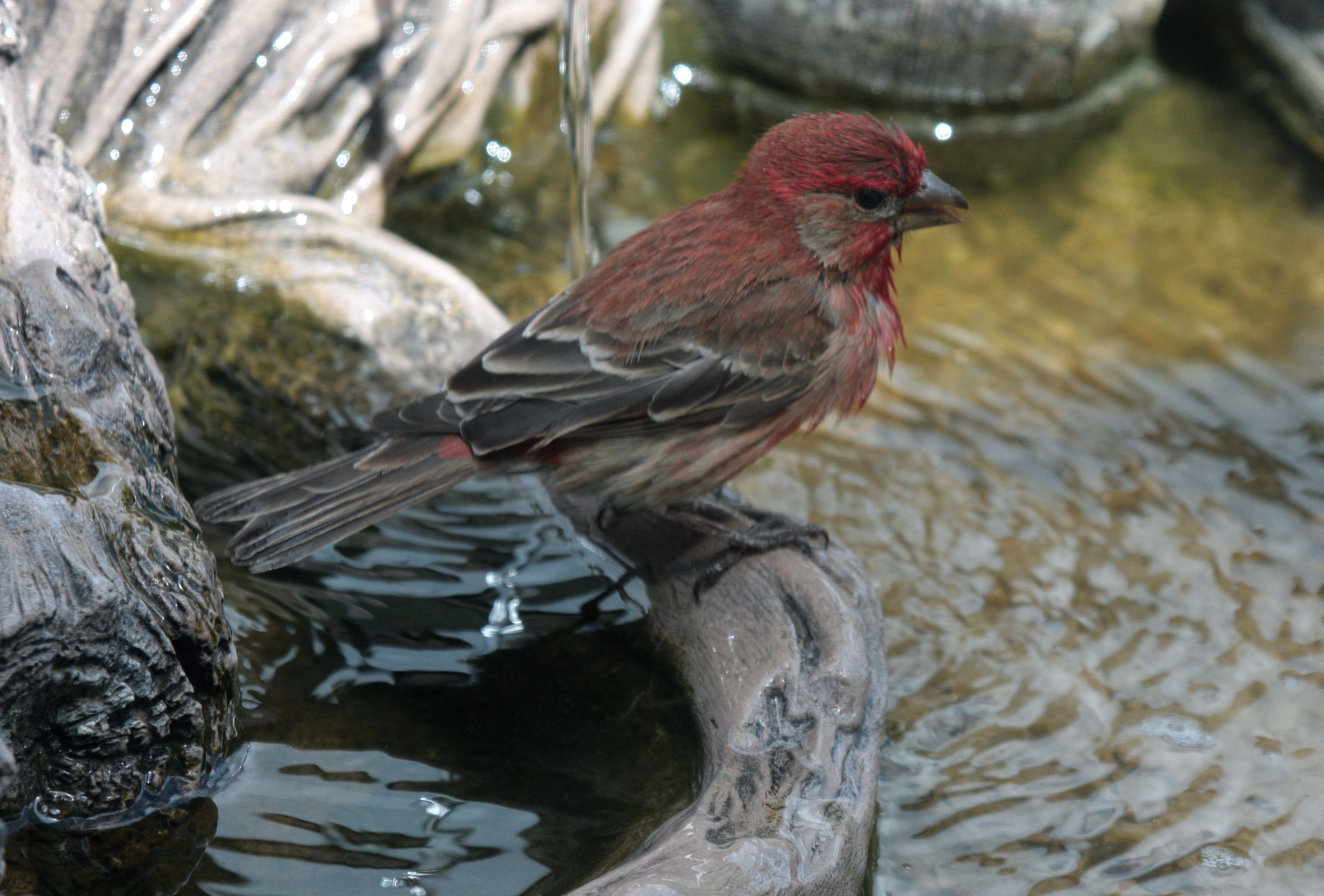
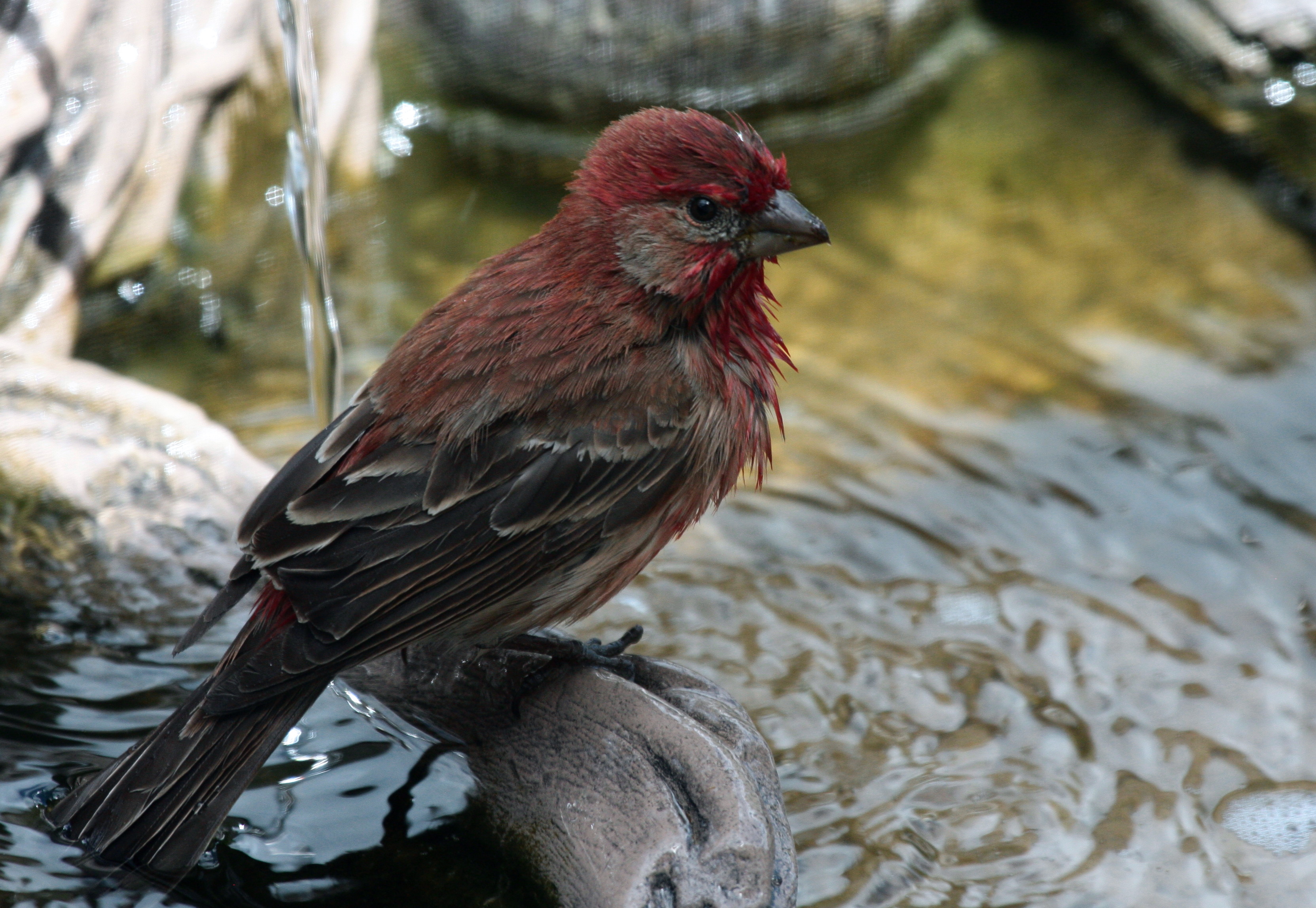
When I first saw this bird I thought it was a Purple Finch.  It has raspberry-red plumage that extends over the top of the head and onto its back like a Purple Finch.  In all other respects it looks like a House Finch, so it is probably just another male House Finch with unusual colouration.


Posted by Bob Lefebvre

Sunday Showcase: Tree Ducks

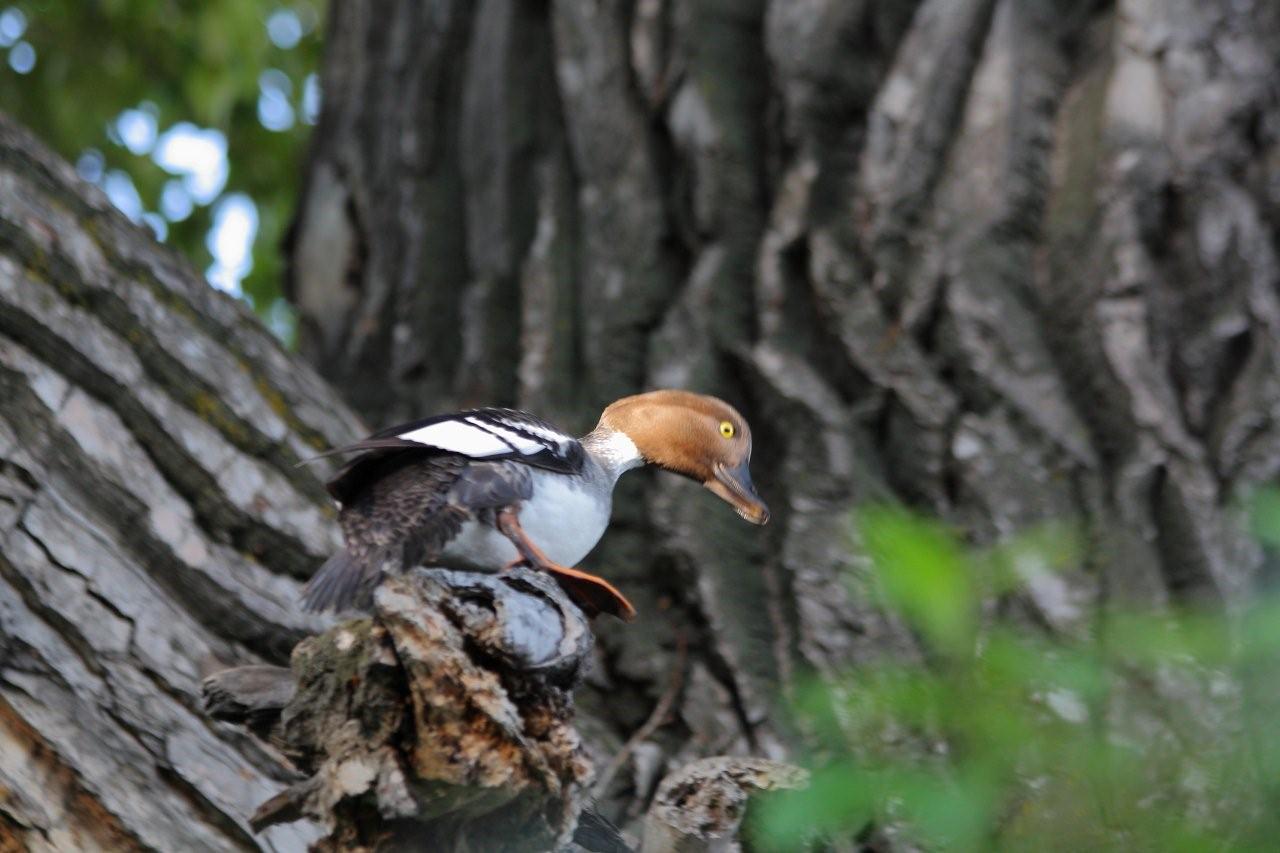
More treasures from Rob English in this series of Common Goldeneye photos. Click on images for a larger view, and enjoy!

Oh What a Canada Day!

Canada Day, last Friday, I rode my bike out to Fish Creek once again to see what I could find. At a storm water pond, I found a total of 9 cute Common Goldeneye ducklings; swimming and diving about.

In Hull’s Wood, I was alerted to a Common Raven and her two young by some loud croaking, the immature birds hungrily calling for food, despite being able to feed themselves.

As I passed by the Bow River, I could hear a Song Sparrow singing and after a quick search, I located this melodious little sparrow.

As I worked my way back to the intersection of Canyon Meadows and Bonaventure Dr. I passed over Bridge #11. As I did so, I could hear a pair of House Wrens scolding me.

I soon found out why I was being scolded. Just beyond the bridge, was a railing, and inside the railing was the Wren’s nest with several young on the inside. The parents flew inside several times to feed the young and it was quite a tight squeeze!

I continued on my way, not wanting to bother the young family. As I came to the last storm water pond between the ranch and the Glennfield area of Fish Creek, I saw an interesting shape in a tree. I stopped my bike, took a closer look, and found the object to be a porcupine! This was great, as I had never seen one before.

Almost out of the park, I saw a perched Osprey near a small path through long grass. I stopped and approached for a closer view… And got absolutely eaten alive by mosquitoes. I added to my bug bite collection by at least 20 in less than 5 minutes!

Oh what a great Canada Day it was!

Posted by Matthew Sim

Wednesday Wings: American Coot Family

More fantastic photos sent to us by Rob English. If you’ve never seen baby American Coots, you’re in for a surprise. Click on images for a larger view, and enjoy!

Movie Monday: First Bath

A fledgling Black-billed Magpie figures out how to use a birdbath.  June 17, 2011.

Posted by Bob Lefebvre

Rare Bird Alert Calgary: June 30

Have you seen an unusual bird in Calgary? If it is on this Reportable_Birds (PDF), please report it to the Nature Calgary Rare Bird Alert line at 403 221-4519 and leave a message after the beep at the end of the recording. If you would like some help with species identification, us email us at zoxox@shaw.ca  To report injured wildlife call the Calgary Wildlife Rehabilitation Society at 403 239-2488, or the Alberta Institute for Wildlife Conservation at 403 946-2361.

This Bird Albert was recorded on Jun 30, 2011.

WEDNESDAY June 29
–HARLEQUIN DUCK (3) – Bow River at Inglewood Bird Sanctuary by Greg Meyer

TUESDAY June 28
–CATTLE EGRET (1) – W of Hwy 4 approximately 1 km from where originally seen on June 27 (see location description below for original sighting) by several Lethbridge birders
–ALDER FLYCATCHER (3) – Porcupine Valley on Nose Hill by Bill Wilson

MONDAY June 27
–CATTLE EGRET (1) – small slough E side of Hwy 4 about 3-4 km S of Hwy 845 junction (SE of Lethbridge) by Jerry Pilny. Sighting one of only about 10 records for the province.

SUNDAY June 26
–UPLAND SANDPIPER (1) – 2 km east of entrance to Frank Lake on Hwy 23 by Peter Roxburgh and four other birders

The next scheduled update of the bird alert is on Monday July 4.

Friday Fun!

See if you can identify the bird in the photograph below; then let us know what you think by posting a comment.

The bird in this photograph is a large, noisy and conspicuous shorebird typical of the prairie sloughs. Do you know what it is? Let us know what you think in the comment section.

Posted by Matthew Sim

5 Must-see birds: July

July is another great month to go birdwatching in the Calgary region. By now, most birds are in the process of raising hungry families while others, such as hummingbirds and certain shorebirds, start their southward migration in late July. Our must-see birds for July are as follows:

1. Western Grebe

Featured before in one of our previous posts (Grebes, Grebes, Grebes), the Western Grebe is a gregarious grebe that is easily recognized thanks to its contrasting black and white plumage, thin green-yellow bill and slender neck. Colonial nesters, the Western Grebe is usually found on medium to large lakes such as Frank Lake ( Glenmore reservoir during migration) where they mainly consume small fish.

A pair of Western Grebes, front, on a crowded Frank lake.

2. Rose-breasted Grosbeak

The male Rose-breasted Grosbeak, a beautiful black-and-white songbird with a rosy red breast, lives up to its name. The female is a brownish-streaked bird with yellow wing linings. Emitting a robin-like song, only richer, more energetic and more rapidly delivered, both male and female Rose-breasted Grosbeak sing.  This bird may be seen in the Glenmore and the Weaselhead area or at Griffith Woods along the banks of the Elbow River in southwest Calgary.

Adult male Rose-breasted Grosbeak feeding a juvenile.

3. Canvasback

The largest diving duck found in the province, I find Canvasbacks to be very beautiful.  The male is resplendent with a canvas coloured back and a chestnut head and neck.  This species prefers lakes and ponds with emergent vegetation and vegetated margins. Weed lake is a good place to observe these ducks. The Canvasback uses its long sloping bill to strain seeds from the mud on the bottom of ponds.

4. Wilson’s Phalarope

The only shorebirds that normally swim,  the sex roles are reversed in phalaropes, the female being larger and more colorful than the male; a black stripe going down from the eye, down the side of the neck and then merging into chestnut. Favouring sloughs and shallow lakes where wet meadows and grassy marshes are present, the Wilson’s Phalarope may be seen on most southeast sloughs and lakes.

5. Cinnamon Teal

Our final bird for the month of July is the Cinnamon Teal, a conspicuous cinnamon red duck that is striking in the right light. This teal prefers shallow lake margins, marshes and ponds; on larger bodies of water, it is never found very far from shore. Look for Cinnamon Teal in early July, before they molt, in the southeast sloughs, Frank Lake, or in Fish Creek at Burnsmead, among other spots.

Let us know which of these birds you saw this month! Happy Canada Day!

Posted by Matthew Sim
Sniping a Snipe

The boy paused to make some adjustments to his gear before moving the long black object that was glinting in the sunlight up to his eye. He slowly, carefully took aim, lining up his target into the right position, not wanting to miss this golden opportunity. Not this time. He paused another moment before finally taking the shot. Snap! The boy looked down at his camera screen, pleased with the result. He rapidly took some more shots before quietly leaving the way he came.

Sunday afternoon, my dad and I headed out to Frank Lake, eager to see some young birds starting to emerge. As we were leaving this birding hotspot, we passed a small marsh beside the road; a fence running along the edge of the water. “Stop!” I suddenly exclaimed. We turned the car around when the traffic had died down and found a quiet place to park. On a fencepost, I had seen a Wilson’s Snipe,  a long-billed shorebird often seen in and around wetlands. We hopped out of the car, listening to the music of the wetland around us; boreal chorus frogs, yellow-headed blackbirds, red-winged blackbirds and coots, all adding to the cacophony of sounds around us.

We slowly and cautiously made our way closer and closer to the snipe, not wanting to scare it . We had never been quite so close to a snipe before and we approached to within a couple of meters of the bird before stopping. We admired and observed this well-marked little bird, delighted to have such a close encounter.

After doing some research on this  remarkable little bird, I found that its long bill is really quite amazing. The bill of the Wilson’s Snipe is flexible and the tips can be opened and closed with no movement at the base of the bill. Sensory pits at the tip of the bill act a little bit like sonar, allowing the snipe to feel its prey (small invertebrates) deep in the mud.

Posted by Matthew Sim