Tony LePrieur sent in these great shots from June 8th, taken at Inglewood Bird Sanctuary and Fish Creek Park, between Shannon Terrace and Bebo Grove.


Tony LePrieur sent in these great shots from June 8th, taken at Inglewood Bird Sanctuary and Fish Creek Park, between Shannon Terrace and Bebo Grove.
Posted by Matthew Sim
So how many species of birds can you find in a single day in Fish Creek P.P.? Last year, I set out to find the answer. I turned up 93 species, 7 short of my goal of 100. This year, I was back out again, trying my luck once more. Once again though, I fell short, managing to find a total of 89 species for the day.

American Wigeon were common throughout the park.
I won’t write up too much here or I could have several pages of notes but I will point out some of the highlights, and of course, low points. Surprising this year was the lack of quite a few species that should have been easy to find. Notably, Osprey, Belted Kingfisher, Ruddy Duck, Tennessee Warbler, Forster’s Tern, Black Tern and Pied-billed Grebe were missing. Some of these were absent due to the (until quite recently), low water levels at the Lafarge Meadows sloughs. I had wondered why there were few birds at the sloughs and Dan helped me out by pointing out the fact that the sloughs had been quite low for the last few weeks, perhaps turning away some species.

While I did have some surprising misses, I also found some good species, including the Brewer’s Blackbird above.

Although some of the common species such as Osprey were absent, most, including the Clay-colored Sparrow above and the American Goldfinch below were relatively easy to find.

Then there were some species that I missed last year but were easy to find this year. I could not find any LeConte’s Sparrows last year but this year I managed to find nearly a dozen. This little guy posed nicely for a few minutes near the Ranch.

Perhaps I forgot to mention too that it was an early start? I was at the park just before 5, when the songsters were just getting started.

Lincoln’s Sparrow
One of the many birds to be singing early on was the Red-eyed Vireo. These little birds sing nice and loud but can be very tricky to spot. Luckily for me, this one Red-eyed Vireo below sang right from the top of a poplar. So although he was easy to see, he was still a long way up!

It was a good day and I’m looking forward to doing it again next year. I guess then it will have become the 3rd Annual Fish Creek Big Day…

Spotted Sandpiper
While it has only been two weeks since our last visit to the Weaselhead, and only a week since my last post on it, that amount of time can lead to a huge difference in the birds one will see and hear in such a dynamic habitat. In addition to some of the birds we only heard on our last visit, a bunch of new arrivals made for an eventful day. I was thankful for that, because by the time I started with our group at 7:30, I’d already been out in the Weaselhead for almost 4 hours with the Dawn Chorus, listening for birds in the pre-dawn light, and had already accumulated a list of close to 60 species for the day!

Return to the Weaselhead
A small contingent of six of us decided to visit the Weaselhead again, and while we didn’t expect too much in the way of new birds, we were very pleased with what we did find! One of our first new finds though was a pair of Least Chipmunks rummaging around in the freshly stocked feeders. This one actually sat inside while we watched him snacking on the sunflower seeds.

Least Chipmunk
Looking out over the Elbow River towards the area where the Rufous Hummingbirds are, we spotted this little fellow much closer still, and snapped a few shots. When we confirmed the ID as a Ruby-throated Hummingbird, we edged closer and were able to get some very nice views and photos.

Ruby-throated Hummingbird

Ruby-throated Hummingbird

Showing off his gorget
Down the hill we went, checking on the Rufous Hummingbirds, but not before finding a couple of the birds we’d heard well the past few weeks but hadn’t seen. Both the Cedar Waxwings and Gray Catbirds seemed much more comfortable sitting out in the open this week, and both allowed nice photo opportunities.

Cedar Waxwing

Gray Catbird
The old faithful pair of Eastern Phoebes under the wooden bridges in the Weaselhead were both present, but we got our first good looks at the male under the north bridge. After looking the wrong way for him for a few minutes, thought I’d look down over the edge, and sure enough, less than five feet away from me, there he was! Once he knew that I’d seen him though, he flew under the bridge and away from us to continue his hunting for the morning.

Eastern Phoebe
As we walked through the meadow where the Calliope Hummingbirds nest, we heard two separate Ruffed Grouses drumming, and as we neared our usual Boreal Chickadee grove, this male was drumming so close to us that I could actually hear the wind whistling through his flight feathers.

Ruffed Grouse
Onward and westward we went, staying away from the main pathway as much as possible, as apparently there was a race going on along the main central path… though we didn’t see or hear much in the way of runners. As we neared the pathway though, we did hear this Yellow-bellied Sapsucker calling and tapping on this dead snag… at least when he wasn’t preening himself.

Yellow-bellied Sapsucker
A visit to the south ponds netted the calls of a Sora, a few American Wigeon on the ponds, more Least Flycatchers than one could count, and at least two Rose-breasted Grosbeaks calling from the treetops. This male allowed us a few minutes of viewing before flying off once again.

Rose-breasted Grosbeak
One notably absent species were the Cliff Swallows. Their nests were empty, and we weren’t the only ones who noticed. This Merlin was sitting near the bridge staring intently down at the nest colony, in hopes of snagging some lunch. He sat there until long after we left, waiting for his lunch “on the wing” to be delivered.

Merlin
Our last new species of the day was actually one that is generally more evasive than the most secretive birds, but for some reason, this young Thirteen-lined Ground Squirrel was sitting on the ground nibbling away on grass and seeds when we nearly stumbled over it. We could have sat there all morning taking hundreds of photos of it, but this little ground squirrel was completely fearless!

Thirteen-lined Ground Squirrel
Next week I’ll be away, but I will share some highlights from the May Species Count with you, along with some really great sightings we had at the annual Livingstone Ranch Golf Course bird count! Have a good week, and good birding!
This last Sunday’s walk was once again plagued with the Sunday Morning Curse. While it wasn’t cold or windy, it was interspersed with rain throughout the morning, and during the last twenty minutes or so of our walk the skies opened up and drenched us. Oh yeah, and I didn’t have a rain coat with me either… At least I did manage a few decent pictures of some great new birds of the season for our group!

Bowmont Park
Early on, we were surprised by this little Orange-crowned Warbler in the budding poplar trees. It was one of the few warblers we saw (or heard) all day that wasn’t a Yellow Warbler!

Orange-crowned Warbler
As we passed one of the small ponds north of the pathway, we spotted a family of Mallards swimming around the edge of the pond, and a little further along found a Bank Swallow nesting colony. These swallows whipped about overhead, snatching insects from the air expertly, then whizzed back to their nest cavities to rest or to feed their mate.

Bank Swallow nesting colony
We headed north into the wooded area, and found ourselves at a small pond, where we had good looks at a pair of Gray Catbirds, heard a few Song Sparrows, a lone Lincoln’s Sparrow, and had over a hundred swallows of various types swooping around overhead. We even had a few Northern Rough-winged Swallows feasting on the hatched insects over this pond.

Northern Rough-winged Swallow in flight
Much to our surprise, we even heard a Common Yellowthroat calling, and while he had no qualms about calling, he certainly didn’t pose very long for any photos!
The star of the pond though were these little Mallard ducklings, peeping and quacking about the pond, but as soon as Mom and Dad landed on the pond, they made a bee-line for them!

Mallard ducklings

Mallard Duckling
After spending quite a bit of time with these little balls of fluff, we finally headed out of the woods and up the river valley slope. While the calls of the House Wrens were ever present, the first one we had good looks at was at the top of a spruce tree at the base of the slope. While it only stuck around for a few shots, the White-crowned Sparrows further up were much more photogenic.

House Wren

White-crowned Sparrow
And as we reached the top, the Gray Catbirds seemed to multiply, being seen all around us in every direction we looked. It wasn’t just the Gray Catbirds that popped into view either. American Goldfinches seemed to sprout from every branch like flowers. Take this little gent, for instance.

American Goldfinch
It was almost too soon, but as the rain began to come down harder, we nearly made a bee-line for the parking lot. We did, however, have time to spot this little Western Wood-Pewee zipping up from the banks of the river to snatch a mosquito or a midge before taking its place back down on the bank, over and over again until it had finally had its fill. They really are quite the adept little predators!

Western Wood-Pewee

Western Wood-Pewee
And with that, I’m all caught up and ready for another weekend of new birds as we head back to the Weaselhead in search of more of our many and varied feathered friends. Until next week, good birding!
I don’t think I need to mention again how much I love the Weaselhead Natural Area in SW Calgary. This year provided great weather for our Sunday walk, and gave us a bevy of amazing and beautiful birds, with plenty of opportunities to get the very best shots.

Weaselhead Natural Area
As it was part of the May Species Count, our group usually visits the Weaselhead a few weeks ahead of the rest of the Friends of Fish Creek outings, and Bob and I headed out even earlier in hopes of a few of the thrushes singing, and maybe some other early morning birds. We got our wish early on, with this Veery sitting out in the open just south of the first bridge, but sadly were shut out from hearing either the Swainson’s Thrush or Hermit Thrush which can often be found here.

Veery
After listening for the other thrushes, and taking our time getting back to the starting point to meet the others, we began our trip again, stopping at the top to listen for various other birds calling, and were lucky enough to see this lone Spotted Towhee singing from the top of a spruce tree just down the hill.

Spotted Towhee
As we descended the hill for the second time, we spotted a few good birds on the way down, plus a bonus mammal, the Least Chipmunk, feeding at the bird feeders mid-way down the hill. At the bottom, we had some not so good views of White-throated Sparrows, but could hear their songs all throughout the morning.
As we reached the bridge, we had nearly three hundred Cliff Swallows flying overhead, and a few even came down to their nests, whether to rest or share food with their mates, I’ll never know. What I do know is that photographing swallows in general is one of the truest tests of a bird photographer. Thankfully, out of nearly fifty shots of the colony, I found one that turned out relatively ok!

Cliff Swallow returning to the colony
We followed the pathway all the way to its end at the southern edge of the Weaselhead, and turned up good numbers of Yellow Warblers, and some of the first Least Flycatchers of the year, which could be heard all through the park with their distinctive “chi-bec” calls. Thankfully they’re also one of the easiest to identify by sight as well as sound, with their distinct thick eye-ring and buffy sides.

Least Flycatcher
Down at the very south end, we heard the calls of a Northern Waterthrush, more Yellow Warblers than we could ever want for, and even a pair of elusive Sora. Hopefully the next time we see them they’ll be more cooperative for the camera!
We began the long trip back through the central portion of the Weaselhead, hearing our first Rose-breasted Grosbeak of the year, along with Red-breasted Nuthatches, Boreal Chickadees, and White-winged Crossbills, but the main reason for revisiting the central meadow was for the Calliope Hummingbirds who are annual residents here, and this year this male put on quite a show for us.

Calliope Hummingbird

Calliope Hummingbird display

Calliope Hummingbird flaring his gorget
Once we’d had our fill of watching this hummingbirds antics, we headed to the north side of the Elbow River in search of the other regular hummingbird species here, the Rufous Hummingbird. Once again, we were not disappointed as we found a single male high up in a spruce tree, and even were lucky enough to watch as he faced off with another male in a territorial dispute. Here is the champion flaring his gorget in victory.

Rufous Hummingbird
As we were preparing to leave for the next few stops along our May Species Count route, we were given a low and slow flyby by a male dark morph Swainson’s Hawk that’s been resident here in the Weaselhead for a few years.

Swainson’s Hawk (dark morph)
And that’s it for another week of birding for us. With last weekend’s May Species Count, and the weeks crazy schedule, I missed my regular post last week, so this week you get two (at least!) new posts from me. Watch for the next one on Thursday! Until then, good birding!
Rob English was lucky enough to come across these Sandhill Cranes northwest of Cochrane. He says “the male sure put a run on those geese. These two cranes were very co-operative as at one point they walked out of the marsh on to the road while I was hiding in the bushes. They finally had enough of me and flew. A real experience!”


A whooping crane egg has hatched at the Calgary Zoo’s Devonian Wildlife Conservation Centre near Dewinton. Although every year fertile eggs are sent to recovery partners in the U.S., this is the first chick to hatch at the zoo’s breeding facility in the last three years.


Photos courtesy of The Calgary Zoo
“The whooping crane chick is doing extremely well,” said area curator, Colleen Baird. “It is strong and showing signs of healthy development.”
This chick hatched from a total of six fertile eggs that the whooping cranes laid this year at the Centre. Five eggs will be sent to other facilities in North America to continue to supplement wild whooping crane populations. There are seven breeding pairs of whooping cranes at the Centre and one non-breeding pair on display at the zoo.
As the chick matures, the zoo’s animal care team will determine if it will be part of the ongoing whooping crane breeding program at the Centre or if it will be relocated to be a part of other breeding programs.
Whooping cranes are currently listed as endangered on the IUCN Red List and are one of three bird species in Canada in that category. Through the efforts of the Devonian Wildlife Conservation Centre, the Calgary Zoo is helping to ensure the long term survival of the species through participating in the conservation breeding program and species reintroduction efforts.

Adult whooping crane at the DCRC. Photo P Bumstead
Guest Post by Greg Wagner

White-faced Ibis by Dan Arndt
Ducks Unlimited developed the Frank Lake project under the North American Waterfowl Management Plan which is a tripartite initiative between Canada, the United States and Mexico aimed at conserving migratory birds across the continent. The Plan’s goal is to return waterfowl populations to 1970s levels through the protection of upland and wetland habitat.
This has certainly been achieved at Frank Lake where upland habitats have been secured and are managed for nesting waterfowl and other birds, and where wetland habitat has been created and protected through the establishment of dams and the addition of tertiary treated effluent from the Town of High River and Cargill. It is also one of the few large wetlands with large cattail and/or bulrush beds in southern Alberta and attracts a number of breeding bird species that are dependent on these habitats including White-faced Ibis, Black-crowned Night Heron, Franklin’s Gull, Forester’s Tern, Western Grebe and Eared Grebe. Many of these species are listed as sensitive under the General Status of Alberta Wildlife Species, largely because of the scarcity of large wetlands with emergent vegetation.
Because of its conservation importance, Frank Lake has also been identified as an Important Bird Area and as an Environmentally Significant Area within the Municipal District of Foothills.
Frank Lake is also a popular area for hunting, birding, wildlife photography, dog walking and hunting dog trials. Ducks Unlimited has also established an educational program at the lake, which had initially been offered to students in Calgary schools, but which is now being offered to rural schools in the area. It truly is the goose that laid the golden egg. If people show some respect for the area and following a few basic rules (eg., dogs on leash during the nesting period from 1 April to 1 July) it should remain as an area that can serve as a significant wildlife conservation area, and at the same time be enjoyed by a number of different user groups.
The best known and most heavily used site on the lake is the observation blind on Basin 1 in the northwest corner of the lake. It is located within an extensive bulrush marsh and provides excellent viewing opportunities of Eared Grebe, Coots, Ruddy Ducks, Blackbirds and Marsh Wrens. Looking out to the east you can count dozens if not hundreds of White-faced Ibis. During the spring, the calls of Franklin’s Gulls are deafening. This reed bed supports the largest breeding population of emergent dependent birds on the lake, and in the province.
In the past photographers have been observed wading through the reed bed near the blind and trying to get close to the reed bed and nesting area of White-faced Ibis on a crudely constructed raft. These individuals cause untold damage to the birds nesting in these areas, in violation of the federal Migratory Bird Convention Act and the Alberta Wildlife Act. I few weeks back I raised my concerns with the local Fish and Wildlife Officer.

Making a hasty retreat.
Unfortunately, last weekend I encountered two individuals (a man with graying hair and a women with long blonde hair) marching through the reed beds north of the blind, cameras and long lenses in hand and pulling an inner tube with camouflage material wrapped around it. They were right in the area where the Ibis and Night Herons nest. About 25 Black-crowned Night Herons were flying around the reeds at the time.
I yelled at them to get out of there and that they were destroying nests in violation of the Alberta Wildlife Act. I also phoned Report a Poacher 1-800-642-3800 and ended up speaking with the local Fish and Wildlife Officer I had met with a few weeks back. I indicated what these two people were doing and that they were disturbing nesting birds in violation of the Migratory Bird Convention Act and the Alberta Wildlife Act. He asked me to record their license plate number. I also took some photos of them in the reeds.
After about twenty minutes they came out ashore and had the pleasure of some lively conversation and in your face time with yours truly. They indicated that they were long-time birders and were doing nothing to disturb the birds. I have left the matter in the hands of the Fish and Wildlife Officer. But I wonder, do these two pick up a couple of six packs of mice from their local pet store anytime the go out looking for owls?
Last spring, I watched the Franklin’s Gull return to Frank Lake and begin nesting over most of May. Unfortunately, I was away for most of June. When I got back, I visited another large reed bed marsh supporting a large Franklin’s Gull breeding colony. The place was deafening with adult birds circling overhead, and recently fledged young everywhere.

Their vehicle
Frank Lake was much different. I only saw a flock of 20 birds heading to the lake from nearby fields. No adult birds circling over the reed beds and no recently fledged young. There was zero nest success. I wondered at the time what had happen, and probably will never know. I thought it was probably something environmental, a quick increase in lake levels following a major rainfall event. But now, I wonder if it may simply have been caused by photographers traipsing through the bulrushes.
Frank Lake has become widely known as being the home to White-faced Ibis. I fear the breeding colony, or at least the major colony of the lake, has been destroyed. So if someone is out at Frank Lake and wants to know why there aren’t so many Franklin’s Gulls around the blind, or where all the Ibis have gone. maybe this post provides an answer.
—————————
Posted by Pat Bumstead:
We know Frank Lake is a very popular birding destination for many of our readers. Put the Report A Poacher number 1-800-642-3800 in your cellphone. If you see idiot photographers endangering the birds for the sake of a picture, make note of the following and give them a call:
Most of our Canadian bird species are in serious trouble throughout their ranges. Bird watchers are the ones out in the field, and can cover far more territory than Fish & Wildlife officers. If you see someone wading through nest sites, baiting owls, stealing eggs from a nest or anything else that threatens the birds, speak up for them! If we don’t, there might not be any birds to watch.
Posted by Dan Arndt
One of the longest walks with the Friends of Fish Creek birding courses is the Sikome Lake to Lafarge Meadows trip. With a variety of ponds, wooded areas, river access, and open fields, the number of different biological niches that are filled along the route make it hard for me to skip or overlook any one area over another. This is one of the reasons that when I found out it was available for the May Species Count weekend last year, I jumped at the opportunity. Sure it’s a whole lot of walking, and there are some other areas that can be covered by driving, or still others that are smaller and can be completed in a couple of hours, but this week’s walk with the Friends of Fish Creek on Sunday was a great scouting trip, and was absolutely worthwhile.
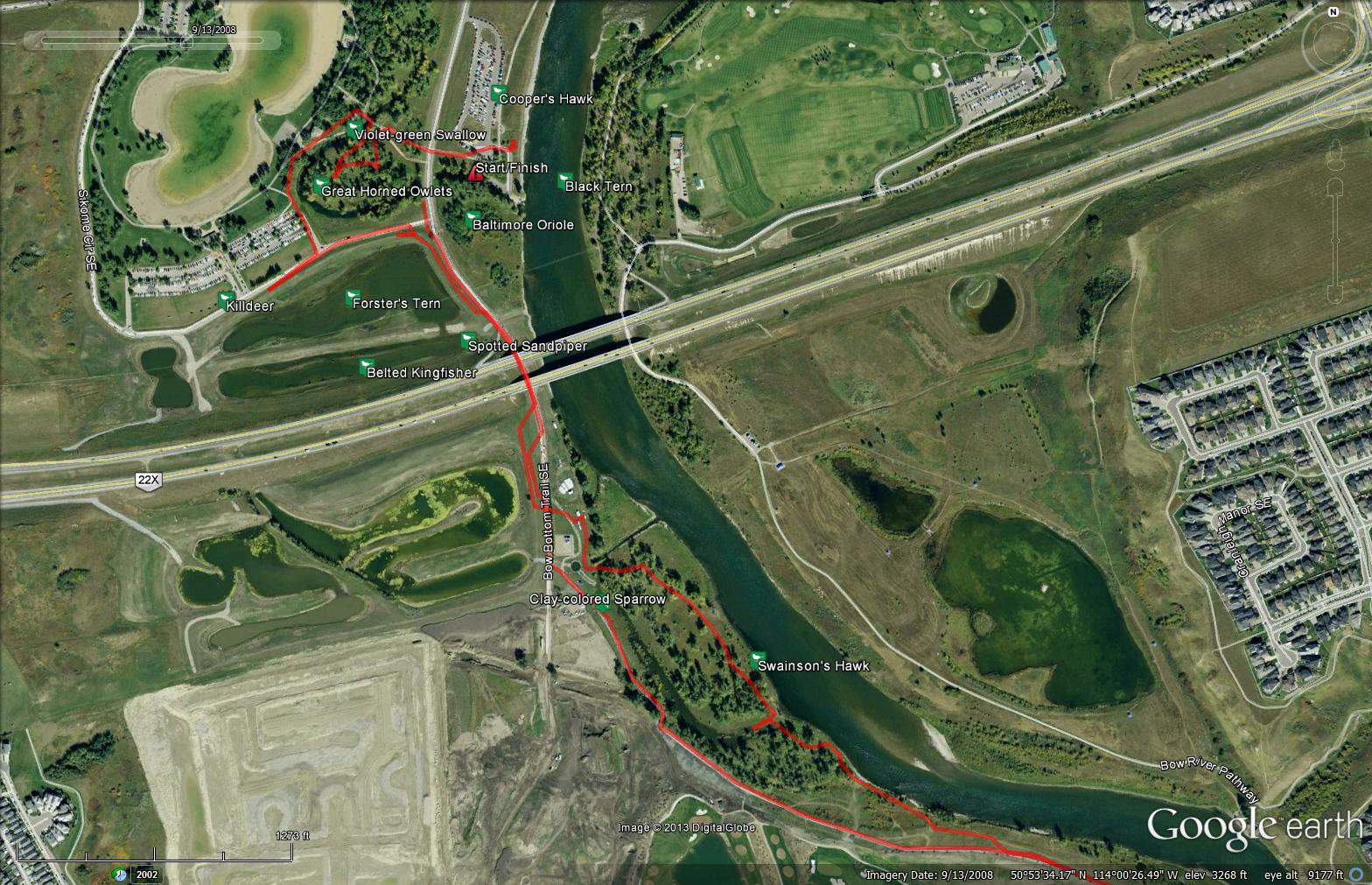
Sikome Lake and Lafarge Meadows, the longest walk.
Right off the bat there was activity. While we waited for the main gate to be opened for us, we heard our first House Wren and Clay-colored Sparrows for the year, along with at least three Ring-necked Pheasants and many, many Savannah Sparrows. Once we got to the south parking lot though, we the number of new species jumped again. First, a Cooper’s Hawk was waiting for us in the parking lot, a few Black Terns flew overhead, and hundreds of Cliff Swallows swirled about high up in the morning sky.
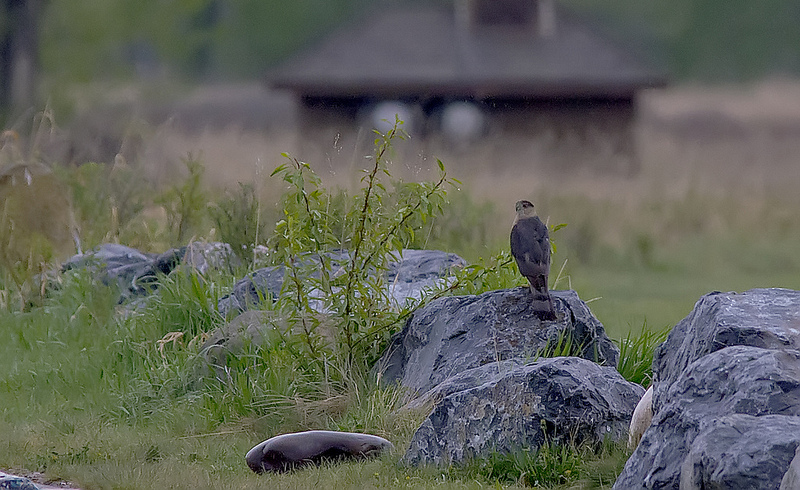
Cooper’s Hawk
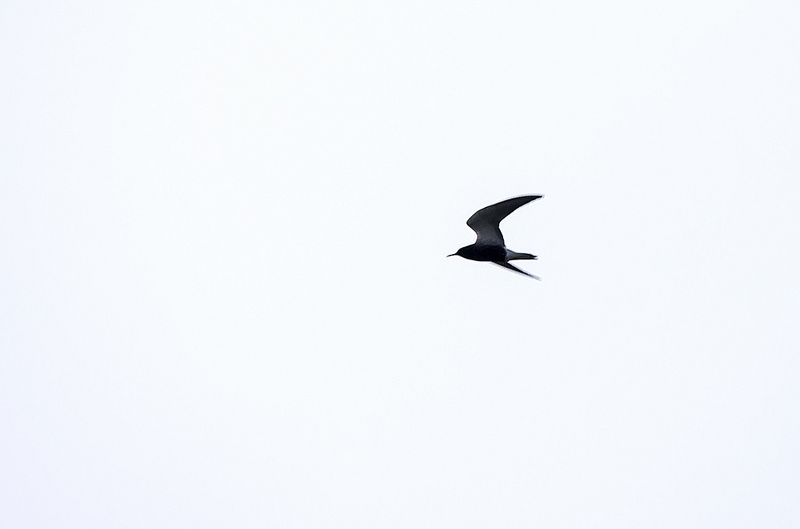
Black Tern
I had heard that the owlets at Sikome Lake had fledged last week, and when we came upon the two young, we could not have asked for a better scene. We were treated as well to our first good views of a Violet-Green Swallow, standing out distinctly from the many Tree Swallows who had taken up nests in the wooded grove.
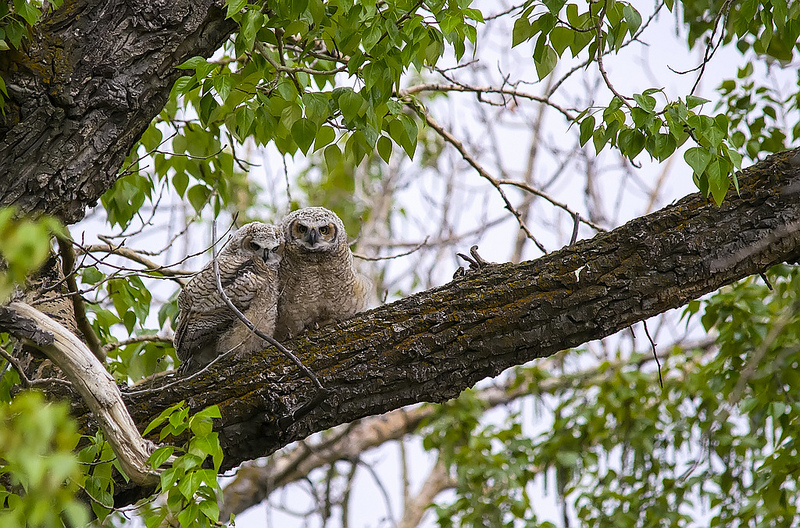
Great Horned Owlets
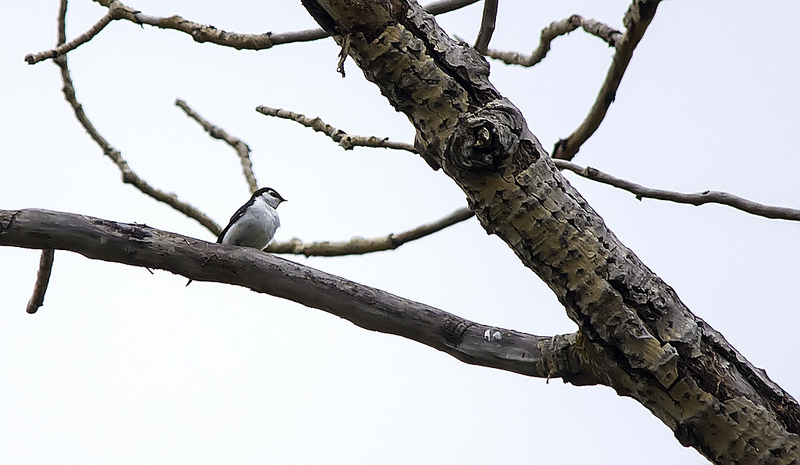
Violet-green Swallow
When we finally tore ourselves away from the amazingly adorable owlets, we headed to the first set of ponds and were treated to even more new sights. First, an adult Killdeer performing its broken-wing display, leading us away from a very well hidden nest that no amount of searching would have found. Over the pond, a trio of Forster’s Terns called back and forth, one pair even displaying and finally mating. A female Belted Kingfisher looked on with disdain, hoping they wouldn’t scare off all the fish. As we headed back south, a few Spotted Sandpipers were courting as well, and while this pair wasn’t quite as much interested in exhibitionism, a few we found later on in the day didn’t seem to mind our intrusion one bit.
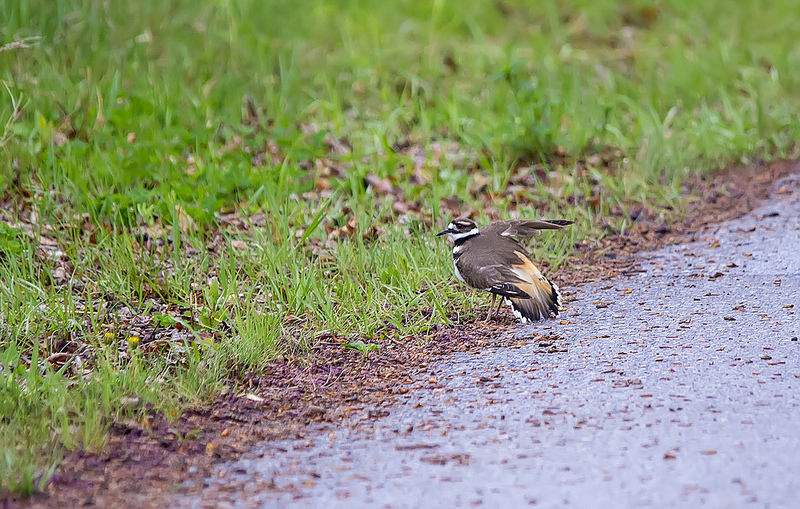
Killdeer performing broken wing display
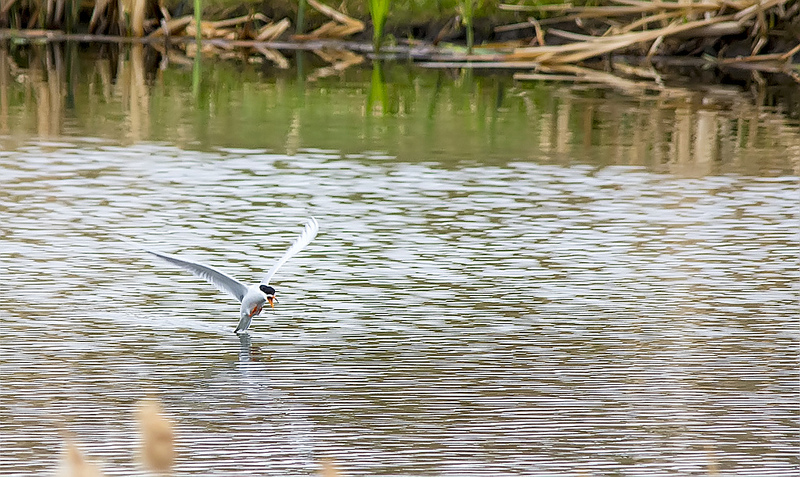
Forster’s Tern
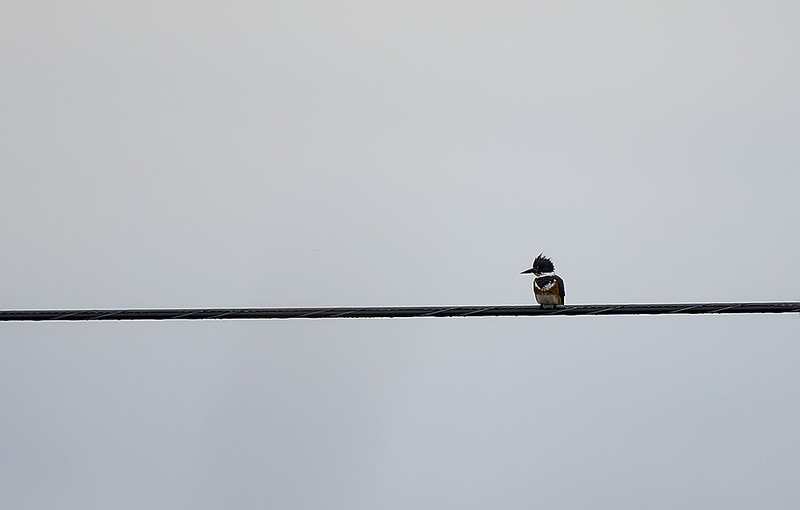
female Belted Kingfisher
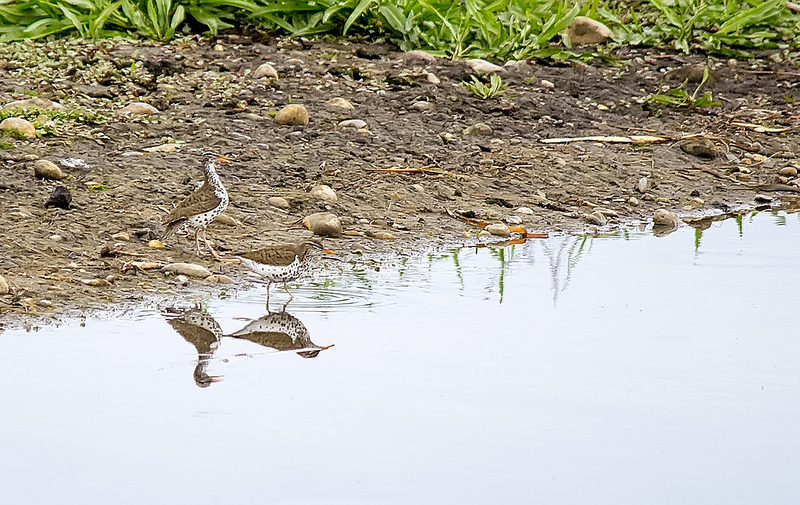
Spotted Sandpipers
On the south side of the bridge were more delights. Our first Yellow Warblers were calling from the woods repeatedly, until their calls became the dominant noises surrounding us, but the distinct call of a low flying Swainson’s Hawk was definitely impossible to miss!
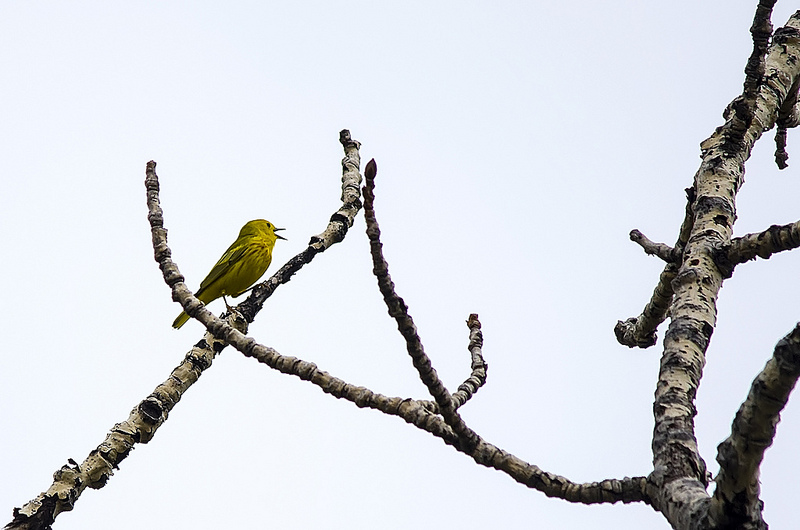
Yellow Warbler
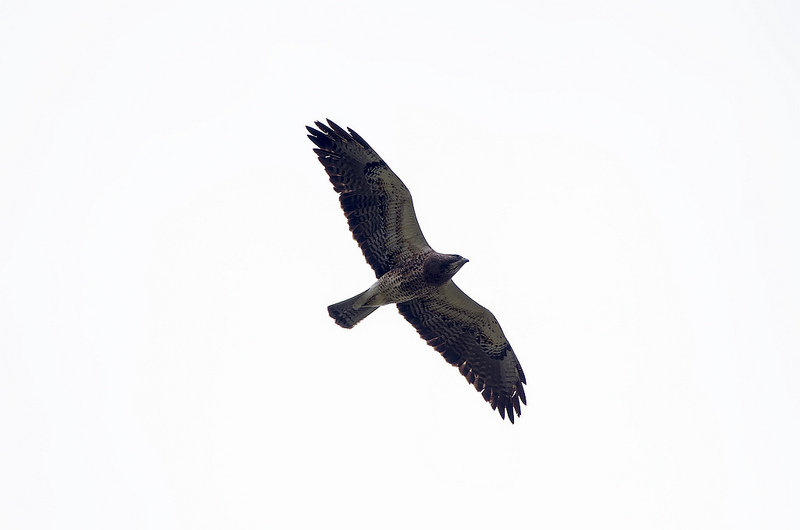
Swainson’s Hawk
Our trip to the far south end didn’t turn up any new species, but did turn up better looks at some old ones, including Yellow-headed Blackbirds, Cinnamon Teal, and Red-necked Grebes, with no less than six pairs nesting on the pond this year. We headed back, deciding to call it a day after four hours of walking and birding, but even still we added two more clear sightings. First, this Clay-colored Sparrow singing on the fence on the south side of the bridge, and the clarion call of a Baltimore Oriole on the north side, just as we called it quits.
It was a great day to be birdwatching, despite the gray skies!
Next week we’re off to the Weaselhead for the May Species Count. This promises to be an amazing morning. See you then!
Posted by Matthew Sim
As soon as we arrived at Smith Oaks I knew the birding was going to be good; before we had even entered the gates a Red-eyed Vireo jumped into the bushes in front of us. Then, in the first tree we passed, there was a male Golden-winged Warbler, a male Black-and-White Warbler and a male Blackburnian Warbler.

Black-and-White warbler
Just like that migrants were in every tree and bush. Blue-headed Vireo and Rose-breasted Grosbeak. Magnolia Warbler and Black-throated Green Warbler. How about another Yellow-throated Vireo? More Black-and-white Warblers over here! Had enough Scarlet Tanagers yet? With each bird the woods seemed to become a immeasurable buffet with numerous gorgeous migrants on which to feast the eye.

Black-throated Green Warbler

Magnolia Warbler
I looked up and spotted an Anhinga, a sign that we were approaching the famous rookery and its rowdy inhabitants.

As we walked further and further the birding only got better and better. There were literally migrants in every bush and tree. Bay-breasted, Yellow, Blue-winged, Magnolia, Black-throated Green, Blackburnian, Chestnut-sided, Black-and White and Tennessee Warblers were adorning every branch as were Northern Parulas, Common Yellowthroats, Philadelphia Vireos, Eastern Wood-Pewees, American Redstarts and Scarlet Tanagers. Even a beautiful Cerulean Warbler made a very brief appearance!

Bay-breasted Warbler

Yellow Warbler

Northern Parula

Blackburnian Warbler
Birding didn’t get any slower at the rookery as egrets, spoonbills and herons went about raising their families.

Rookery

The excitement didn’t even stop there as we got distant looks at a pair of beautiful Purple Gallinule. And one final highlight came as we were heading back to our car; a pair of Armadillo! It certainly was a great trip!

Nine-banded Armadillo