Rare Bird Alert Calgary: Oct 1

Have you seen an unusual bird in Calgary?

If it is on this Reportable_Birds (PDF), please report it to the Nature Calgary Rare Bird Alert line at 403 221-4519 and leave a message after the beep at the end of the recording. If you would like some help with species identification, email us at birdscalgary@gmail.com.  To report injured wildlife call the Calgary Wildlife Rehabilitation Society at 403 239-2488, or the Alberta Institute for Wildlife Conservation at 403 946-2361.

Compiled by Terry Korolyk

SEPT 27

PALM WARBLER – west Fish Creek PP, Richard Clarke
AMERICAN TREE SPARROW – in Calgary area

SEP 28

SEMIPALMATED PLOVER – 1 at slough on 304 St, SE 2 kms south of Hwy 552 – Richard Clarke
PECTORAL SANDPIPER – 100 as above
BLACK-BELLIED PLOVER – 20 as above
AMERICAN BITTERN – slough on Twp Rd 273 just east of Rge Rd 261 southeast of Irricana – RC
HERMIT THRUSH – 2 at Confederation Park – Bill Wilson
SWAMP SPARROW – 1, as above

SEP 29

HERMIT THRUSH – at Confederation Park – BW

SEP 30

SNOW GOOSE – 4 adults at slough on 304 St 2 kms south of Hwy 552-Terry Korolyk
SANDHILL CRANE – 2 at a slough south of the Jumpingpound Gas Plant north of Hwy 1
BLACK-BELLIED PLOVER – 34 at the slough on 304 St SE, 2 kms south of Hwy 552 – TK
SEMIPALMATED PLOVER – 1 as above
PECTORAL SANDPIPER – 50 as above, 25 at slough on 338 Ave and Hwy 799
BAIRD’S SANDPIPER – 2 as above
LEAST SANDPIPER – 3 as above, 3 at slough on 338 Ave and Hwy 799

The next scheduled update of the Bird Alert is on Thu Oct 4.

BIRD STUDY GROUP:

Bird Study Group meets 1st Wednesday of the month, 7:30pm in Room 211 of the BioSciences Building, U of C.

WEDNESDAY, OCT 3, 7:30pm – IMPORTANT BIRD AREAS (IBAs) IN ALBERTA – Petra Rowell, Nature Alberta.

WEDNESDAY, NOV 7, 7:30PM – DANIEL ARNDT AND DAVID PUGH will share their experiences with technology in the world of birding.

Friends of Fish Creek Birding Course – Week 4 – Carburn Park

Posted by Dan Arndt

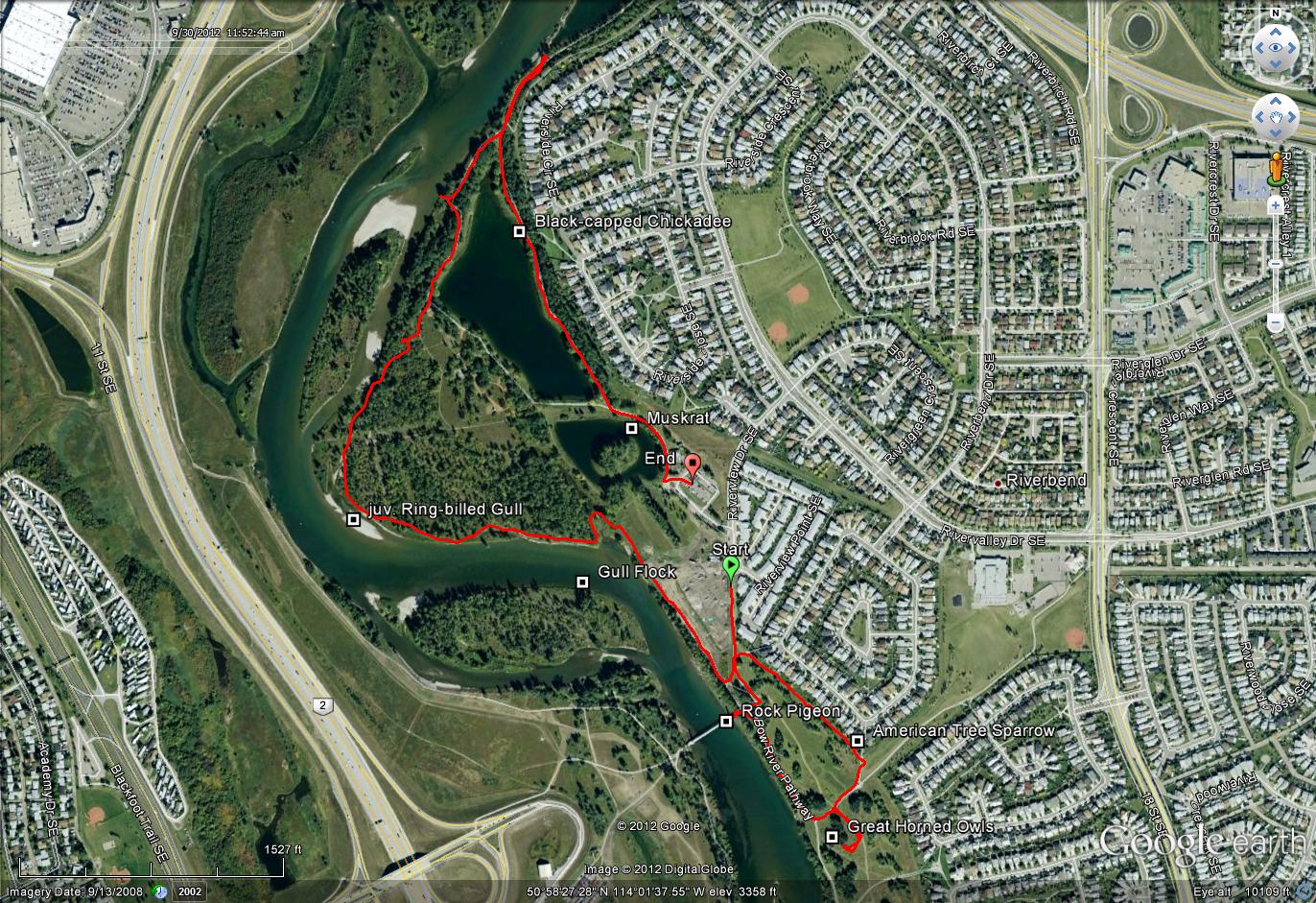
One of the regular parks attended by the Friends of Fish Creek birding courses is Carburn Park. Located just off Deerfoot Trail, it is an oasis of mixed deciduous and coniferous forest in the middle of the urban landscape, and is adjacent to Beaverdam Flats to the north, and the Southland Dog Park to the west. The route we took this week took us from the parking lot, south to a small grove of trees containing a special surprise for us, exploring some bird feeders just off the main trail, then back up along the river before returning to our vehicles by way of the east bank of the middle pond.


For some reason, I was pretty gung-ho about taking photos for the first half of the walk, but once we got near the ponds there weren’t a lot of opportunities given the general shyness of the birds, the close foliage, and shooting into the light, I didn’t really get many good opportunities.

Carburn Park

Carburn Park

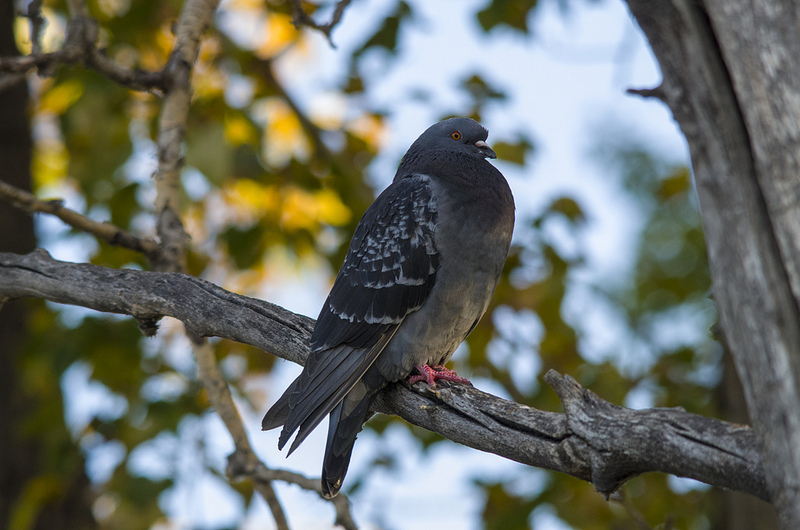
Our first stop of the morning was at the bridge that crosses the Bow River, and but unfortunately there weren’t too many birds on, or over the water. What we did get was this (relatively) gorgeous Rock Pigeon posing gracefully on this dead tree limb.

Rock Pigeon

Rock Pigeon

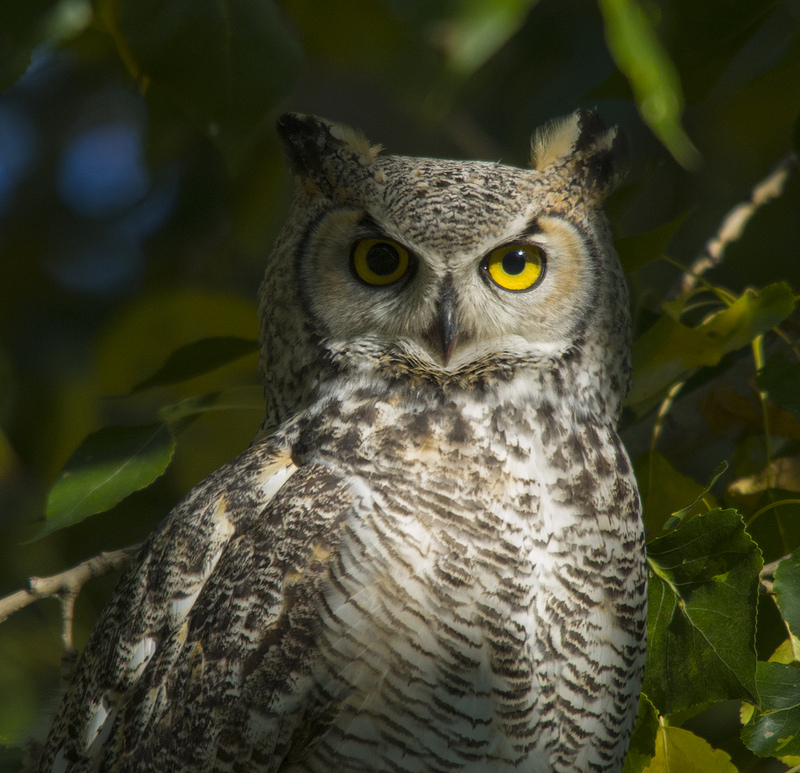
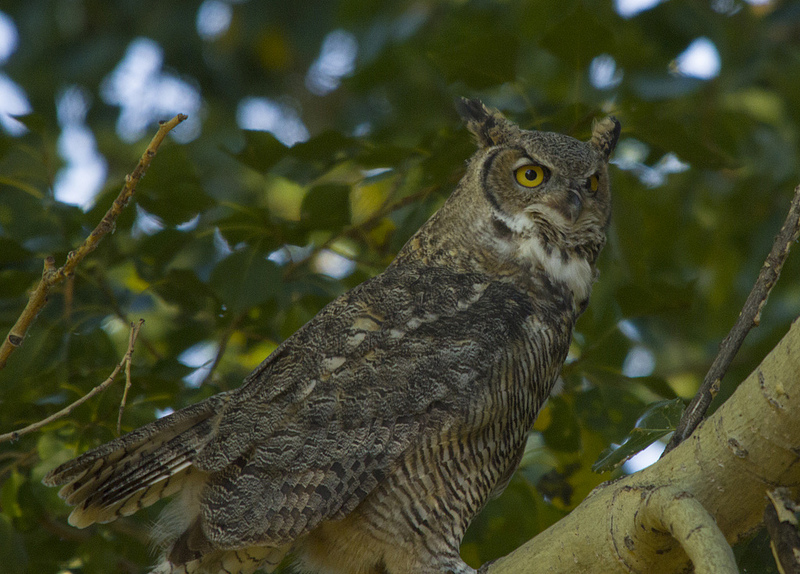
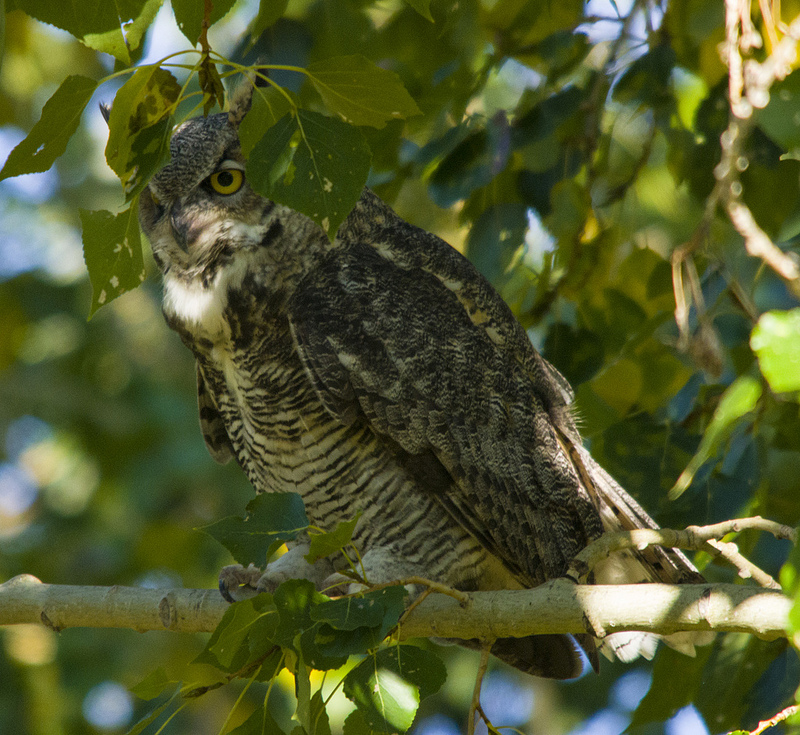
Heading south along the river, we had hopes of flushing a Ring-necked Pheasant, or seeing something interesting on the river, or at the very least, getting some interesting birds at the bird feeders, but as they hadn’t been seen on any of the walks this week, we were quite surprised at a trio of Great-Horned Owls at the southern-most point of our walk!

Great-horned Owl

Great-horned Owl

Great-horned Owl

Great-horned Owl

This one thought that he could hide from the shutterbugs clicking away with their cameras…

Great-Horned Owl

Great-Horned Owl

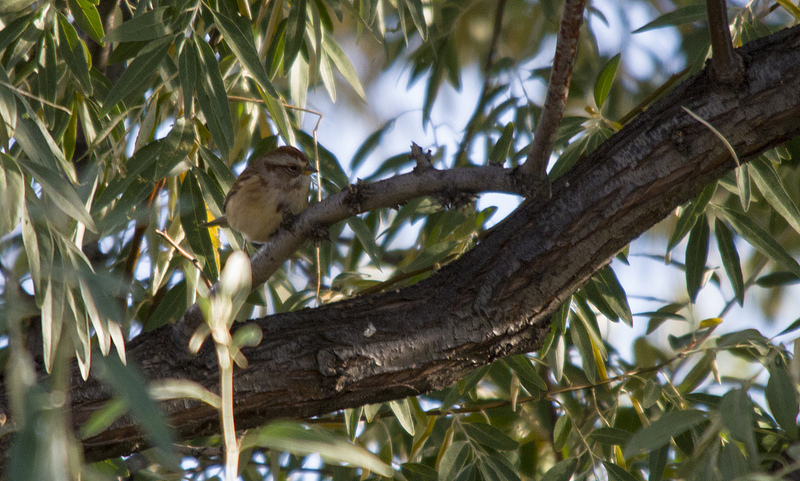
Moving over to the feeders and allowing these owls their space, we came upon a large mixed flock of sparrows and warblers in a large Russian Olive tree. Orange-crowned Warblers, Yell0w-rumped Warblers, Lincoln’s Sparrow, Dark-eyed Junco, and even a pair of American Tree Sparrows!

American Tree Sparrow

American Tree Sparrow

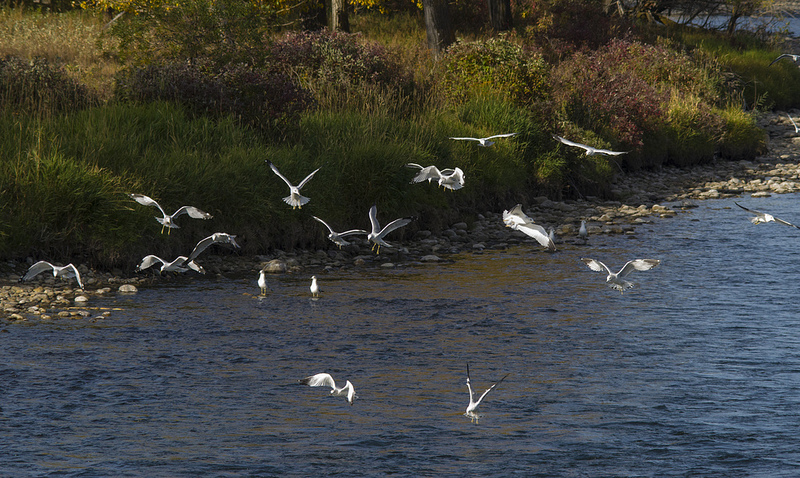
Our walk continued with a few other nice sightings. Common Mergansers fishing alongside large flocks of Ring-billed Gulls resting on the gravel bars, and even a small flock of Green-winged Teals flushed up by one of the many fishing rafts on the river. One of the Ring-billed Gulls had managed to pluck a small fish from the river, causing all the other gulls around to fly at it in an attempt to steal away an easy meal. Sadly, I don’t think any of them ended up with lunch in all the commotion!

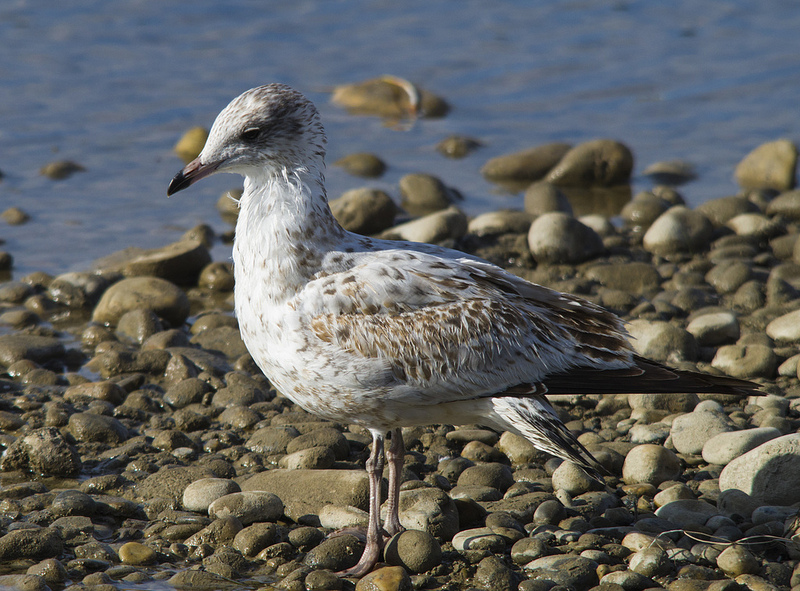
Along the river was also a stretch of about 10 meters that was highly productive, with many Black-capped Chickadees, a few Ruby-crowned Kinglets, another pair of Orange-crowned Warblers, Belted Kingfishers, Northern Flickers and a Downy Woodpecker to top off the list. Around the corner from there was another gravel bar populated entirely by Ring-billed Gulls, and this juvenile posed nicely for us. It wasn’t until it began walking away that we noticed that it was injured, with its tail-feathers skewed off to the side making it seemingly unable to fly.

juvenile Ring-billed Gull

juvenile Ring-billed Gull

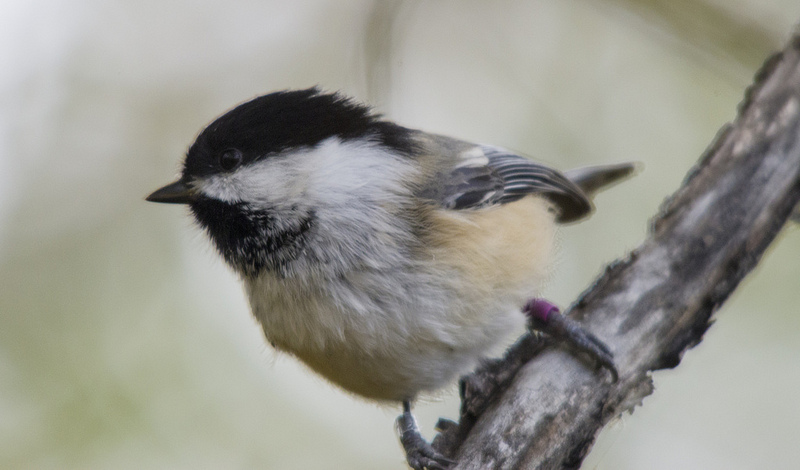
We trudged through the woods getting very good, close looks at a lone Golden-crowned Kinglet, a Red-necked Grebe on the middle pond, and a few Buffleheads on the far north pond. On our way back along the east side of the middle pond, we were assaulted by another small flock of Black-capped Chickadees in search of a handout.

Black-capped Chickadee

Black-capped Chickadee

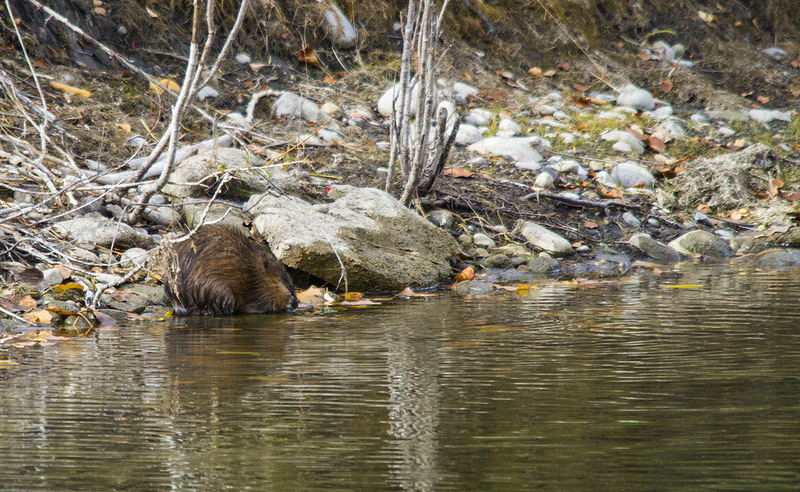
As we rounded the bend and neared the parking lot, a few of us were reflecting that we hadn’t seen a Muskrat in any of the ponds. Sure enough, within a few moments, this little guy swam over to the far bank and hung around just long enough for us to get some shots of him.

Looks like we’ll be touring the Elbow River, from Stanley Park through to the Glenmore Dam.

Good birding!


Snowy Owls Released

In June of this year, we featured a post entitled Help For Wildlife Rehabilitation. The Alberta Institute for Wildlife Conservation (AIWC) has been rehabilitating injured wildlife and releasing them back into the wild for over 20 years.  The lease on their land is ending, and they have to move to a new location. Consequently, they are trying to raise $250,000 this year.  AIWC has always relied on donations but they need your help now more than ever. This is just one sample of the vital work they do for wild species.

Rare Bird Alert Calgary: Sept 27

Have you seen an unusual bird in Calgary?

If it is on this Reportable_Birds (PDF), please report it to the Nature Calgary Rare Bird Alert line at 403 221-4519 and leave a message after the beep at the end of the recording. If you would like some help with species identification, email us at birdscalgary@gmail.com.  To report injured wildlife call the Calgary Wildlife Rehabilitation Society at 403 239-2488, or the Alberta Institute for Wildlife Conservation at 403 946-2361.

Compiled by Terry Korolyk

Bird Sightings:

Sept.22
–SWAMP SPARROW(several) Frank Lake by Marcel Gahbauer.

Sept. 23
–PRAIRIE FALCON, PEREGRINE FALCON(2), NORTHERN PYGMY OWL and CLARK’S NUTCRACKER(139),seen at Plateau Mtn, in the Kananaskis, by Peter Roxburgh et al

Sept. 26
–At Confederation Park were a NASHVILLE WARBLER,PALM WARBLER(2),SWAMP SPARROW(2), WHITE-THROATED SPARROW(20) and a HERMIT THRUSH, all seen by Bill Wilson. A HERMIT THRUSH was seen there by BW on the 24th.also.
–At IBS were HERMIT THRUSH(7),PALM WARBLER(7), OVENBIRD,SWAMP SPARROW and the first fall AMERICAN TREE SPARROW, all seen by Greg Meyer.
–Seen at IBS by Sandra Savage were two RUSTY BLACKBIRDS.

The next meeting of the Nature Calgary Bird Study Group will be held on Wednesday October 3 in Room 211 of the Biosciences Building of the University of Calgary. Doors are open at 7:00 PM and the meeting will begin at 7:30 PM.

Petra Rowell, Nature Alberta will be presenting “Important Bird Areas (IBAs) in Alberta”. The IBA program is a global effort to identify, conserve, and monitor sites that provide essential habitat for bird populations. Of 600 IBA sites in Canada, 48 are in Alberta (of which 36 are globally significant).

There is a large map of the University of Calgary campus at http://www.ucalgary.ca/map. The Biosciences building is in the right of the map and is marked BI. Parking is available in lots L21 and L25. Evening parking is available for $5.

Status of Landbirds in Alberta’s Boreal Plains

The Alberta Biodiversity Monitoring Institute (ABMI) has released its latest report on the state of biodiversity in Alberta. The Status of Landbirds in Alberta’s Boreal Plains Ecozone reports on the status of common bird species that are monitored by the ABMI in Alberta’s Boreal Plains Ecozone (BPE).

The BPE represents 58% of Alberta’s total land area and covers a vast expanse of northern Alberta. Alberta’s BPE is rich in natural resources; it serves as a working landscape for industry, and is considered an integral part of North America’s “bird nursery”. The report highlights the status of individual species and landbird groups such as neo-tropical migrants, forest interior specialists, winter residents and species at risk.

  • the status of 74 landbird species in the Boreal Plains Ecozone were found to be, on average, 80% intact.
  • as of 2010, 21% of Alberta’s BPE has been directly altered by human activities including cultivation, forest harvesting, residential, commercial, energy, and transport infrastructure
  • agricultural cultivation represents the largest human footprint in Alberta’s BPE at 12%
  • protected areas in Alberta include provincial and national parks and National Wildlife Areas account for 11.3% of the BPE
  • the status of 74 common landbirds in Alberta’s oil sands region were found to be, on average, 85% intact. This region currently has a lower human footprint than the entirety of Alberta’s BPE and, therefore, a slightly higher intactness for landbirds.

Read the full report on the Alberta Biodiversity Monitoring Website

Posted by Pat Bumstead

Rare Bird Alert Calgary: Sept 24

Have you seen an unusual bird in Calgary?

If it is on this Reportable_Birds (PDF), please report it to the Nature Calgary Rare Bird Alert line at 403 221-4519 and leave a message after the beep at the end of the recording. If you would like some help with species identification, email us at birdscalgary@gmail.com.  To report injured wildlife call the Calgary Wildlife Rehabilitation Society at 403 239-2488, or the Alberta Institute for Wildlife Conservation at 403 946-2361.

Sept. 20

–BLACK-THROATED GREEN WARBLER and PALM WARBLER at Confederation Park, by Bill Wilson

Sept.21
–CACKLING GOOSE(4),Springwell area, S. of Spruce Meadows, by Terry Korolyk

Sept. 22
–BUFF-BREASTED SANDPIPER(2)(JUV), slough NW corner Hwy 542 and RgeRd 255,N. of Herrington, by Terry Korolyk. Seen at a slough on 304Str.SE S.of Hwy.552 he saw
19 SANDHILL CRANES flying over, and at the slough, there were AMERICAN GOLDEN PLOVER(2),BLACK-BELLIED PLOVER(11), SEMI-PALMATED PLOVER(4), PECTORAL
SANDPIPERS(70),and BAIRD’S SANDPIPER(30).
–SANDERLING(4), S.end Weed Lake, by TK. Seen there on the 23rd. were 40 BLACK-BELLIED PLOVER and 400 GREATER YELLOWLEGS, by Dan Arndt.
–MEW GULL(1),Mallard Pt., FCPP, by Rob Worona. Also seen there on the 23rd.
–SWAMP SPARROW, Mallard Pt., by Gus Yaki et al.
–FOX SPARROW(Slaty), Confederation Park, by BW.

Sept. 23
–SNOW GOOSE(11), Frank Lake, by Andrew Slater

Friends of Fish Creek – Autumn Birding Course – Week 3, Mallard Point

Posted by Dan Arndt

This week, the Friends of Fish Creek course set out for Mallard Point. Located at the far east end of Fish Creek Provincial Park, it abuts the largest island on the Bow River in Calgary, Poplar Island, which is off-limits to the public, but is viewable from the pathways on both sides of the Bow River. We started at the Mallard Point parking lot, walked north along the river, crossed over the bridge, and to the south-east, parallel to Poplar Island. In total, we discovered 36 species in our three hours along the river, all of which gave us incredible looks at them and were amazing to see, as always, and remember, if you want to see a bigger version of the photos in the blog, just click for a full-sized version!

Mallard Point Map

Mallard Point

As we all collected at the parking lot, the consistent racket of a group of 12 Greater Yellowlegs just over the ridge in the flood channel of the Bow River that separates Poplar Island from the rest of Fish Creek Park, and these four decided to ham it up for the photographers of the group, posing close in and making sure everyone got a satisfying look at them.

Greater Yellowlegs

Greater Yellowlegs

We headed up to the river to see what birds we could see on the Bow, or flying over it, but the star of the show was this small Northern Pike, who seemed just as interested in staring at us as we were in staring at it.

She Ain't Pretty (she just looks that way)

Northern Pike

After crossing the bridge and exploring a bit of the east side of the river, we set our eyes on the small pond that originates from a storm water outflow from the Douglasdale community, and found a fairly large group of American Wigeon joined by a solo female Northern Shoveler.

American Wigeon

American Wigeon

While I’m not an expert on gulls, I enjoyed the plethora of plumages visible on the gravel bar just south of the second storm-water outflow into the Bow. We saw adult versions of the three most common species of white-headed gulls out there, those being Ring-billed Gulls, California Gulls, and Herring Gulls. I believe we saw juvenile versions of all three of those gulls as well, though I could always be mistaken!

juvenile Ring-billed Gull

juvenile Ring-billed Gull

juvenile Herring Gull

juvenile Herring Gull

juvenile California Gull

juvenile California Gull

We continued on south-east, and saw one of the harbingers of the change of seasons; a breeding plumaged male Downy Woodpecker. It seems all spring and summer that these guys simply went into hiding, but the last few weeks they’ve reappeared like magic!

male Downy Woodpecker

male Downy Woodpecker

One of the highlights of my day at least was seeing this beautiful Orange-crowned Warbler, who, along with a Ruby-crowned Kinglet, Gray Catbird, and about ten Yellow-rumped Warblers were found near the southern-most extent of our walk in the brush, chipping and whistling away while we strained our eyes to find just who was calling in the bushes.

Orange-crowned Warbler

Orange-crowned Warbler

Onward we trekked, and as we neared the furthest point of our walk, we were greeted by another gorgeous sight of a group of Mallard ducks, one of which being a male just coming back into his breeding plumage and showing off the broad violet speculum on his wing while stretching his legs, and in amongst the Mallards was another female Northern Shoveler.

male Mallard duck

male Mallard duck

male Mallard (bottom left) and female Northern Shoveler (top right)

male Mallard (bottom left) and female Northern Shoveler (top right)

It seemed a fitting end to the walk as we began to head back that many of our other friends from the summer would see us off. There were no small number of Meadowhawk dragonfly species flitting about as the sun warmed them up, and a handful of damselflies as well, but most noticeable was that their numbers were significantly less than last week, and far less than earlier in the summer. I do hope they hold on a while longer, as I always enjoy seeing and hearing them flit about, but it’s just a matter of time before the temperatures drop and the last of them dies out for another year.

Black Meadowhawk dragonfly

Black Meadowhawk dragonfly

As we neared the bridge, and our walk was nearly at an end, we were gifted with just one more species as this Osprey flew overhead. I sure hope he didn’t see our Northern Pike from earlier in the day!

Osprey

Osprey

That’s all for now. Next week, Carburn Park!

Rare Bird Alert Calgary: Sept 20

Have you seen an unusual bird in Calgary?

If it is on this Reportable_Birds (PDF), please report it to the Nature Calgary Rare Bird Alert line at 403 221-4519 and leave a message after the beep at the end of the recording. If you would like some help with species identification, email us at birdscalgary@gmail.com.  To report injured wildlife call the Calgary Wildlife Rehabilitation Society at 403 239-2488, or the Alberta Institute for Wildlife Conservation at 403 946-2361.

Compiled by Terry Korolyk

Sept. 15, 17, 18 and 19:
Birds seen at Confederation Park included FOX SPARROW(2),and BLUE-HEADED VIREO(2) by Dan Arndt and Bill Wilson.

Sept. 16
At Weed lake, 20 BLACK-BELLIED PLOVER and one SANDERLING were seen by Bob and Dan Lefebvre.

Sept. 17
At IBS, a MAGNOLIA WARBLER, SWAINSON’S THRUSH and A SWAMP SPARROW were seen by Greg Meyer, and on the 18th he saw a MOURNING WARBLER there.
At Mallard Point,FCPP, a BROAD-WINGED HAWK and a PEREGRINE FALCON were seen by Gus Yaki et al., and on the 18th, they saw a COOPER’S HAWK there.

Sept. 18
At FCPP, Glenfield area, a MOURNING WARBLER was seen by Terry Korolyk, and on the 19th, a PURPLE FINCH by TK.

Note: IBS(Inglewood Bird Sanctuary); FCPP(Fish Creek Provincial Park)

Bird Profile: Least Sandpiper, the smallest of them all

Last week I went out for a walk in my neighborhood down here in Houston, Texas. As I walked along a storm water retention basin, I noticed 2 very small shorebirds hanging out with the usual Killdeer. Upon further investigation, I discovered that they were Least Sandpipers, a species that shows up several times a year in my neighborhood during migration.

These Least Sandpipers are quite unique and their name might give you a hint as to why; this species is the smallest shorebird in the world at a mere 13-15 cm in length and weighing only 19-30 grams. The pair that I saw provided an interesting look at differences in plumage, while one was a drab adult in winter plumage, the other was a more brightly colored juvenile.

Adult Least Sandpiper in winter plumage

Juvenile Least Sandpiper

The Least Sandpiper is a shorebird known as a peep, a group of small, difficult to identify sandpipers. While many “peeps” can be challenging to identify, the Least Sandpiper is usually fairly easy to name. The number one characteristic that separates the Least from other peeps is its yellow legs, (the others have black legs) though sometimes their legs can appear dark in poor light or when covered with mud. I once read an interesting article from the American Birding Association (ABA) that described how to identify peeps based on posture; the Least Sandpiper, it said, could be separated from the other 4 regularly occurring North American peeps by these habits:

  1. They typically feed from a crouched position with their “knees” (tibia-tarsus joint) almost brushing the ground
  2. The way they plant their feet can often make it seem like they are feeding between their toes though this is not quite as evident in my photos
  3. Least Sandpipers also seem quite nervous, glancing around a lot and freezing at any sudden noise or motion.

Least Sandpiper in breeding plumage

I found this ABA article quite interesting because it adds a whole new dimension to birding, birding by posture, that not everybody may use or be aware of. You can read the full article here.

While the Least Sandpipers I saw this past week were quite timid as always, once I sat down and waited patiently, the juvenile approached me and passed by me within feet, though I had to be careful not to make any sudden motions.

Least Sandpipers have likely all passed through Calgary already on the way back from their arctic breeding grounds to warmer regions in the southern U.S.A., Mexico and South America where they will spend the winter however next May they will be right back again, to complete their long travels once again.

Rare Bird Alert Calgary: Sept 17

Have you seen an unusual bird in Calgary?

If it is on this Reportable_Birds (PDF), please report it to the Nature Calgary Rare Bird Alert line at 403 221-4519 and leave a message after the beep at the end of the recording. If you would like some help with species identification, email us at birdscalgary@gmail.com.  To report injured wildlife call the Calgary Wildlife Rehabilitation Society at 403 239-2488, or the Alberta Institute for Wildlife Conservation at 403 946-2361.

Compiled by Terry Korolyk

Sept.13:
–Possible hybrid warbler, Tennessee/Mourning, seen by Terry Korolyk in Fish Creek PP, E. of bridge # 7.

Sept. 14 + 15:
–AMERICAN GOLDEN PLOVER, S.end Weed lake along Hwy.560. Several seen there by Marcel Gahbauer, and one by TK.

Sept. 15 + 16:
–SEMI-PALMATED PLOVER(2), SEMI-PALMATED SANDPIPER(10), PECTORAL SANDPIPER(200+), SW corner of Hwy 560 and Hwy 24, by TK.
–RED-NECKED PHALAROPE(60), Cattleland Feedlot slough, N. of Strathmore, by TK.
–WHITE-FRONTED GOOSE(3) seen by TK 2km.S.ofHwy 552 on 304 Str. SE. Small flock seen by Ron Kube at RR 282 and TwpRd 360.

Sept. 16:
–BROAD-WINGED HAWK(2), by Peter Roxburgh and Calgary Nature members,seen at Plateau Mtn. in Kananaskis country.
–CLARK’S NUTCRACKER(500+) migrating through Plateau Mtn. area, as above.