Tag Archive | birds calgary blog

More On Weasels

On Saturday the Friends of Fish Creek birders were walking on the path just outside the Inglewood Bird Sanctuary when we noticed another weasel – this time a Long-tailed Weasel – already in its white winter coat with a black tip on the tail.  These weasels are about eighteen inches long (45 cm), and about half of that length is the tail.  They are considerably bigger than their relatives, the Least Weasels, which are only about six inches (15 cm) long (see my recent post about Least Weasels here).

Long-tailed Weasel checking us out. Photo by Dan Arndt.

The weasel was aware of us, and it would duck behind bushes or into long grass to try to keep out of sight, while keeping an eye on us.

Photo by Wayne Walker

Photo by Wayne Walker

Occasionally he would run, then stop…

Photo by Wayne Walker

Photo by Wayne Walker

…and have another look at us…

Photo by Wayne Walker

There were many Richardson’s Ground Squirrel holes there, and it looked like he was checking the holes for a meal…

Photo by Wayne Walker

One last run and stop…

Photo by Wayne Walker

Photo by Wayne Walker

…then he disappeared through the fence and we didn’t see him again.

See more of Dan Arndt’s photos at http://www.flickr.com/photos/ubermoogle/ 

Posted by Bob Lefebvre

Flying Squirrels of Calgary

I seem to be doing a lot of mammal posts lately, but as birders, we are interested in the entire web of nature.  I find that the more birding I do, the more interested I become in all other animals, and in plants as well.

Last Saturday, Dan Arndt and I, plus assorted wives and girlfriends, took a hike at dusk in the Weaselhead with the intention of finding and photographing Northern Flying Squirrels.  These rodents are strictly nocturnal, so many people aren’t even aware that they exist here.  But in fact they range across the entire northern boreal forest of Canada and Alaska, and down into the continental United States as well.

Photo by A. Freeman, from Wikimedia Commons

I first saw these animals in March of 2008 when I attended a Nature Calgary “Owl Prowl”, led by Gus Yaki, to listen for Northern Saw-whet Owls.  We didn’t hear any owls that night (according to Gus, it was Christmas – “the First No-owl”), but as we walked back through the woods in the dark I saw a shape streak through the trees against the dim sky.  I assumed it was a bird going to one of the nearby feeders, but what bird goes to a feeder in the dark?  Then someone shone a flashlight on the trees, and we saw that it was a small squirrel with very large reflective eyes!

Photo by US Fish and Wildlife Service, from Wikimedia Commons

Since then Nature Calgary has had annual outings to this spot to see these amazing animals, and we did see them again in 2009 and 2010.  This spring they didn’t show, so I wondered if they were still around.

On Saturday we arrived a little early, so we walked around the forest on the south side of the Elbow River bridge for a while, hoping to see an owl.  Again there was no luck spotting any owls, but we did see one Pine Grosbeak and one Common Redpoll, plus dozens of Canada Geese overhead.  At dusk we headed back across the bridge to the feeders to set up our cameras.

Sunset was at 5:05 pm and two Northern Flying Squirrels glided in at 6:05 pm, right on schedule, as it seems that they make this feeder their first stop of the night, a half-hour or so after it gets dark.  The squirrels seemed reluctant to go right to the feeder – they hid in the trees somewhere for ten minutes or so before we saw them again.  We saw a few more gliding shapes and some squirrel silhouettes on tree trunks, and heard them scrabbling up and down the bark, but never got a good look at them.  Finally, my wife snapped a few shots with a flash when she heard one on the tree in front of her, resulting in a couple of fuzzy images as the squirrel tentatively climbed down toward the feeder. (Click on pictures to enlarge them.)

We will certainly be heading out again in search of the Northern Flying Squirrel.  Maybe someday we’ll get a photo as clear as the one below.

Photo by Bob Cherry from Wikimedia Commons

Posted by Bob Lefebvre

Christmas Bird Count 2011 – Here’s Your Chance to Volunteer!

House Finch

The 60th annual Calgary Christmas Bird Count will take place this year on Sunday, December 18th.  There are two ways to get involved – as a birder in the field, or as a feeder-watcher in your yard.

There are over thirty territories in the count circle, so we need to get a lot of birders out in the field to identify and count all the birds.  In recent years the number of field volunteers has dropped below 100, and we’d like to get it back up over that number for this 60th count.

The Count Circle (click to enlarge).

If you’d like to help with this, please consider volunteering.  You don’t have to be an expert birder – there will be at least one experienced birder in each territory, so you will be assigned to help them out.  Most groups will be going out for the full day, but you can participate for a half-day if you wish.

Contact Phil Cram at crampj@telusplanet.net to volunteer, or for more information.  

American Wigeons

Feeder-watchers:

If you are unable to get out birding with us on December 18, you can still participate by spending some time counting the birds in your yard.  You needn’t spend all day at this, but should try to record the maximum numbers of each species in your yard, and the time spent watching.

To participate as a feeder-watcher, you must register to take part, and live within the above 24-km-diametre count circle.  If you are outside the circle, perhaps you have friends who feed birds and live within it – you could persuade them to take part, and assist them with their counting.

Contact Jean Moore at jmmoore@ucalgary.ca or phone 403-282-4162 for more information on the feeder-watch program, or to volunteer.

Downy Woodpecker

Northern Flicker

There are several other Christmas Counts in the Calgary region every year.  Keep an eye on our “Free Nature Walks” tab at the top of this page for updates on these, or see the Bird Studies Canada page to find a list of all counts in Canada.

(Previous blog posts on this topic: 2009 Christmas Count.  2010 Christmas Count.)

Posted by Bob Lefebvre.  All photos by myself unless otherwise indicated.  Click on pictures to see a larger version.

Birds of Elliston Lake

A little-known gem in the city is Elliston Lake, a stormwater pond at the east end of 17th Avenue SE.   It is the second-largest body of water (after Glenmore Reservoir) in Calgary.  At times it can harbour an impressive array of waterfowl, as well as some interesting mammals. (Click on pictures to enlarge them.)

Photo by Dan Arndt

When the Friends of Fish Creek group went there last Saturday, the lake was mostly frozen over, but there were still several thousand waterfowl on the few open areas.  (The northeast corner of the lake usually has some open water all winter.)

 The north half of Elliston Lake, looking west.

From 17th Avenue SE, turn south on 60th Street to access the parking lot.

The action actually started before we even got to the parking lot – a Merlin was feeding on a Rock Pigeon on the roadway.  I got a poor shot through the car windshield.

There was quite a bit of traffic, so it abandoned the pigeon and landed on a nearby pole.

Photo by Dan Arndt

A few minutes later we saw the Merlin attack a flock of pigeons above 17th Avenue.

Almost as soon as we started the circuit of the lake, someone spotted a Red Fox out on the ice.

Later, we saw the fox check the shoreline for disabled waterfowl, but it came up empty.

Photo by Dan Arndt

The birds didn’t seem to mind the fox much; they just moved away from the shore.

A close inspection of the masses of Canada Geese and Mallards turned up some interesting birds:

Northern Shoveller (rear centre)

The next picture highlights the size difference between a Green-winged Teal and a Mallard, and shows off the brilliant colour in the teal’s speculum.

Photo by Dan Arndt

A juvenile Barrow’s Goldeneye (below, rear) is identified by having a steeper forehead and shorter bill than the Common Goldeneyes.

Many of the Canada Geese on the lake belonged to one of the small, short-necked subspecies, but there was one goose in among them that was smaller yet – only slightly bigger than a Mallard.  At first I thought it might be a Cackling Goose, but those are Mallard-sized and have a very stubby bill.  This goose (lower centre) is just a very small subspecies of Canada Goose.  Compare it to the Mallards just behind it.

Here is a Gadwall (rear):

There were a few Ring-necked Ducks:

Below are two Ring-necked Ducks (right foreground) with Lesser Scaup:

This Lesser Scaup landed on the ice and tried to walk back to the open water, but slipped…

…so he just gave up and sat down.

We also saw some Common Redpolls feeding on birch seeds:

Photo by Dan Arndt

Photo by Dan Arndt

Two Rough-legged Hawks flew over, the second one chased by a Common Raven:

Photo by Dan Arndt

Near the end of our tour, some Canada Geese walked out on the ice, then flew off…

To see more of Dan Arndt’s photos, check his Flickr page at http://www.flickr.com/photos/ubermoogle/

Posted by Bob Lefebvre

Bird Profile: Bohemian Waxwing

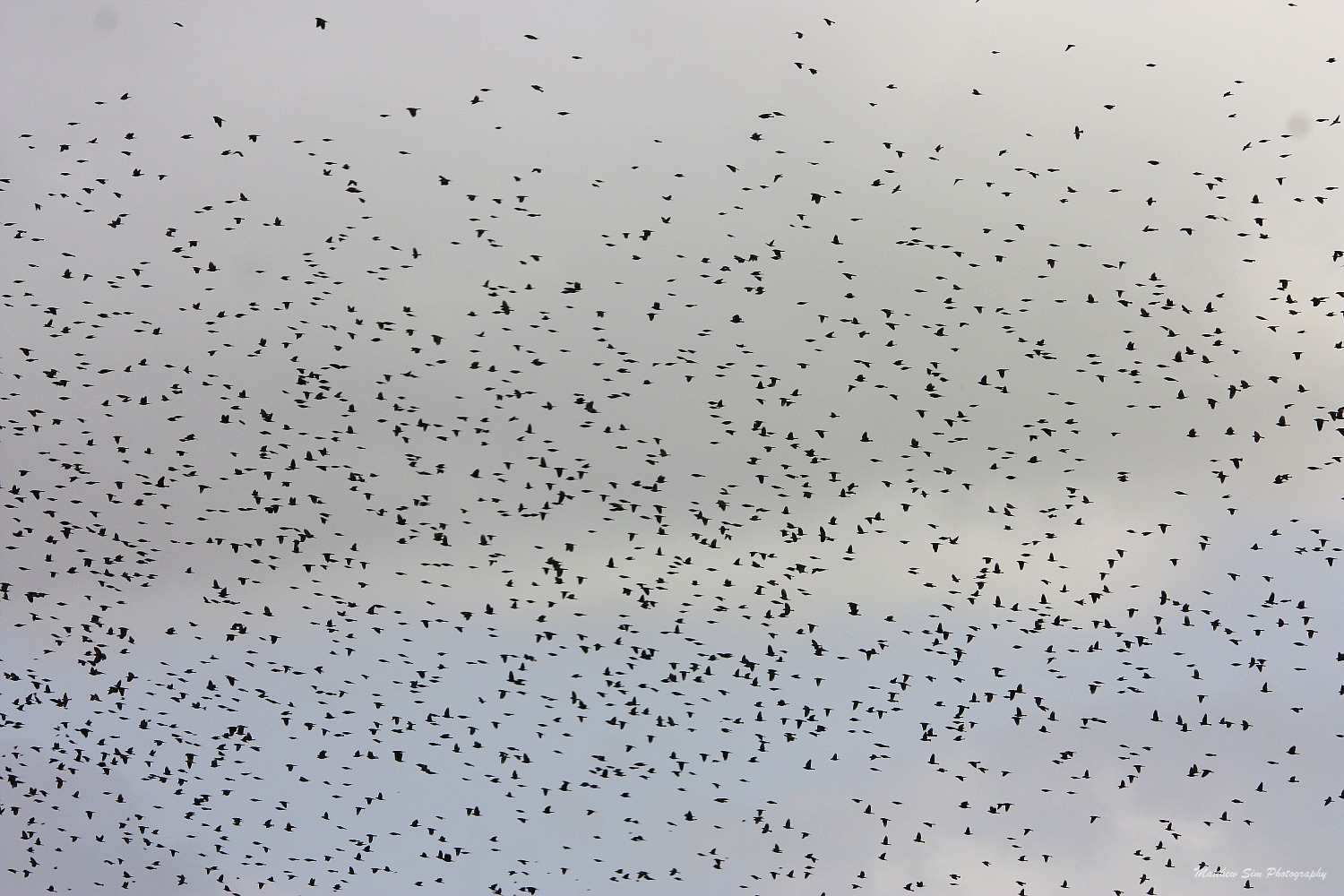
A rush of wings, followed  instantly by  high-pitched trills break the silence. It is a cold, wintry scene, snow falling slowly from the never-ending sheet of clouds that blanket the sky in a gloomy grey. Standing still, nothing is to be heard; no cars, no people, and, above all, no birds. Just when it seems as though the entire world has gone into a peaceful slumber, the calm is broken by the sound of nature.

When they descend in hundreds, berries don’t last long at all. These birds are highly social and travel tight together, descending en masse on fruit bearing trees, where they proceed to rapidly consume thousands of berries. A very hardy bird, the Bohemian Waxwing toughs out the frigid winters of northern latitudes, enduring harsh conditions.The waxwing is both gregarious and elegant with a slick crest, and soft, silky plumage; it is deemed attractive by many. Named for the red, drop-shaped, waxlike tip on their feathers, this bird has warm grey-brown plumage, a black patch through the eye and a yellow-tipped tail. Bohemian Waxwings are berry aficionados and during winter, survive on the fruit of trees such as mountain ash and juniper, but also eat saskatoon and choke berries. Such a heavy reliance on one source of food can greatly affect a birds population and will cause much fluctuation. If there is a high population one year and a low fruit crop the same year, many waxwings will disperse in winter further south out of their regular mapped range. These years are known as irruptive years and are cherished by southern birders who do not usually get the opportunity to observe these birds.

I love witnessing large flocks of Bohemian Waxwings, it is possible to hear the whir of thousands of wings as they land, the twittering as they communicate endlessly, and the soft thud of berries as the fruit falls into the snow below, dropped by  a careless tug from the beak of a waxwing. Sometimes, after the flock has left, the snow will be littered with bright red berries. Then as cars and people pass over the fruit, the snow will be stained a rose color, evidence of the masses of birds that banqueted there.

Remember next time you are shoveling snow in -30 degree weather; you are privileged in that you can witness this elegant species brightening up the dull grey day. These birds are truly northern and hardly extend into the U.S. They are definitely one of the things I will miss most about Calgary winters.

Posted by Matthew Sim

Loon Survey, Part Three

It’s high time I updated the Loon Survey I did for Bird Studies Canada this past summer. You can read about the survey, and see pictures of the eggs, fledglings, and adult loons, on my previous posts: Loon Survey, Part One, and Loon Survey, Part Two.

In late August I returned to Leisure Lake, near Bragg Creek, to check on the Common Loon family.  The purpose of the third visit, late in the season, is to see if the young loons have survived.  Like all birds, loons have a high rate of mortality among fledglings.

I was happy to find that the two young, still in their brown plumage, were doing well.  They were starting to look like adults. (Click on any picture to enlarge it.)

  Juvenile Common Loon, about two months old.

The two juveniles with an adult.

However, despite making a long slow circuit of the entire lake, I only saw one of the parent loons.  I thought that perhaps one of the adults was hiding on shore somewhere, but I’ve been told that loons are so ungainly on land that they only go ashore to incubate their eggs.  It’s possible that it was in the reeds somewhere and I missed it, but that seems unlikely.  Perhaps one of the adults departed for the wintering grounds earlier than the other adult and the young.  I don’t know if they normally do that or if they all leave together.  The other possibility is that the missing adult succumbed to disease or a predator.  It will be interesting to see what happens there next spring.

If you want to participate in the Canadian Lakes Loon Survey, there are plenty of unmonitored lakes with loons on them.  Contact Bird Studies Canada for more information.  Here is a link to the Canadian Lakes Loon Survey page.

Posted by Bob Lefebvre

Saturday Selection: Winter Birds in the Calgary area

Here is a photographic collection of some of the birds you may see in the Calgary region this winter.

Snowy Owl

Common Merganser

Hairy Woodpecker

Mountain Chickadee

Brown Creeper

Red Crossbill

Posted by Matthew Sim

Revering a Raptor

From the day that I first laid eyes on the species, gliding on broad wings over a coniferous forest in the Rocky mountains of Alberta, I have always looked with awe at it, astounded by its sheer magnificence. Many people have soft spots for raptors. I have a soft spot for one in particular: the Northern Goshawk.

I first saw a goshawk just over a year ago. It was early October 2010, and I had signed up for the Mount Lorette Golden Eagle field trip with Nature Calgary. I went out on my own to explore the area right around the location of the watch, and, while out on the path, witnessed an adult goshawk rise up from the spruce trees and circle away. From that moment on I was always looking for goshawks; every chance I got, I would go searching for them.

Rising up out of the forest; my first views of a Northern Goshawk

Several days later, on a biking trip to Fish Creek Provincial Park, I came across an adult Goshawk perched high up in a poplar, sitting and gazing at the world around him. I stood and watched this magnificent raptor for more than half an hour, pointing the bird out to anybody who came near. Many of these were joggers or were merely walking their dogs. They took little interest in this bird, that is somewhat tricky to spot in the city of Calgary. I was rewarded though by the few who did pause to look up at the goshawk and comment on his size.

“What did you say it was called?”

“A Northern Goshawk”, I would reply eagerly, ” it’s somewhat unusual here in Calgary.”

“Really? Wow! Look at how big he his!” After staring up at him for several more seconds, they would smile and move on. Hopefully the Goshawk had made an impression on them though.

While I watched this large, strong accipter (agile, forest dwelling hawks with short rounded wings and long tails) it scratched its head withs its talon, giving me glimpses of those wicked sharp utensils it uses to tear apart its prey. Eventually, it lifted off and disappeared amongst the trees.

Goshawks are among the largest, strongest and most audacious of the hawks of North America. In November 2010, a little over a month since I first observed this species, I got an excellent opportunity to view this audacity. I was riding my bike home from Fish Creek and was running slightly late. I looked down for a moment as I pulled onto a dirt path going around a storm water pond, and, when I looked up again, there, sitting merely yards away from me in a small tree no taller than 10 feet, was an adult goshawk. They now seemed to be everywhere I went! I slammed on the brakes as hard as I could and screeched to a stop, panting breathlessly. Pulling out my camera, I marveled at how close this bird had let me get. I stood watching him, he stood watching me, this went on for several minutes before he abruptly flew away.

Taken with a 200mm lens and no crop; I could see every detail in the feathers

Instead of leaving altogether though, the goshawk started hovering over a field, pulled up, started hovering again and then pulled up once more. Then, with a sharp turn, he came whizzing right at me and flew by me at a distance of about 4 feet! The raptor was so close that my lens couldn’t focus on it!

These incredibly neat personal experiences combined with an amazingly beautiful species, have come to make me love the Northern Goshawk.

Posted by Matthew Sim

Weasel Wednesday

Sometimes when you go birding you don’t find what you hope to see.  But sometimes you see something unexpected that is just as great.  And sometimes it’s not even a bird.

Last Saturday the Friends of Fish Creek Society birders explored the Votier’s Flats area of Fish Creek Park.  Our goal was to find a Northern Pygmy-Owl, which is always a treat to see, and which several members of the group had never seen.  The owl has not yet been reported in the park this fall but in the last few years it has first been sighted at about this time.

We didn’t find an owl, but someone spotted a writhing mass at the side of the path that turned out to be a family of Least Weasels – a mother with eight young.

Photo by Dan Arndt

The nine little mammals moved through the undergrowth in a mass, over and under each other, but always in contact.  In his report on Albertabird, Gus Yaki described them as “travelling together so close that they seemed to be a single organism.”  Pat Bumstead says that they probably were making one of their first forays outside their natal den, and were exploring their surroundings.

Photo by Wayne Walker

The mother crossed the trail near us, and the young separated amongst our feet.  They showed no fear of us.  I put my hand down, and briefly had one in my gloved hand.  The shots below show just how small Least Weasels are.  These young are as big as an adult, or nearly so.

Photo by Wayne Walker

Photo by Wayne Walker

Photo by Wayne Walker

Photo by Wayne Walker

Photo by Wayne Walker

The juveniles eventually crossed the trail to reunite with their mother.

Photo by Dan Arndt

Although they are impossibly cute, weasels are carnivores, capable of killing animals many times their size.  In these photos they show off their teeth.

Photo  by Wayne Walker

Photo by Anne Elliott

We were very lucky to see such an amazing sight.  If you’re like me, you can’t get enough of looking at these little guys, so below there are some more pictures for you to enjoy.

(To see an additional Birdscalgary post about another species of weasel, click here.)

(To see a YouTube video that uses some of these pictures, with music, click below:)

Here are the rest of the photos:


Photo by Dan Arndt

Photo by Dan Arndt

Photo by Anne Elliott

Photo by Wayne Walker

Photo by Wayne Walker

Photo by Wayne Walker

Photo by Wayne Walker

Photo by Wayne Walker

Photo by Wayne Walker

Photo by Wayne Walker

Photo by Wayne Walker

Photo by Wayne Walker

Photo by Wayne Walker

Photo by Wayne Walker

Photo by Wayne Walker

Photo by Wayne Walker

Photo by Wayne Walker

Photo by Wayne Walker

Photo by Wayne Walker

Photo by Wayne Walker

Photo by Wayne Walker

Photo by Wayne Walker

Photo by Wayne Walker

Thanks to the three photographers who contributed these great pictures:  Wayne Walker, Dan Arndt, and Anne Elliott.

Posted by Bob Lefebvre

Nothing But Shoreline

The irrigation canal in southeast Calgary is drained in late September, and as the water level drops, it exposes lush shorelines with plenty for the birds to eat.  From mid-September to freeze-up is the time to get out to look for waterfowl, gulls, and late migrating shorebirds.

Fall colours reflected in the remaining water

I usually explore the sections from the canal headworks near the Max Bell Arena to south of 50 Avenue SE.  There are four parking areas, and you can go up and down a portion of the canal from each one.  It’s a long walk to do it all at once, but a fairly short bike ride.
Click to enlarge the map.

Max Bell Arena:  Access from Barlow Trail SE, just south of Memorial Drive.  There is a large parking lot north of the arena, and you can walk down to the canal headworks from there, and walk along the east bank.  If you want to get to the west bank, you have to cross over at the 17 Avenue SE bridge.

Bow Waters Canoe Club:   Access is off 26 Street SE, just south of 17 Avenue.  Cross the bridge to get to the paths on the west side.  The path on the east side between here and Gosling Way has some steep, difficult terrain, and it is almost impassable by bike.  This lot is fairly secluded and I don’t like to leave my vehicle there.  I prefer Max Bell or Gosling Way.

Gosling Way:  Go west off 26 Street SE at 34 Avenue.  This is the road that goes to the Inglewood Golf and Curling Club.  The parking lot, used by off-leash dog walkers, is just west of the bridge over Deerfoot trail, on the south side of Gosling Way.  It only holds about ten vehicles.  From this lot, walk down to the bridge over the canal and take the paths from there.  In the winter, you can also park at the golf and curling club, but it is a bit of a walk back to the canal.

50 Avenue SE:  It is difficult to park here.  There are only two small spots, each with room for two cars,  at the east end of the bridge over the canal.  It can also be a very busy road, so I avoid parking here as well, and usually just walk from Gosling Way.

The canal has a paved path on one side (sometimes on the east, sometimes on the west) and a dirt or gravel path of sorts on the other side.  I like to go on the east side in the mornings and on the west side in the afternoons, to keep the sun behind me.  This late in the year, the water is usually frozen in the mornings, so there are few birds around.  But on warm afternoons the ice melts, and the birds arrive.

Muskrat and female Hooded Merganser

Detail of Gosling Way Parking.  Click to enlarge.

Looking south from Gosling Way.

Looking north to the bridge on Gosling Way.

Pat and I have each posted about birding the canal before.  You can see Pat’s post here, and my post here.

Lately I’ve seen quite a few Canada Geese, Mallards, and Ring-billed Gulls, and a few Hooded Mergansers, Common Goldeneyes, and Greater Yellowlegs.  In past years I’ve seen Redheads, Blue-winged Teal, Killdeer, Long-billed Dowitchers, and Rusty Blackbirds all feeding along the shorelines.

Mallards and an assortment of Yellowlegs.

Muskrat and Mallard sharing the Muskrat’s lodge.  Background by Monet.

A Black-billed Magpie looks for food on the old canal bottom.

Posted by Bob Lefebvre